
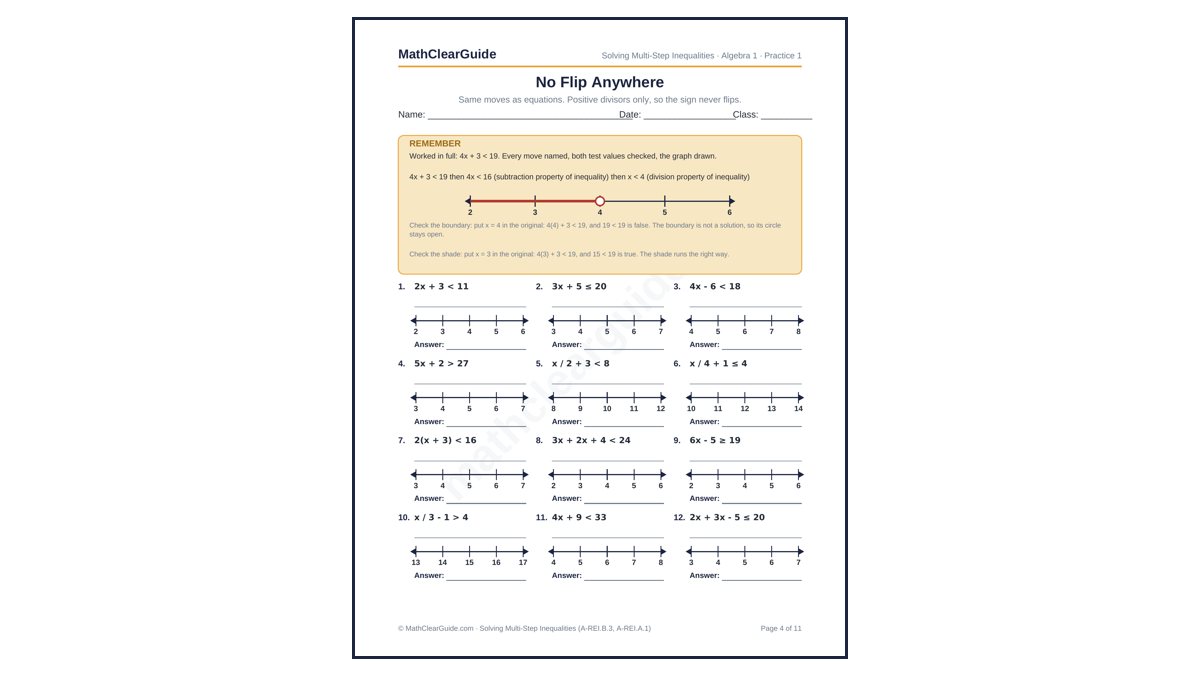
Solving an inequality is solving an equation with one new rule and a range for an answer. The moves are the moves pupils already own. The answer is not one number but every number that works, drawn on a number line and checked with test values. Here, algebra 1 inequalities get the full treatment in five lessons. The first lesson, Multi-Step Inequalities, is a complete lesson with slides, task cards, a worksheet and a filled in key, free with an email signup: Solving Multi-Step Inequalities. Behind this unit sits Algebra 1 Unit 1, Solving Equations. Ahead sits Algebra 1 Unit 3, linear functions and graphing. Beneath it sits the Grade 6 inequalities lesson, for a pupil who needs the ground rebuilt.
What an Inequality Answer Really Looks Like
An equation answer is a value. An inequality answer is a set, drawn as a ray when the numbers run one way for ever, and as a segment when they stop at both ends. A filled circle keeps its boundary in. An open circle leaves it out.
Every answer here is defended by two test values: the boundary, tested in the original inequality, and one value inside the shade. If both agree with the drawing, the answer stands.
One new rule does the rest. Take 2 < 5, which is true. Multiply both sides by -1 and the values trade places: -2 sits to the right of -5, so the true sentence is -2 > -5. The order has reversed, so the sign must turn. A pupil whose negative number work is the real gap can rebuild it with the Grade 7 integers unit.
The sign flips for a reason. A pupil who can give the reason stops fearing the step.
The Unit at a Glance
Every lesson has the same shape: 23 teaching slides, a worksheet with a teacher guide, task cards, practice pages, and a filled in key that shows every step, graph and check. The first lesson is free. The other four are member lessons.
| Lesson | What it teaches | Standard | Fits |
|---|---|---|---|
| 1. Multi-Step Inequalities (free) | The undo moves carried over, and the flip rule as a property | A-REI.B.3, A-REI.A.1 | Week 1 |
| 2. Compound Inequalities | And as overlap and or as either, answers three ways | A-REI.B.3, A-REI.A.1 | Week 2 |
| 3. Variables on Both Sides | Gathering the variable, and the endings that are not rays | A-REI.B.3, A-REI.A.1 | Week 3 |
| 4. Absolute Value Inequalities | The bars read as distance, split into compound work | A-REI.B.3, A-REI.A.1 | Week 4 |
| 5. Inequality Word Problems | Writing inequalities from stories, plus a first look at systems | A-CED.A.1, A-REI.B.3, A-REI.A.1 | Week 5 |
The road runs in order. Behind this unit, Algebra 1 Unit 1, Solving Equations is live, and its free lesson, Two-Step Equations, is the step a lost pupil takes first. Beneath it, the Grade 6 inequalities lesson waits for younger ground. Next is Algebra 1 Unit 3, linear functions and graphing, named here in words only.
Start Free: Multi-Step Inequalities
The free lesson starts where equations left off. The undo order is the same. Each step names the property that allows it. The one new rule is taught as a property, not as a warning: multiply or divide both sides by a negative number, and the sign flips, because the order of the two sides has reversed. Add or subtract, and the sign never moves.
Every worked example ends with the two tests. The boundary goes back into the original inequality, and one value inside the shade goes back in too, until the habit is theirs.
Teach the free lesson here: Solving Multi-Step Inequalities. For fresh practice in the same skills, the free Worksheet Generator builds it.
Compound Inequalities: And Means Overlap, Or Means Either
Some answers live between two ends, and some live outside them. And means overlap: a value must pass both halves at once. Or means either: passing one half is enough. Pupils name the join before they solve, because that reading is where this lesson is won.
Here is one chain in full, the way the key writes them.
Solve -3 < 2x + 1 and 2x + 1 ≤ 7, written as one chain.
-3 < 2x + 1 ≤ 7
-4 < 2x ≤ 6 (subtract 1 from all three parts: subtraction property of inequality)
-2 < x ≤ 3 (divide all three parts by 2: division property of inequality)
In words: every number from -2 to 3, with -2 left out and 3 kept in.
In symbols: -2 < x ≤ 3
In interval notation: (-2, 3]
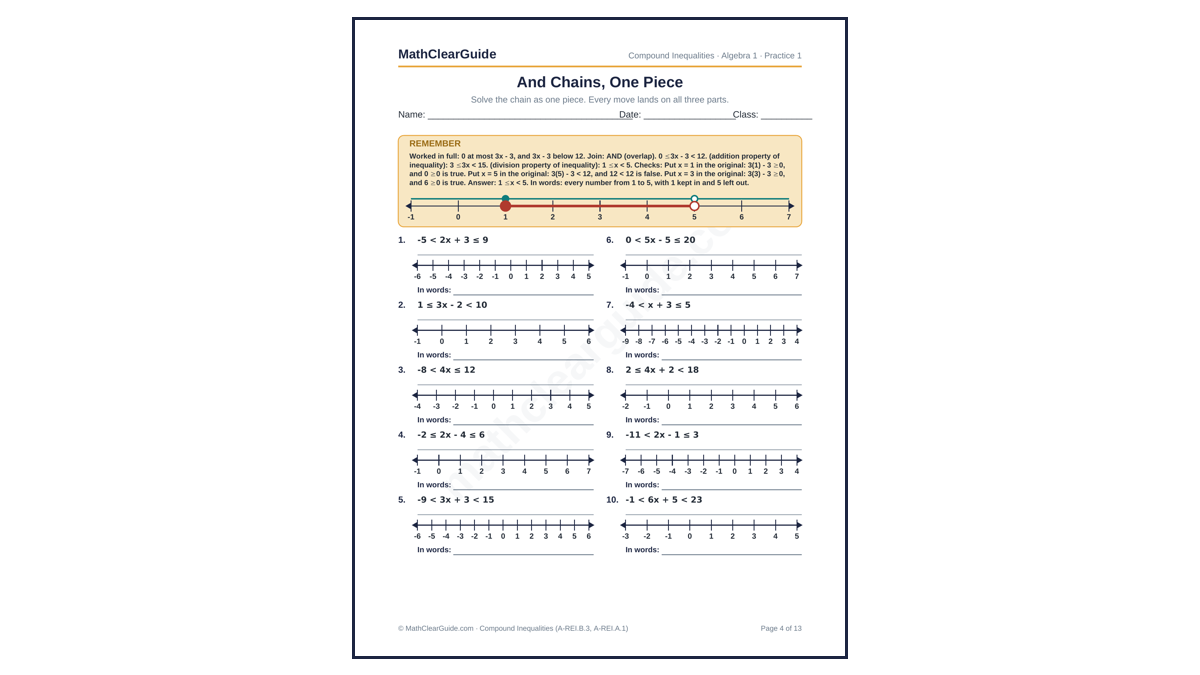
Members teach it here: Compound Inequalities. The paid lesson gives every answer three ways, in symbols, in words and on the graph, and teaches the two honest endings: the empty overlap, where no number passes both halves, and the covering join, where every number passes at least one. Story ranges close it.
Both Sides, and the Endings That Are Not Rays
The gathering move carries over from equations whole. When the variable lives on both sides, collect it into one place, then undo as always. The craft is in the choice made first: pick the side that keeps the work kind, and the flip can often be dodged.
The new reading skill is prediction. Pupils compare the two sides first and say what ending is coming: a ray this way, a ray that way, or one of the two endings that are not rays at all.
When the variable gathers away to nothing, the numbers left behind give the verdict. A false sentence means no number works. A true sentence means every number works. Both are answers, stated in words.
A pupil who can predict an ending has understood the gathering, not memorised it.
Members teach it here: Inequalities with Variables on Both Sides.
Absolute Value Is Distance
The bars have always meant one thing: distance. The value inside is measured by how far it sits from a centre on the number line. A distance is never negative, and that one fact does all the splitting in this lesson.
Less than means between. A distance smaller than the allowed reach stays within reach of the centre on both sides, so the split is a chain and the graph is one segment. Greater than means outside: an or pair, two rays.
The edge cases are read off the same picture, in plain words. Bars less than a negative number have no answer at all, because no distance is negative. Bars greater than a negative number are answered by every number, because every distance clears a bar set below zero.
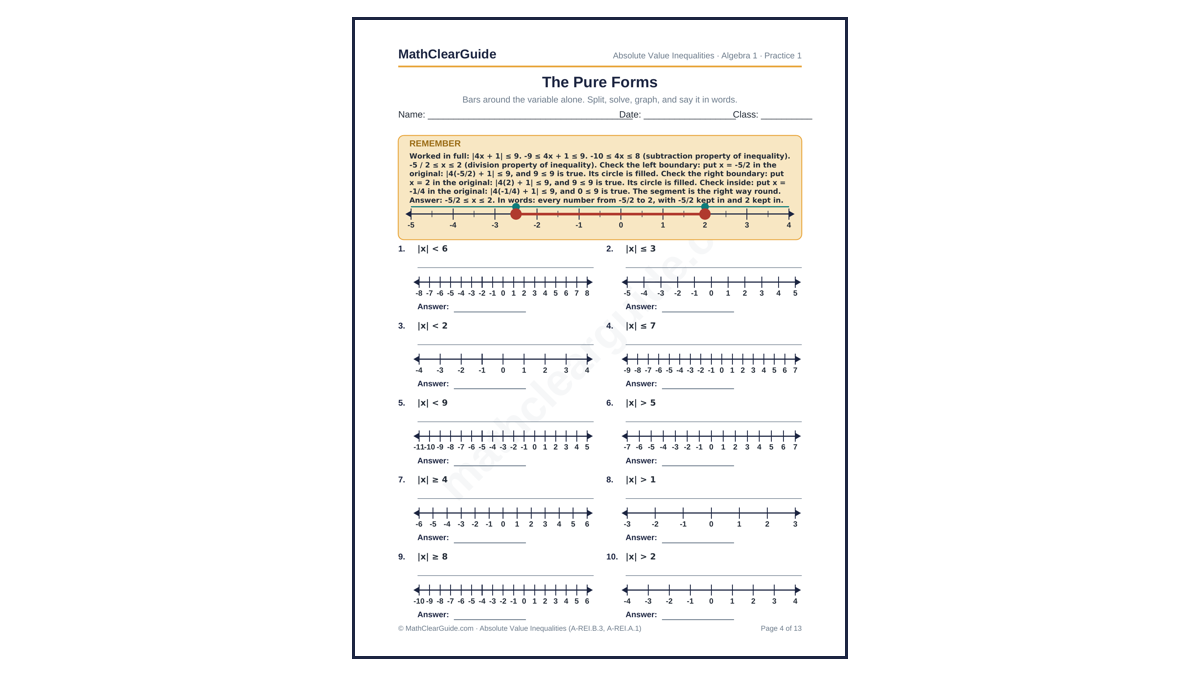
Members teach it here: Absolute Value Inequalities.
Word Problems: The Words Choose the Sign
The capstone teaches the writing, not only the solving. Every solution begins with a define sentence: let the letter stand for the thing the story asks for, in its units. Then the story is read for its constraint word. At most, at least, fewer than and no more than each choose a sign.
Then the routine runs in order. Write the inequality. Solve it with every step named. Check the answer against the story, not only the symbols. And reject, in words, any answer the story cannot use, such as a test score above the top mark.
One page at the end is a labelled first look at systems of inequalities. It solves nothing and can be skipped whole.
Members teach it here: Inequality Word Problems.
Start Where Your Class Stands
Here is the honest ladder. A class still shaky on the idea of an inequality starts below this unit, with the Grade 6 inequalities lesson, and can read the road around it on the Grade 6 expressions unit page. A class shaky on equations starts one unit back, with Algebra 1 Unit 1, Solving Equations and its free lesson, Two-Step Equations.
A class ready for this unit takes the five lessons in order. Each one spends the one before it: the compound work spends the flip, the distance split spends the compound work, the stories spend all of it. After this unit comes Algebra 1 Unit 3, linear functions and graphing, named here with no link yet, because it is not live.
One Story, Three Levels
The class trip story opens the last lesson of the unit. A class trip costs $120 to hire the bus, plus $8 a pupil for tickets. The school budget for the trip is at most $600. How many pupils can go on the trip?
Support pupils get the frame built. The define line is given: let x stand for the number of pupils. The word line is given too: at most takes the sign ≤. They write 120 + 8x ≤ 600, solve it, and read the answer back.
Core pupils start from the story alone. They define the variable, read the constraint word, write and solve, and draw the graph. The working runs: subtract 120 from both sides to get 8x ≤ 480, then divide both sides by 8 to get x ≤ 60. The check is done against the story: 60 pupils cost exactly $600, and 61 pupils cost $608, which passes the budget. At most 60 pupils can go on the trip.
Challenge pupils take the story further. Add a second bound, a minimum party size the group ticket price needs, and the answer becomes a compound inequality with two ends to defend. Or set a second bus company quote against the first and find from which number of pupils it wins. The whole number answer is defended against the boundary beside it, not just stated.
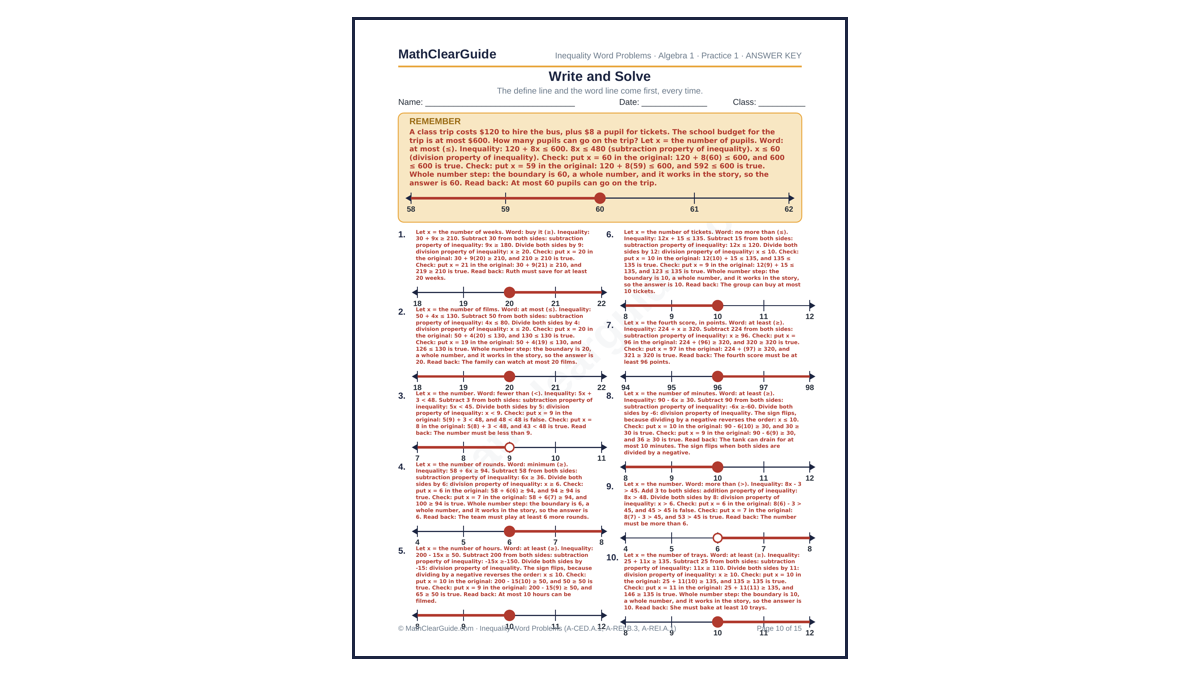
The answer is the sentence the story can use, with its units attached, or it is not finished.
Questions Teachers and Parents Ask About Algebra 1 Inequalities
Is the first lesson really free?
Yes. Multi-Step Inequalities is a complete lesson, slides, task cards, worksheet and filled in key, free with an email signup like every free lesson here. The paid lessons that follow teach new skills, and the free lesson names them at its end.
What standards does the unit cover?
A-REI.B.3 and A-REI.A.1 run across the unit, and A-CED.A.1 joins them in the word problems lesson. The codes are printed on the covers.
Does this unit teach systems of inequalities or quadratic inequalities?
No. Both wait for their own Algebra 1 units. The word problems lesson holds one labelled first look page at systems: two printed systems to read and one story matched to a printed graph. Nothing on it is solved, and no code is claimed for it.
Why does the sign flip?
Because multiplying or dividing by a negative reverses the order of the two sides. The free lesson shows it with two number lines: 2 < 5 is true, and after both sides are multiplied by -1 the true sentence is -2 > -5.
What do I need to print?
One worksheet per pupil per lesson. The task cards are cut once per class. Every paid lesson carries both the color file and the black and white file.
The road in one line: equations behind, inequalities here, linear functions next. Start with the free lesson: Solving Multi-Step Inequalities. The whole shelf sits in the Resource Library. No promise is made here that the site cannot keep: every step justified, every answer graphed and checked, every story read back in its own words.
Every topic clicks faster with practice. Our Resource Library has free lesson packs with slides, printable worksheets and full answer keys, ready to download and teach.
Members unlock every lesson in the library, including the full Fractions, Multiplication, Place Value, Addition & Subtraction, Time & Money and Geometry & Shapes units. See the full library


1 thought on “Algebra 1 Inequalities: A Simple Guide for Teachers and Parents”