

January is financial literacy month in Ontario classrooms, and the money unit lands right after the winter break. The problem is the worksheets. Most of what a search turns up is US money: pennies and dollar bills no Canadian till has seen in years. These packs were built the other way. Every coin and bill in them is Canadian, and the first week of the middle pack is free.
Canadian Money in Plain Words
Canada has five coins: the nickel (5 cents), the dime (10 cents), the quarter (25 cents), the loonie (1 dollar) and the toonie (2 dollars). It has five bills: $5, $10, $20, $50 and $100. There is no penny. The 1 cent coin stopped being made in 2013, so cash totals round to the nearest 5 cents. There is no $1 bill and no $2 bill. The loonie replaced the $1 bill in 1987, the toonie the $2 bill in 1996. These packs use only that money, so the loonie toonie worksheets here match the coins in real pockets.
Which Pack for Which Grade
Three packs cover Grades 1 to 5, one per band, and each follows Ontario Strand F for its band.
| Grade | Pack | Challenge strip | Ontario code |
|---|---|---|---|
| Grades 1 and 2 | Canadian Money Grades 1 and 2 | Pitched at Grade 2 | Grade 1 F1.1, Grade 2 F1.1 |
| Grades 3 and 4 | Canadian Money Grades 3 and 4 | Pitched at Grade 4 | Grade 3 F1.1, Grade 4 F1.1 |
| Grade 5 | Canadian Money Grade 5 | Full Grade 5 stretch | Grade 5 F1.1 |
Start Free: One Week for Grades 3 and 4
The free sample is Week 1 of the Grades 3 and 4 pack, page for page: counting coins and bills to $20, the same amount two ways, mixed coins to $2, a first shop and first change under $10. Five student pages, their filled in keys and a cut out coin card page. It teaches fully on its own, and the paid pack continues into Weeks 2 to 4. Download the free sample: Canadian Money Free Sample
Grades 1 and 2: First Coins and Bills
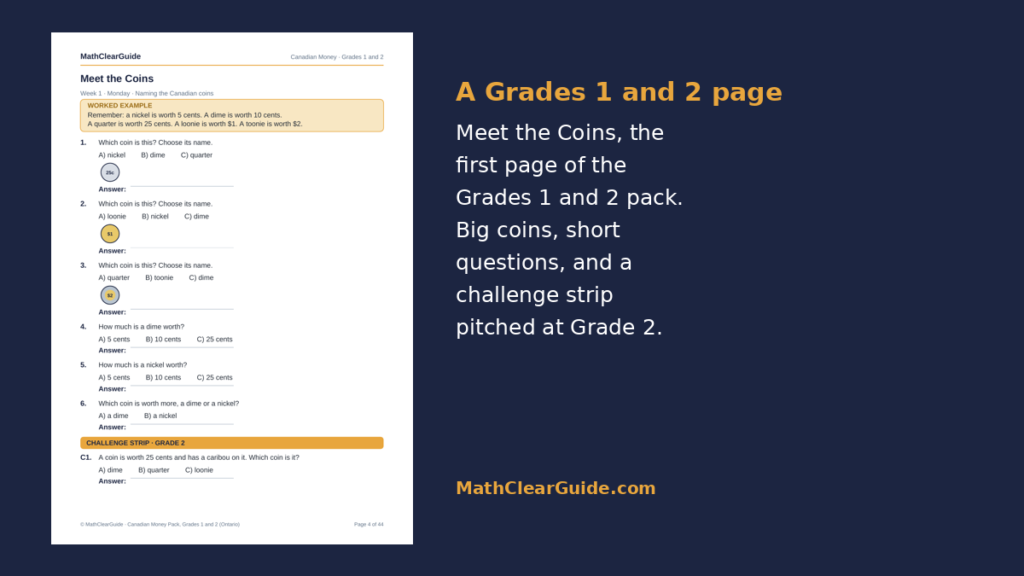
The youngest pack starts with the coins: naming them, valuing them, counting one kind at a time to 50 cents. Bills arrive the same week, to $50, with the $100 bill counted in Week 3. By Week 4 the class is making amounts two ways and paying exact amounts in a first shop. Every page opens with a worked example, and most end with a challenge strip pitched at Grade 2. See the pack: Canadian Money Grades 1 and 2
Grades 3 and 4: Change, Payment and Saving
This is the pack the free week opens. Week 2 is making change, from $10, from $20 and under one dollar, with estimate first pages that teach pupils to guess before they work it out. Week 3 rounds cash totals to the nearest 5 cents, the way a real till does, and counts to $100 and $200. Week 4 turns to ways to pay, needs and wants, a first saving goal and a shop role play day. See the pack: Canadian Money Grades 3 and 4

Grade 5: Budgets and Real Choices
Grade 5 money is about choices, not coins. Week 1 follows how money is transferred: cash in hand, debit cards, cheques, e-transfers and direct deposits. Week 2 plans budgets that balance and fixes budgets that go over. Week 3 compares prices with unit costs and tests whether a special offer is a real deal. Week 4 sets saving goals and thinks like a consumer. One page names tax in plain words, and no tax amount is worked out. See the pack: Canadian Money Grade 5
No Penny, No Dollar Bill: The Two Mistakes to Avoid
The two mistakes in Canadian money teaching both come from borrowed worksheets. The first is the penny. Canada stopped making it in 2013, and a worksheet that asks for change in pennies teaches a till that no longer exists. Prices in these packs are always multiples of 5 cents. The second mistake is the dollar bill. There has been no $1 bill since 1987 and no $2 bill since 1996. One dollar is a coin. Two dollars is a coin. If a worksheet shows a $1 bill, it is not Canadian money, whatever its title says.
A real loonie in a child’s hand teaches more than ten pictures of one. We pass the coin box round before we open the worksheets.
A Grade 3 teacher in Ontario, on starting the money unit
The January Unit, Week by Week
Each pack runs four weeks of five short pages, about fifteen to twenty minutes a day. Week 1 names and counts the money. Week 2 works the core skill of the band. Weeks 3 and 4 apply it in shops, budgets and role play. If a week runs short, drop the Friday page first: Fridays are self-checking practice, no new teaching. Money work stands on skills from earlier in the year, so keep place value and addition and subtraction warm alongside it, and use the worksheet generator when a pupil needs one more practice page.
Shop Role Play Without Buying Anything
Every pack prints a cut out card page: the five coins and the $5, $10 and $20 bills, twice each. Print it on card stock once per pair of pupils, cut on the dashed lines, and keep the sets in a class money box. The shop pages then run with no shopping at all. One pupil prices, one pays, the shopkeeper counts the change out loud. Grade 5 uses the same cards for budget role play. Between units, the Math Fact Practice tool keeps the adding underneath money work fast.

The till teaches what a page cannot. A child who has short changed a friend once counts change carefully forever after.
A Grade 4 teacher, on shop role play day
Same Page, Two Depths
The challenge strips are how one page serves two grades. Take the Thursday shop page in Week 4 of the Grades 3 and 4 pack. A Grade 3 pupil runs the till on the core page: add the prices, then count out change from $10 and from $20. A Grade 4 pupil takes the challenge strip: a cash total of $12.88 to round, a payment method to choose, and a reason to write down. Same page, same shop, two depths. All the packs and tools live on the tools page.
The child who learns to wait a week for something learns more than money. Patience is the real lesson, and it lasts.
A Grade 5 teacher, on saving goals
January comes back every year, and so does this unit. Start with the free week and let the packs carry the rest of the month.
Common Questions
Is there a penny in Canada?
No. Canada stopped making the 1 cent coin in 2013. Cash totals round to the nearest 5 cents, and card payments stay exact to the cent.
What is a loonie and a toonie?
The loonie is the Canadian 1 dollar coin, named for the loon on its face. The toonie is the 2 dollar coin, a silver ring with a gold coloured centre.
Is the first week free?
Yes. Week 1 of the Grades 3 and 4 pack is a free download with its full answer key, linked at the top of this post.
Which grades does this cover?
Grades 1 to 5, in three packs: Grades 1 and 2, Grades 3 and 4, and Grade 5.
Does it follow the Ontario curriculum?
Yes. Each pack is built on Ontario Curriculum 2020, Strand F, Financial Literacy, for its band: F1.1 in every grade from 1 to 5.
Can I use it outside Ontario?
Yes. The money is the same across Canada, and the skills, counting, change, budgets and comparing prices, are taught in every province. Only the strand codes are Ontario codes.
Reading about it is one thing, practising it is another. Our free Telling Time to the Hour and Half Hour lesson builds the idea step by step, with slides, a printable worksheet and a full answer key.
Members unlock every lesson in the library, including the full Fractions, Multiplication, Place Value, Addition & Subtraction, Time & Money and Geometry & Shapes units. See the full library


