
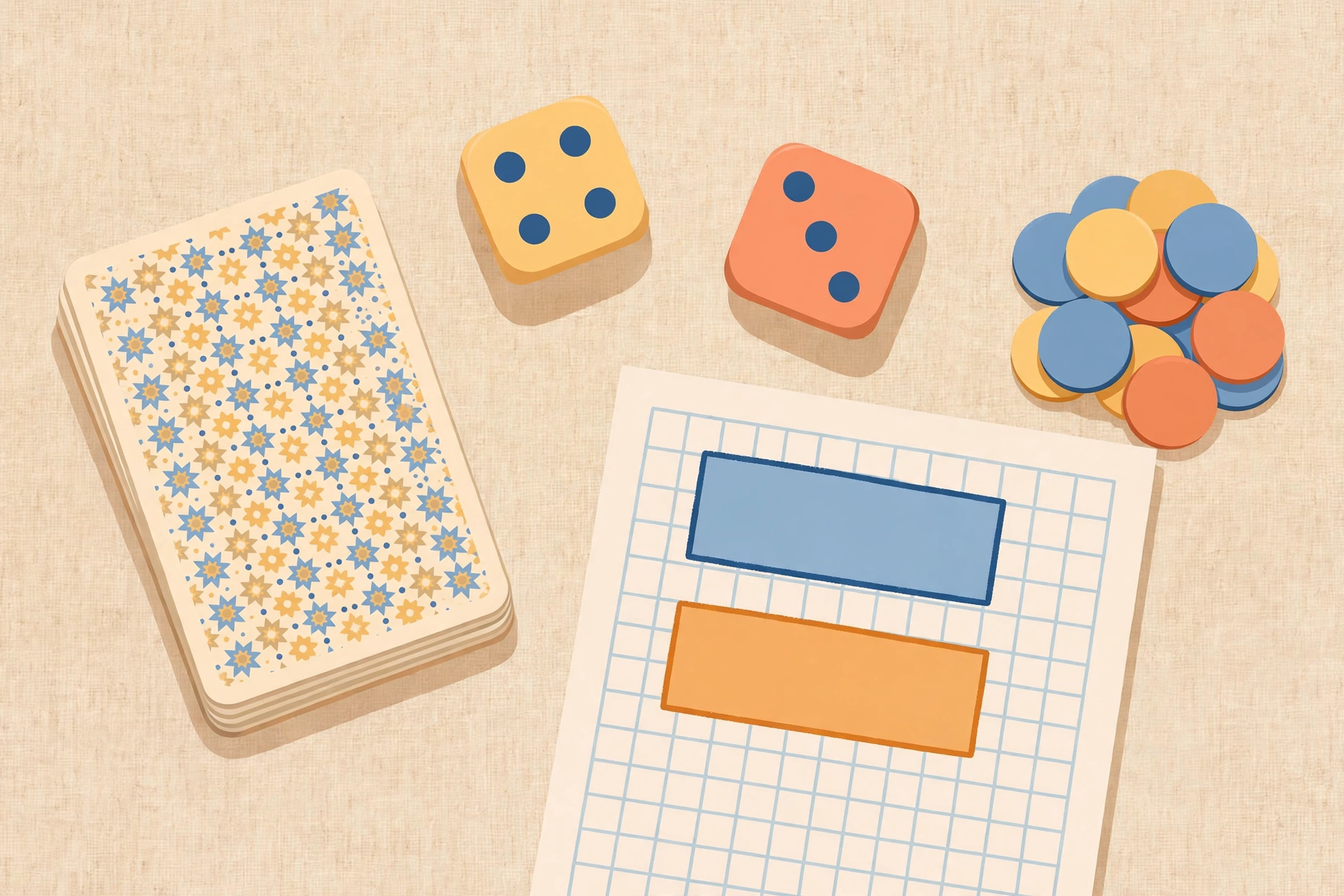
The best fun math games for 4th graders need nothing but a deck of cards, a pair of dice, grid paper, or one good printable, and every game below targets a real grade 4 skill: multi-digit multiplication, division with remainders, comparing fractions, factors and multiples, area and perimeter, and place value into the thousands.
This list is screen-free on purpose, works at the kitchen table and in the classroom, and every game states its players, materials, setup time, and the skill it builds, so you can pick one in seconds and be playing in under two minutes.
Quick answer: Best no-prep game: Multiplication War, two players, one deck of cards, zero setup. Best for multiplication facts: Multiplication War for speed and Missing Factor Bingo for the multiplication and division link.
Best for fractions: Fraction War, where you build a fraction from two cards and beat your partner’s. Best printables: Place Value Yahtzee for place value and Remainders Wanted for division with remainders. Best board game to buy: Prime Climb for confident 4th graders, and Proof! for the whole family.
Quick Picks: The Best Game for Every Skill
Short on time? Find the skill your child is working on, and start with that game. Every one of them is explained in full below.
| Skill | Best game | What you need |
|---|---|---|
| Multiplication facts | Multiplication War | A deck of playing cards |
| Multi-digit multiplication and arrays | Area Conquest | 2 dice, grid paper, 2 colored pencils |
| Division with remainders | Remainders Wanted | Printable board, 1 die, counters |
| Comparing fractions | Fraction War | A deck of playing cards |
| Factors and multiples | The Factor Game | Printed or hand-drawn 1 to 30 board, 2 pencils |
| Place value | Place Value Yahtzee | Printable score cards, 5 dice |
| Multi-step problem solving | Target Number | A deck of cards, 2 dice, scrap paper |
| Multi-digit addition | Race to 5,000 | A deck of playing cards |
No-Prep Card and Dice Games
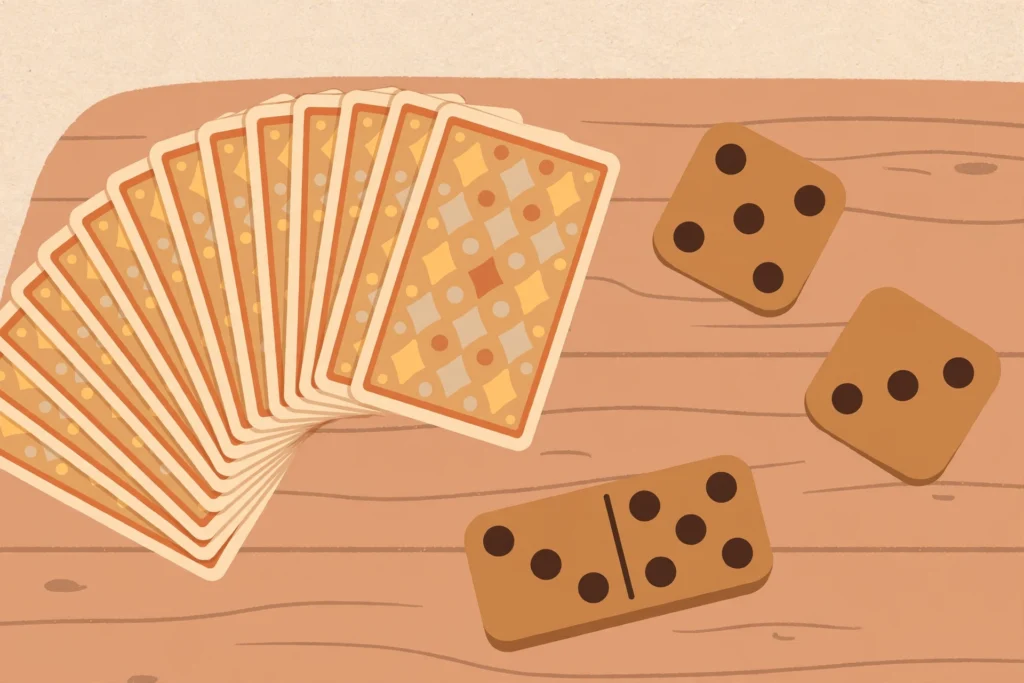
These seven games live in a kitchen drawer. If you own cards and dice, you own all of them, and none takes more than a minute to set up.
1. Multiplication War
Players: 2 · You need: one deck of playing cards · Setup: under 1 minute
How to play: Remove the face cards (Ace counts as 1) and deal the whole deck out evenly, face down. Both players flip their top two cards at the same time, multiply them, and say the product out loud. The higher product wins all four cards.
On a tie, leave the cards in the middle and flip two more each, with the winner taking the lot. Play until one player holds every card, or set a timer and count cards at the end. If a fact stumps someone, check it together on our interactive multiplication chart and play on.
Skill: Multiplication facts to 10 × 10 (keep the Jack as 11 and Queen as 12 later for a 12 × 12 challenge). Honest note: Pure speed can crush a slower child. With mixed levels, score a point per round instead of winner takes all, or give the younger player a smaller fact range.
2. Fraction War
Players: 2 · You need: one deck of playing cards · Setup: under 1 minute
How to play: Remove the face cards (Ace = 1) and deal the deck evenly. Both players flip two cards and arrange them as a fraction, smaller number on top as the numerator and larger underneath as the denominator, so every fraction is a proper fraction.
The larger fraction wins all four cards, and players say the comparison out loud (“three fifths beats two sevenths”). Equal fractions mean war: flip two more each. Most cards when the deck runs out wins. A number line on the table settles arguments, and our fraction calculator checks a really close call step by step.
Skill: Comparing fractions, fraction size sense, spotting equivalent fractions. Honest note: Comparing unlike denominators is real grade 4 work, so early games run slow. That thinking time is the point, not a problem.
3. Domino Fraction War
Players: 2 · You need: a set of dominoes · Setup: about 1 minute
How to play: Spread the dominoes face down and each player draws one. Turn your domino so the smaller end is the numerator and the larger end is the denominator. The bigger fraction wins both dominoes. Play until the pile is gone, and the most dominoes wins.
Skill: Comparing fractions with varied denominators, fraction size sense. Honest note: A blank end makes a fraction worth zero, which kids find hilarious, and a double blank is a free gift. A double nine or double twelve set gives more interesting fractions than a double six.
4. Target Number
Players: 2 to 4 · You need: a deck of cards (face cards removed, Ace = 1), 2 dice, pencil and scrap paper · Setup: about 1 minute
How to play: Roll both dice to set a two-digit target, first die as the tens digit and second as the ones (4 and 6 make 46). Deal five cards to each player.
Using any of your cards with +, −, ×, or ÷, build an equation that hits the target exactly or lands as close as possible. You do not have to use all five cards.
Whoever lands closest collects all the cards played that round, and when the deck runs out, the most cards wins.
Skill: Multi-step thinking, all four operations, order of operations, estimation. Honest note: This one goes quiet, not rowdy, because the thinking time is the learning. Give two or three minutes per round and expect plenty of crossed-out attempts.
5. Area Conquest
Players: 2 · You need: 2 dice, one shared sheet of grid paper, two different colored pencils · Setup: about 1 minute
How to play: Roll both dice: the two numbers are the length and width of a rectangle. Draw that rectangle anywhere it fits on the shared grid, in your color, without overlapping existing rectangles. Write the rectangle’s area inside it (write its perimeter too for a bonus challenge).
Take turns until one player cannot fit the rectangle they rolled, then add up the areas each of you captured. The bigger total area wins. The rectangle drawing is the area model in disguise: length times width, made visible.
Skill: Area and perimeter, multiplication as arrays, spatial planning. Honest note: Turns slow down deliciously at the end as space runs out, and that squeeze is the strategy. Half a sheet of grid paper keeps one game near 15 minutes.
6. Race to 5,000
Players: 2 to 4, or teams · You need: one deck of playing cards (Ace = 1, face cards = 0) · Setup: under 1 minute
How to play: Each player draws eight cards and arranges them into two 4-digit numbers. Add your two numbers together. Whoever’s total lands closest to 5,000, over or under, wins the round. First to win three rounds takes the game.
Skill: Multi-digit addition with regrouping, place value, estimation. Honest note: The arranging step is where the learning hides, because kids have to think in place value before they add a single digit. Do not rush it.
7. Greatest Number
Players: 2 to 4, or a whole class · You need: one die (a 10-sided die is ideal, a standard die works), paper with four empty boxes per player labeled thousands, hundreds, tens, ones · Setup: about 1 minute
How to play: Roll the die, and every player writes the digit into one of their four boxes. Once written, a digit can never be moved. Roll five times in total, and each player throws away one roll as a spare. When all four boxes are filled, read your number aloud, and the largest 4-digit number wins the round.
Skill: Place value to the thousands, comparing large numbers, deciding under uncertainty. Honest note: It scales painlessly: three boxes for an easier game, five or six boxes with an extra spare roll once they are confident. Our place value page backs up the idea behind every decision.
Printable Math Games
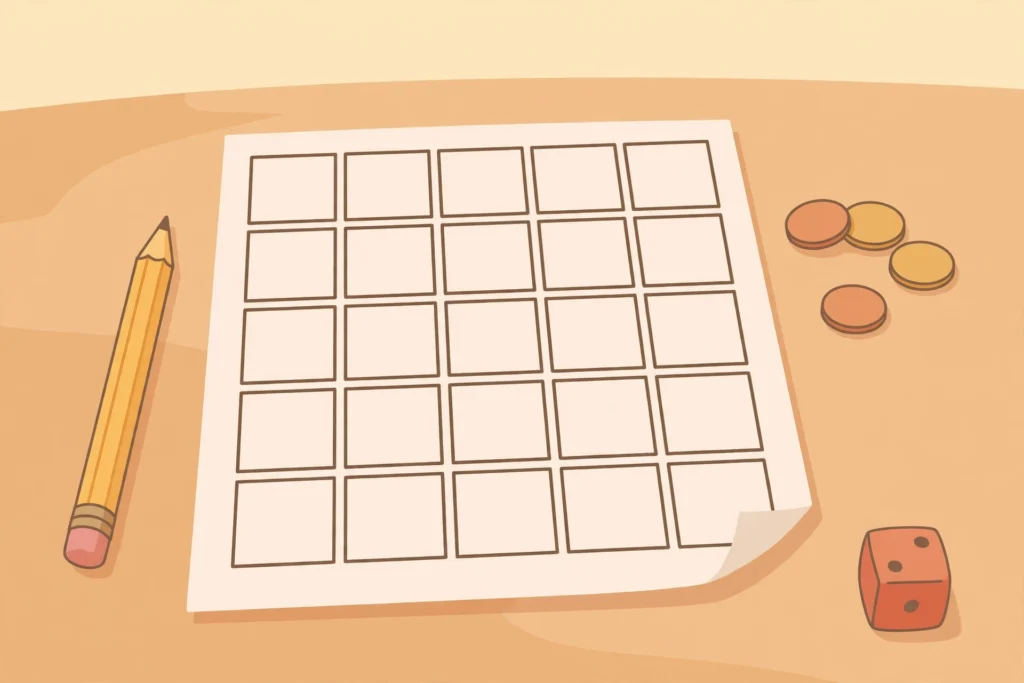
Print these once and play them all year (laminate the keepers). Five minutes with a printer buys you the five games below, and our free worksheet generator prints fresh fact practice any time you want new bingo boards or call cards to go with them.
8. Multiplication Bingo
Players: 2 to a whole class · You need: printed bingo boards filled with products (one per player), a caller with fact cards, counters or coins as markers · Setup: about 10 minutes once, then reusable all year
How to play: The caller draws a fact card and reads the multiplication fact aloud (“seven times six”). Players work out the product and cover it if it appears on their board. First to complete a row calls Bingo, then proves it by reading back the fact for every covered square.
Skill: Multiplication fact recall, connecting facts to products. Honest note: The caller does no math, so in class make caller a rotating student job, and at home swap roles every game.
9. Missing Factor Bingo
Players: 2 to 4 · You need: printed game boards (each square shows a multiplication expression with a missing factor, like __ × 7 = 42), one die per player, markers · Setup: about 2 minutes (free printable boards from Math Geek Mama)
How to play: Everyone rolls their die at the same time. Find an expression on your board that your rolled number completes as the missing factor, and cover it. If no expression fits your number, you skip that roll. First to cover four in a row, or the whole board if you agree that first, wins.
Skill: Missing factors, the multiplication and division connection, early algebra thinking. It works because a fact family ties the two operations together: if 6 × 7 = 42, then 42 ÷ 7 = 6. Honest note: Because everyone rolls and covers at once, nobody sits waiting for a turn. It is a rare bingo that stays fast and quiet.
10. Place Value Yahtzee
Players: 2 to 4 · You need: one printed score card per player (free from Games 4 Gains), 5 dice, pencils · Setup: about 2 minutes
How to play: On your turn, roll all five dice, then you may roll once more, keeping any dice you like.
Arrange your final dice into the biggest number you can and write it into one of the nine categories on your score card. Each category can be used only once, and if nothing fits you must cross a category out with an X.
When every card is full, compare category by category: the biggest number in each earns 1 point, and the most points wins. Bonus rule from the game’s creator: you only earn a point if you can read your number aloud correctly.
Skill: Place value, building and comparing large numbers, reading numbers aloud. Honest note: The read-aloud rule exposes gaps fast, so keep it light-hearted. The printable comes in versions for different number sizes.
11. Remainders Wanted
Players: 2 to 4 · You need: the printed game board (a grid of division-ready numbers, free from Teacher Scout Mom), 1 die, counters · Setup: about 2 minutes
How to play: On your turn, place a counter on any uncovered number on the board: that is your dividend. Roll the die: that is your divisor. Divide, and say the answer with its remainder. The remainder is your score for that turn, so big remainders are what you want.
Keep a running total, and when the board is covered (or after an agreed number of rounds), the highest total remainder wins. Stuck on how remainders work? Our long division calculator shows the steps.
Skill: Division with remainders, the slipperiest grade 4 division idea. Honest note: Delightfully backwards: kids start hunting for dividends that leave the biggest remainder, which is genuine divisibility thinking in disguise.
12. The Factor Game
Players: 2 · You need: a board with the numbers 1 to 30 in a grid (print it, or draw it in about a minute), two colored pencils · Setup: about 2 minutes
How to play: Player 1 circles any number and scores that many points. Player 2 then circles every still-uncircled proper factor of that number (all its factors except the number itself) and scores the sum of those factors. Swap roles and keep going: circle a new number, and your opponent collects its remaining factors.
Beware: pick a number whose factors are all circled already and you score nothing for it and lose the turn. The game ends when no useful moves remain, and the higher total wins. (From Connected Mathematics, with a free interactive version at NCTM Illuminations.)
Skill: Factors and multiples, prime and composite numbers, strategy. Honest note: The strategy talk is gold. 24 looks big, but it hands your opponent 1 + 2 + 3 + 4 + 6 + 8 + 12 = 36 points. Expect instant rematches.
Board Games Worth Buying
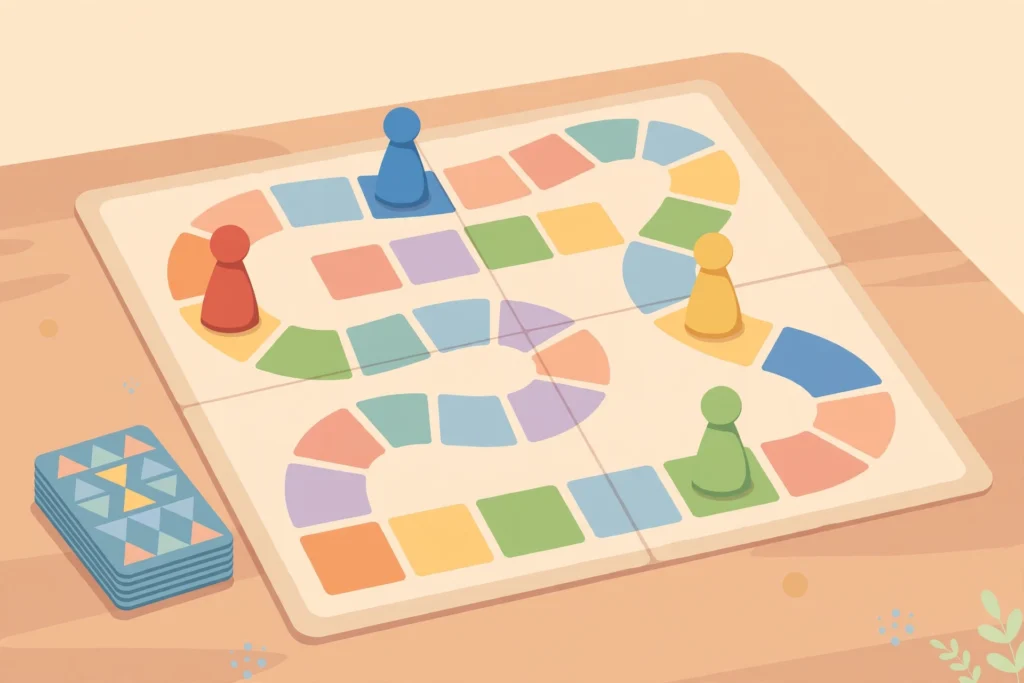
Most math practice at this age should be free, and the twelve games above are. These three boxed games are the exceptions that earn their shelf space.
13. Prime Climb (Math for Love)
Players: 2 to 4 · Ages: 10+ on the box · Time: about 10 minutes per player · Price: around $30 to $35 (checked October 2026)
How to play: Race both of your pawns to the exact center space, 101. Roll two 10-sided dice and apply each number to a pawn with +, −, ×, or ÷.
Landing on an opponent sends them back to start, and landing on a prime earns a Prime card. The board is color-coded by prime factorization, so multiplication and division become visible instead of memorized.
Skill: Multiplication, division, prime numbers, and factors. Honest note: The box age is 10+, so this sits at the very top of the grade 4 range. It is ideal for a confident 4th grader, or played in adult and child teams. Younger siblings will struggle.
14. Proof! (Master Theorem Games)
Players: 2 to 6 · Ages: 9+ · Time: about 15 minutes · Price: around $18 (checked October 2026)
How to play: Nine number cards from a deck of 100 cards (numbered 0 to 100) lie face up in a grid.
Everyone hunts at the same time for a set of cards that forms a true equation using +, −, ×, or ÷. Spot one, shout the answer, show your proof, and keep those cards.
New cards refill the grid, and when the deck runs out, the most cards wins.
Skill: Mental math across all four operations, flexible number sense. Honest note: It is speed-based, so faster players dominate. Level the field by making stronger players use at least three or four cards in every equation.
15. Zeus on the Loose (Gamewright)
Players: 2 to 5 · Ages: 8+ · Time: about 15 minutes · Price: around $10 to $14 (checked October 2026)
How to play: Players add number cards to a shared pile, keeping a running total.
Land the total exactly on a multiple of 10 and you grab the Zeus figure, and Greek god cards change the total or steal him away.
The round ends when the total reaches exactly 100: whoever holds Zeus wins the round, and winning four rounds (spelling Z-E-U-S) wins the game.
Skill: Adding to 100, multiples of 10, tactical timing. Honest note: The arithmetic itself is easy for most 4th graders, so treat this as a family game night fluency builder and confidence game, not new grade 4 content. Its real work is multiples of 10 and sneaky timing.
How to Choose the Right Game for Your Goal
Only 10 minutes? Play Multiplication War, or one round of Proof! if the box is already on the shelf.
A quiet classroom center? Missing Factor Bingo or Place Value Yahtzee. Everyone plays at the same time, nobody shouts, and the teacher can hear herself think.
Homework battles at home? Fraction War or Target Number, with the parent as a playing partner rather than a referee. Losing to your own kid occasionally is part of the medicine.
One weak skill to fix? Go back to the Quick Picks table and play that game twice a week for a fortnight. Short, repeated, and targeted beats one long session.
A whole class at once? Multiplication Bingo with a student caller, or Greatest Number with the teacher rolling for everyone.
Buying a gift? Prime Climb for a confident young mathematician, Proof! for mixed-age family play, and Zeus on the Loose for a younger-leaning family game night.
Frequently Asked Questions
What are some fun math games for 4th graders to play at home?
Start with Multiplication War and Fraction War: one deck of cards, no setup, real grade 4 skills. Add Target Number when you want them thinking harder, and Area Conquest with dice and grid paper for area and perimeter.
What math games help 4th graders with multiplication?
Multiplication War builds fact speed, and Missing Factor Bingo builds the multiplication and division link behind the facts. Prime Climb and Proof! then stretch multiplication into multi-step mental math.
Are there math games for 4th graders that need no prep and no screens?
Yes, every card and dice game on this page. A deck of cards, two dice, and grid paper cover multiplication, fractions, factors, area, and place value, each with under a minute of setup.
Where can I find free printable math games for 4th graders?
Place Value Yahtzee score cards (Games 4 Gains) and Missing Factor Bingo boards (Math Geek Mama) are free printables with the rules included. Our own worksheet generator also prints fresh fact practice you can turn into bingo boards and call cards.
Do these games line up with what 4th graders learn in school?
Yes. Each game is matched to a core grade 4 topic: multi-digit multiplication, division with remainders, comparing fractions, factors and multiples, area and perimeter, and place value. They practice the same skills the school year teaches, without the worksheet.
What is the best math board game for a 4th grader?
Prime Climb for a confident mathematician, though its box age of 10+ makes it a stretch goal. Proof! suits mixed-age family play best, and Zeus on the Loose is the lighter pick for a younger-leaning game night.
Games work because the practice is hidden inside the playing, and a child who would groan at forty flash cards will happily demand a rematch of the game that just drilled the same forty facts.
Keep a deck of cards in the drawer, and math practice stops being a negotiation. When you want the digital companions to these games, our free math tools page gathers the multiplication chart, the calculators, and the worksheet generator in one place.
Every topic clicks faster with practice. Our Resource Library has free lesson packs with slides, printable worksheets and full answer keys, ready to download and teach.
Members unlock every lesson in the library, including the full Fractions, Multiplication, Place Value, Addition & Subtraction, Time & Money and Geometry & Shapes units. See the full library


