
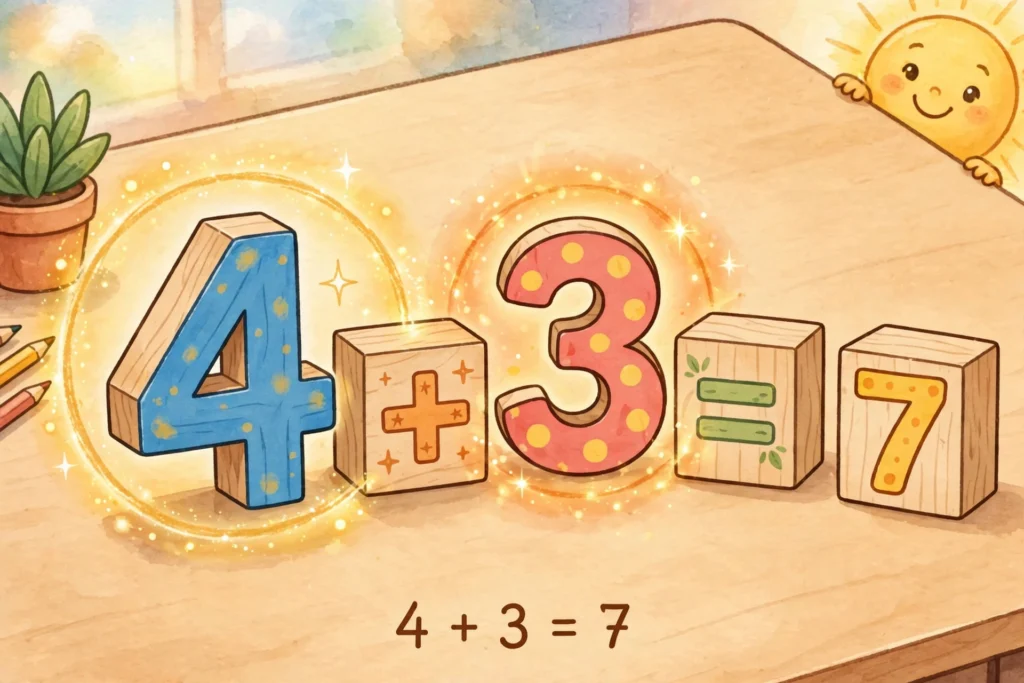
An addend is a number that is added to another number. In 4 + 3 = 7, the addends are 4 and 3, and 7 is the sum.
What Is the Difference Between an Addend and a Sum?
Picture two cups of counters on a desk. One cup holds 2 red counters, the other holds 3 blue ones. A student pours both cups into a bowl and counts 5 counters in all. The 2 and the 3 are the addends, the numbers being joined. The 5 is the sum, the total after joining.
It rhymes, and that helps: addends add, the sum is the total. In every addition sentence, the numbers on the adding side of the equals sign are addends, and the number standing alone as the answer is the sum. Say it out loud a few times, “ADD-end,” and the word sticks fast.
Can You Have More Than Two Addends?
Yes, and classrooms prove it daily. When three friends bring marbles to share, 7 + 4 + 1 = 12, all three numbers, 7, 4, and 1, are addends. Every number being added earns the title, no matter how many join the line.
Longer addition strings show up in real math all the time. A shopping list might read 5 + 2 + 8 + 1 = 16, and each of those four numbers is an addend. There is no limit. If a number is being added, it is an addend.
This idea unlocks a favorite puzzle type: the missing addend. In 5 + __ = 9, the blank is a mystery addend waiting to be found. (The answer is 4.) Fact families, where addition and subtraction sentences share the same numbers, are built on hunting down exactly these missing addends.
Does the Order of Addends Matter?
Not one bit. Watch what happens when we flip an addition sentence: 4 + 7 = 11, and 7 + 4 = 11. Same addends, same sum. Mathematicians call this the commutative property of addition, which is a fancy way of saying the order of addends never changes the total.
One first-grade teacher acts this out with two lines of students. Five kids stand on the left, three on the right: 5 + 3 = 8. Then the lines trade sides: 3 + 5 = 8. The class counts both times and gasps, just a little, at the second 8. Turnaround facts like these cut memorization work in half, because learning 4 + 7 automatically teaches 7 + 4.
Where Do We See Addends Every Day?
Addends hide inside almost every addition story. At the store, a $3 apple and a $2 banana are addends that make a $5 sum. In a soccer game, the 2 goals from the first half and the 1 goal from the second half are addends behind the final score of 3.
Recipes lean on addends too: 2 cups of flour plus 1 cup of sugar. Even a fitness tracker adds morning steps and evening steps as addends to reach the daily total. Once students learn the word, they start spotting addends the way bird-watchers spot birds.
Did You Know: The word addend comes from the Latin addere, meaning “to add to, join, or attach.” Some math fans also call an addend a summand, which means the same thing.
Try It: Addend Detectives
Grab paper, two crayons in different colors, and your sharpest detective eyes. The mission: hunt down every addend hiding in addition sentences.
- Step 1: Write five addition sentences, such as 5 + 2 = 7 and 10 + 4 + 3 = 17.
- Step 2: Circle every addend in your first color. Box every sum in your second color.
- Step 3: Trade papers with a partner. Check each other’s work like a true detective checking evidence.
- Step 4: Bonus case: open a math book and find one addition sentence with three addends. Circle all three and present your evidence to the class.
For an extra challenge, write a sentence with a missing addend, like 6 + __ = 10, and let your partner solve the case. Detectives who can find missing addends are ready for any addition mystery.
Quick Practice
Question: In the equation 7 + 4 + 5 = 16, which numbers are the addends?
Answer: The addends are 7, 4, and 5. Every number being added is an addend, and 16 is the sum.
Related Terms
Keep exploring addition with these dictionary entries:
Frequently Asked Questions
What is an addend in simple words?
An addend is a number being added. In 2 + 3 = 5, the addends are 2 and 3.
In 9 + 6 = 15, what are the addends?
The addends are 9 and 6. The number 15 is the sum, which is the answer, not an addend.
Can an addend be zero?
Yes. In 8 + 0 = 8, zero is an addend, and adding zero leaves the other number unchanged.
Can addends be fractions or decimals?
Yes. Addends can be any numbers at all, including fractions like 1/2 + 1/4 and decimals like 2.5 + 1.5.
What is the difference between an addend and a factor?
An addend is joined to other numbers with addition, as in 4 + 3. A factor is joined with multiplication, as in 4 x 3. Both build bigger numbers, but with different operations.
Reading about it is one thing, practising it is another. Our free What Is Addition? lesson builds the idea step by step, with slides, a printable worksheet and a full answer key.
Members unlock every lesson in the library, including the full Fractions, Multiplication, Place Value, Addition & Subtraction, Time & Money and Geometry & Shapes units. See the full library


