

Addition is the math operation you use to put numbers together. When you join two or more groups into one big group, you are adding.
What Does the Plus Sign Mean?
The plus sign, which looks like a little cross (+), is the symbol for addition. It sits between the numbers you want to join. When you see 3 + 2, you read it as three plus two, and the sign tells you to put those amounts together.
Kids often meet the plus sign with blocks first. A teacher sets down three red cubes, then slides two blue cubes next to them, and draws a plus sign between the groups on the board. The sign becomes a picture of the action, slide together, join, combine.
How Do You Add Numbers?
You start with one group and count on. For 5 + 3, hold five in your head and count three more, six, seven, eight. The answer is eight. This count-on strategy is the one most first graders use before they memorize facts.
A number line gives you another way. Start at 5 and hop three spaces to the right, landing on 8. Ten frames work too. Fill a ten frame with five counters, then add three more counters, and you see eight filled spaces. Every method ends in the same place because joining is joining, no matter how you picture it.
In class, addition often sounds like a story. Maya had four stickers. Her brother gave her three more. How many stickers does Maya have now? The story turns into 4 + 3, and the answer, seven, finishes the story. Word problems like this are how kids learn that addition is not just symbols. It is real things joining together.
What Are the Parts of an Addition Problem Called?
The numbers you add are called addends. The answer is called the sum. In 6 + 4 = 10, six and four are the addends, and ten is the sum. Another word you will hear for the answer is total, which means the same thing.
Knowing these names helps in class. When a teacher asks for the sum of seven and five, she is asking you to add them. When a worksheet says circle the addends, it wants you to mark the numbers being joined. The vocabulary is small, and it pays off fast.
Quick Answer: The sum is the answer you get after adding. If the problem is 2 + 6 = 8, the sum is 8. Any time you finish joining groups and count the whole pile, that final count is the sum.
Does the Order Matter in Addition?
It does not. Three plus two gives the same answer as two plus three. Both equal five. This is called the commutative property of addition, and it is one of the handiest facts in early math.
The order rule saves real work. If you need to solve 2 + 9, you can flip it to 9 + 2 in your head and count on from nine instead of from two. Counting on from the bigger number is faster, and the commutative property is what makes that move legal. Teachers call this starting with the bigger addend, and it is a strategy kids use for years.
There is a second property worth knowing. Adding zero changes nothing. Seven plus zero is still seven. Zero is called the additive identity because a number keeps its identity when zero joins it. Kids love this rule because it feels like a magic trick that always works.
Try It: Build a Sum Tower
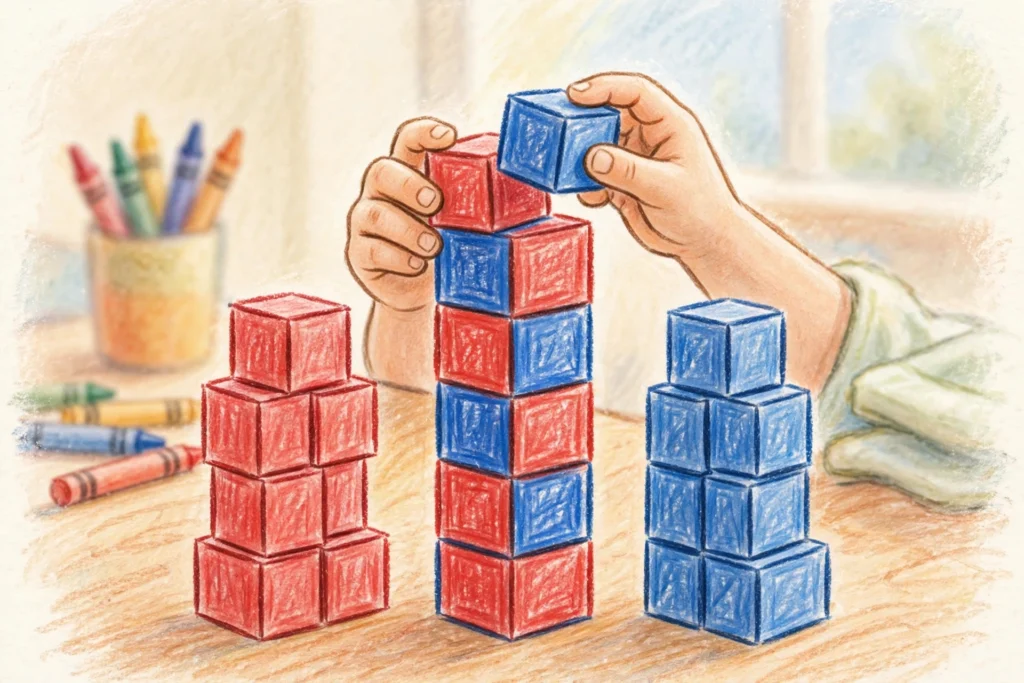
Grab two colors of linking cubes, red and blue. Pick a secret number of red cubes and snap them together into a short tower. Now pick a number of blue cubes and snap them into a second tower. Write down how many cubes are in each tower. Those are your addends.
Now join the two towers into one tall tower. Count every cube from bottom to top. That final count is the sum. Write the whole number sentence, for example 4 + 5 = 9. Now comes the fun part. Take the tower apart and rebuild it with the blue cubes on the bottom. Count again. The sum stays the same, and you just proved the commutative property with your own hands.
Quick Practice
Question: Liam has 7 marbles. His friend gives him 5 more marbles. How many marbles does Liam have in all? Write the addition sentence and find the sum.
Answer: The addition sentence is 7 + 5 = 12. Seven and five are the addends, and twelve is the sum. You can check by counting on from seven, eight, nine, ten, eleven, twelve. Liam has twelve marbles in all.
Related Terms
Frequently Asked Questions
What is the answer to an addition problem called?
It is called the sum. Some people also say total. Both words mean the final amount after you join the groups together.
What happens when you add zero to a number?
Nothing changes. Adding zero to any number gives you the same number back. For example, 9 + 0 = 9. This is called the zero property, or additive identity.
Which words in a word problem mean add?
Watch for words like in all, altogether, combined, total, plus, join, and more. When a story talks about groups coming together or a pile growing, addition is usually the right tool.
How can you check an addition answer?
Use the inverse operation, subtraction. If 8 + 5 = 13, then 13 − 5 must equal 8. You can also add the addends in the other order. If both orders give the same sum, your answer is solid.
What is the difference between addition and adding?
Adding is the action, the thing you do with the numbers. Addition is the name of the operation itself, the whole idea of joining quantities. You use addition when you are adding.
Reading about it is one thing, practising it is another. Our free What Is Addition? lesson builds the idea step by step, with slides, a printable worksheet and a full answer key.
Members unlock every lesson in the library, including the full Fractions, Multiplication, Place Value, Addition & Subtraction, Time & Money and Geometry & Shapes units. See the full library


