
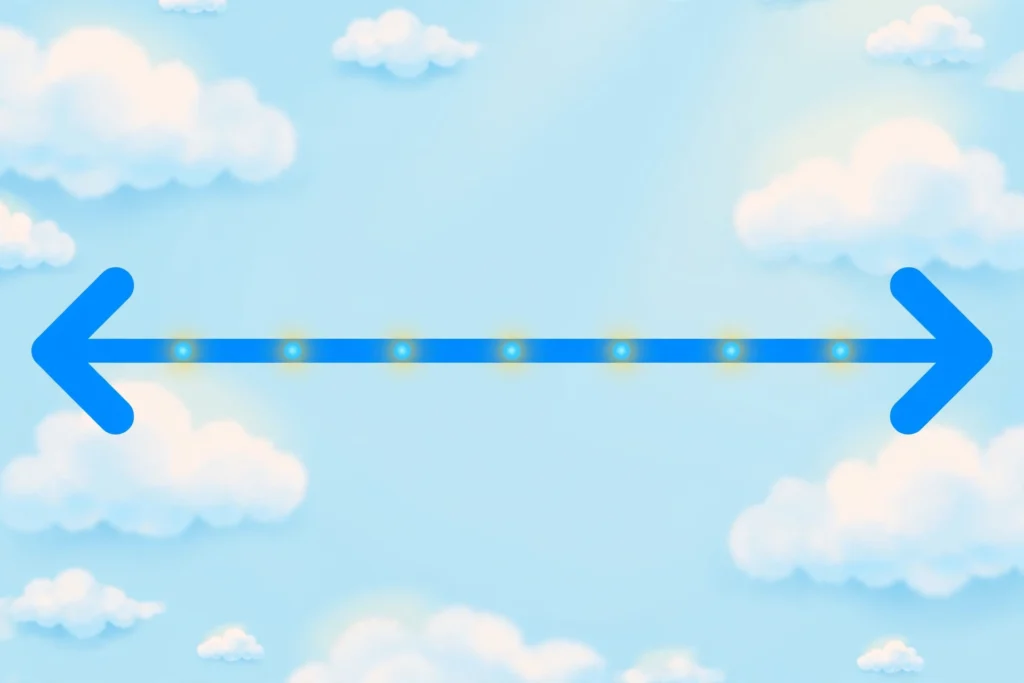
A line is a straight path made of points that goes on forever in both directions. It has length but no width, and it never ends.
What Is a Line in Geometry?
Points are the building blocks of geometry. A point is an exact location with no size at all, usually shown as a small dot. Line up an endless row of points side by side, perfectly straight, and you get a line. That is the whole recipe: straight, endless, and made of points.
Three features define a line. First, it is straight. If it bends, it is a curve, not a line. Second, it is one-dimensional: it has length but no width or thickness. A drawn line on paper has a little thickness because of the marker, but the true math line has none. Third, it extends forever in two directions. Mathematicians draw arrowheads at both ends as a reminder that the line keeps going past the edge of the paper, past the classroom, past everything.
Ancient Greek geometry treated the line as one of its first ideas. Euclid called it a “breadthless length,” a length with no width. More than two thousand years later, students still meet that same idea in third and fourth grade: a straight, endless, widthless path of points.
How Is a Line Different from a Line Segment and a Ray?
Lines, line segments, and rays are a classic trio, and telling them apart is a rite of passage. A line has no endpoints and goes on forever in both directions. A line segment has two endpoints and stops at both. A ray has one endpoint and goes on forever in one direction, like a beam of light leaving a flashlight.
The endpoints are the giveaway. Look for the dots. Two dots and no arrows: line segment. One dot and one arrow: ray. Two arrows and no dots: line. Teachers love asking students to sort pictures into these three groups, because the sorting forces careful looking.
You can measure a line segment because it has a start and a finish. A segment from A to B might be 5 centimeters long. You cannot measure a line or a ray, because at least one side never ends. There is no ruler long enough for infinity.
Common Mistake: Students call any straight mark a “line,” including segments. In everyday speech that is fine, but in geometry class it matters. Say “line segment” when you mean the piece with two endpoints, and save “line” for the endless one with arrows at both ends.
How Do You Name a Line?
Mathematicians name lines with two points on the line. Pick any two points, call them A and B, and you have line AB. The name is written with a double-headed arrow above the letters: AB with arrows pointing both ways. That little arrow symbol is a shortcut for “endless in both directions.”
Sometimes a line gets a single lowercase letter instead, like line m or line l. Both naming styles mean the same thing. The two-point name is more common in elementary school because it connects the line to the points students can see and label.
What Are Parallel and Perpendicular Lines?
Lines have relationships, and two of them get star billing. Parallel lines run side by side and never meet, no matter how far they extend. Think of railroad tracks or the lines on notebook paper. If two lines are parallel, they keep the same distance apart forever.
Perpendicular lines cross each other to form square corners, called right angles. Think of the corner of a book page or a plus sign. Where perpendicular lines meet, all four angles are right angles.
Then there are intersecting lines, the general case: any lines that cross at a point. Perpendicular lines are a special kind of intersecting line, the kind that crosses at exactly 90 degrees. Students hunt for all three kinds on classroom scavenger hunts, spotting parallels in window blinds and perpendiculars in door frames.
Try It: The Endless Road
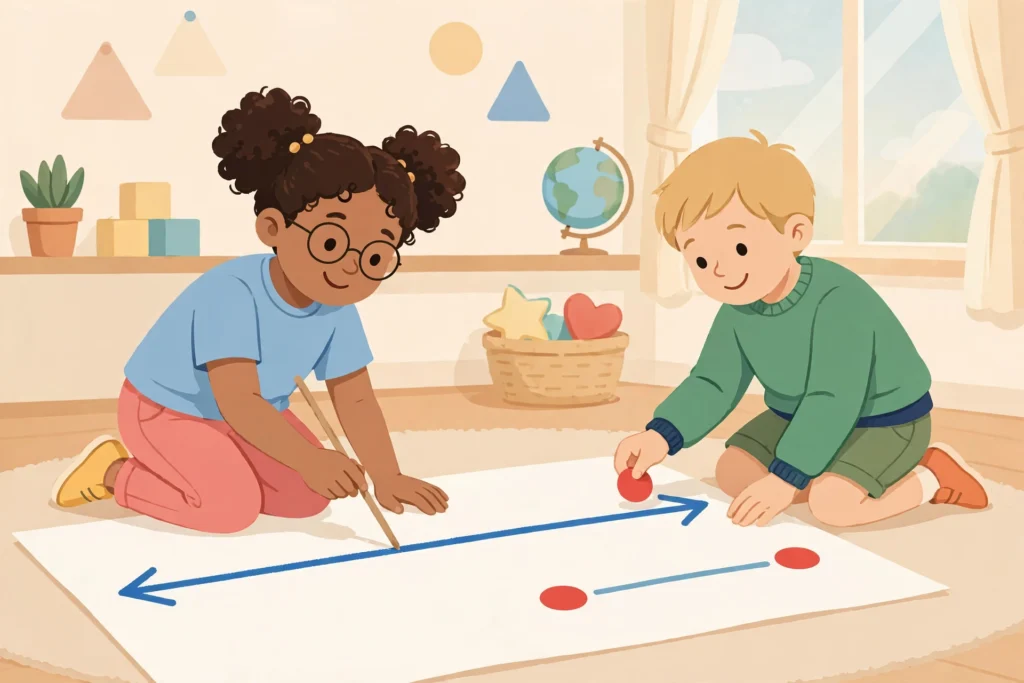
You need a yardstick or meter stick, paper, pencils, and dot stickers. This activity takes about 20 minutes and works well on the floor with big paper.
Use the yardstick to draw one long straight mark. Add arrowheads to both ends. Label two points on it, A and B. This is your line, your endless road. Now draw a second mark with dot stickers at both ends and no arrows. This is a line segment. Draw a third mark with a dot at one end and an arrow at the other. This is a ray.
Measure the line segment with the yardstick and write its length underneath. Try to measure the line. You cannot, and that is the point. Ask a partner: why can we measure the segment but not the line? The answer names the endpoints, or the lack of them.
Finish with a challenge. Draw two lines that never touch to make a parallel pair. Then draw a line that crosses one of them at a square corner to make a perpendicular pair. Tape the best pairs to the wall as a class reference for the week.
Quick Practice
Look at a mark with a dot at the left end and an arrow at the right end. Is it a line, a line segment, or a ray?
It is a ray. A ray has exactly one endpoint, the dot, and goes on forever in one direction, the arrow. A line would need arrows at both ends, and a line segment would need dots at both ends.
Related Terms
Frequently Asked Questions
What is a line in math for kids?
A line is a straight path of points that goes on forever in both directions. It has length but no width. Arrowheads at both ends show that it never stops.
What is the difference between a line and a line segment?
A line goes on forever in both directions with no endpoints. A line segment has two endpoints and a fixed length you can measure.
Can you measure a line?
No. A line extends forever in both directions, so no ruler can cover it. You can only measure a line segment, which has two endpoints.
What are parallel lines?
Parallel lines are lines that run side by side and never meet, like railroad tracks. They keep the same distance apart no matter how far they extend.
Reading about it is one thing, practising it is another. Our free What Are 2D Shapes? lesson builds the idea step by step, with slides, a printable worksheet and a full answer key.
Members unlock every lesson in the library, including the full Fractions, Multiplication, Place Value, Addition & Subtraction, Time & Money and Geometry & Shapes units. See the full library


