
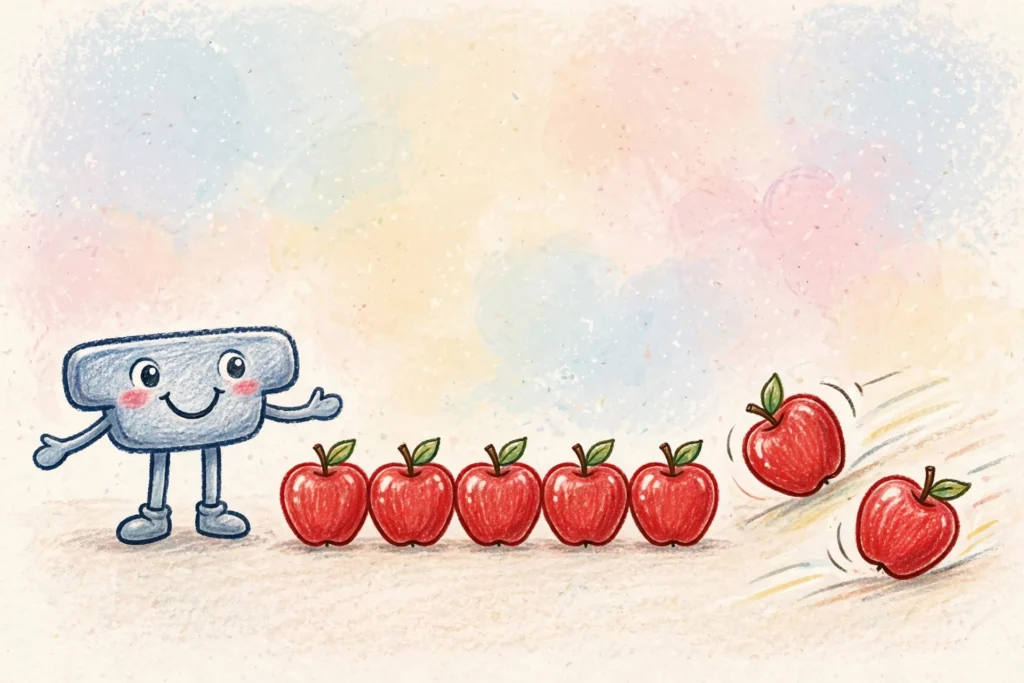
Minus is the word we say for the subtraction sign, the short horizontal line (−) that tells you to take one amount away from another.
What Does the Minus Sign Look Like?
The minus sign is a short, straight horizontal dash. It sits between two numbers, like the bridge between two islands. In 7 − 4, the little line between the seven and the four is the minus sign, and it tells you to subtract.
Kids sometimes mix it up with the plus sign, which has a vertical line crossing the horizontal one. A quick way to remember: the minus sign is the flat one, and flat means something is lying down and leaving. The plus sign stands up tall because it is bringing more in.
What Does Minus Mean in a Number Sentence?
Minus means take away. In 9 − 3 = 6, you start with nine, take away three, and six are left. The number after the minus sign is the amount that leaves. The number before it is the amount you start with.
Picture a lunch table moment. You have five crackers on your napkin. You eat two of them. The story becomes 5 − 2 = 3, and three crackers are left on the napkin. Every minus problem is a tiny story about something getting smaller.
Minus also shows up as the word for what is left over. If a game says you have 10 points and you lose 4, the minus tells you to find what remains. Ten minus four leaves six. The answer to a minus problem is often called the difference, because it shows how different the two numbers are.
What Are the Parts of a Subtraction Problem Called?
The number you start with is called the minuend. The number you take away is called the subtrahend. The answer is called the difference. In 8 − 3 = 5, eight is the minuend, three is the subtrahend, and five is the difference.
A memory trick helps here. Minuend starts with min, like minimum, but it is actually the bigger starting number, the one that gets minimized. Subtrahend starts with sub, like subtract, and it is the amount being subtracted. Teachers in early grades often just say start number, take-away number, and answer, and that is perfectly fine.
How Is Minus Different From Plus?
Plus joins and minus separates. That is the whole difference. With 4 + 3, two groups come together to make seven. With 7 − 3, you start with seven and break three off, leaving four.
The direction on a number line shows this clearly. Plus moves you to the right, toward bigger numbers. Minus moves you to the left, toward smaller numbers. For 6 − 2, put your finger on six and hop two spaces left. You land on four. A frog hopping backward on a sidewalk number line is a favorite classroom picture for this.
Common Mistake: Reading 9 − 5 backwards as 5 − 9. Order matters with minus, unlike with plus. Nine minus five is four, but five minus nine is not four. Always start with the first number and take away the second one. If a minus problem ever looks impossible, like 3 − 8, the numbers may be in the wrong order.
Try It: Take-Away Tray

Fill a tray or a shallow box with twelve pom-poms or counters. Write a minus problem on a card, like 12 − 5. Read it out loud: twelve take away five. Scoop five pom-poms off the tray and drop them into a cup. Count what is left on the tray. Seven left means 12 − 5 = 7.
Play again with a new card, and let a partner do the scooping while you write the number sentence. After five rounds, trade jobs. For a challenge round, put the taken-away pom-poms back and ask: what minus problem would leave exactly three on the tray? There is more than one right answer, and finding them all is great practice.
Quick Practice
Question: There are 11 birds on a fence. Four of them fly away. How many birds are left on the fence? Write the minus sentence and solve it.
Answer: The minus sentence is 11 − 4 = 7. Eleven is the minuend, four is the subtrahend, and seven is the difference. You can check on a number line by starting at eleven and hopping four spaces left to land on seven.
Related Terms
Frequently Asked Questions
Is minus the same as subtract?
Almost. Minus is the name of the sign (−) and the word we say when we read it. Subtract is the action of taking away. You use subtraction when you see a minus sign.
What does a minus sign in front of a number mean?
It marks a negative number, a number less than zero, like −3. This comes up in later grades with temperatures below zero or debts. In early grades, the minus sign sits between two numbers and means take away.
Which words in a word problem mean minus?
Look for take away, left, less, fewer, remain, difference, and how many more. When a story talks about something leaving, disappearing, or being eaten, minus is usually the right tool.
Can the answer to a minus problem be zero?
Yes. If you take away everything you started with, nothing is left. For example, 6 − 6 = 0. This is a good moment to see why order matters, since 6 − 0 = 6 is a different problem with a different answer.
Every topic clicks faster with practice. Our Resource Library has free lesson packs with slides, printable worksheets and full answer keys, ready to download and teach.
Members unlock every lesson in the library, including the full Fractions, Multiplication, Place Value, Addition & Subtraction, Time & Money and Geometry & Shapes units. See the full library


