
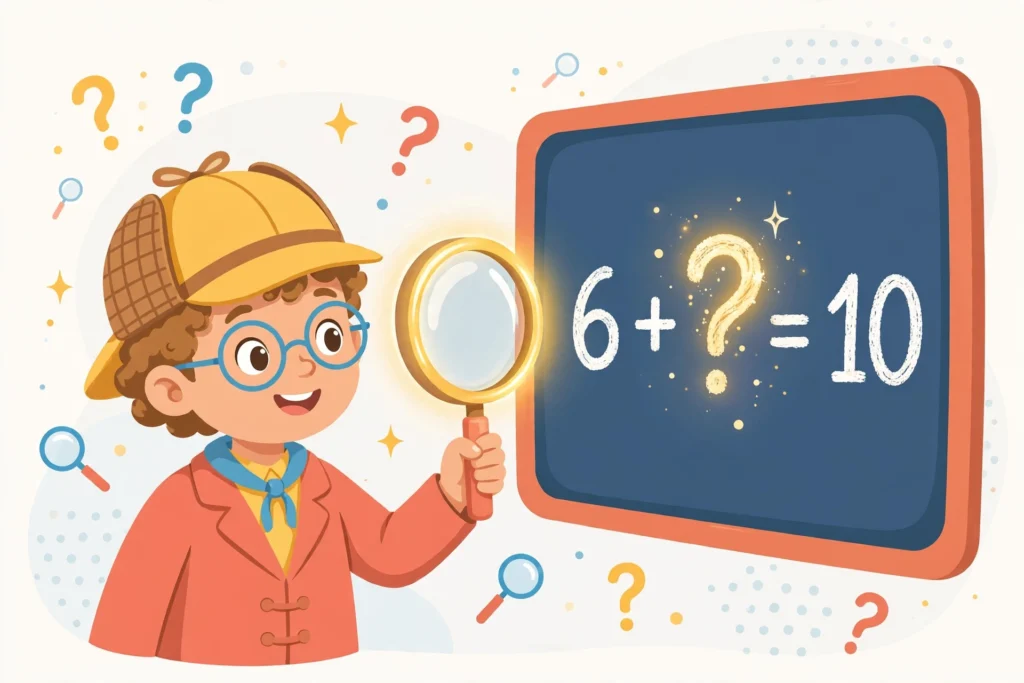
A missing addend is the unknown number in an addition problem, the piece that makes the equation true. In 6 + ? = 10, the missing addend is 4.
What Is a Missing Addend?
In any addition problem, the numbers being added are called addends, and the answer is called the sum. A missing addend is simply one of those addends hiding from view. It might show up as a blank line, an empty box, or a question mark.
Take 5 + ___ = 9. The 5 is an addend we can see. The 9 is the sum. The blank is the missing addend, and a quick check shows it must be 4, because 5 + 4 = 9.
Picture a first grade classroom on a Tuesday morning. The teacher writes 7 + ? = 12 on the board, covers the question mark with her hand, and asks, “Somebody is hiding in this number sentence. Who can find our missing number?” Hands shoot up. The room buzzes because the problem feels like a riddle, not a worksheet. That riddle feeling is exactly why missing addend problems work so well with young learners.
Here is how the parts line up in a few sample problems:
| Equation | Known addend | Sum | Missing addend |
|---|---|---|---|
| 3 + ? = 8 | 3 | 8 | 5 |
| ? + 6 = 11 | 6 | 11 | 5 |
| 9 + ? = 17 | 9 | 17 | 8 |
How Do You Find a Missing Addend?
There are two favorite strategies in early elementary classrooms. Both lead to the same answer, so kids can pick the one that clicks for them.
Strategy 1: Count On
Start at the addend you know and count up until you reach the sum. Keep track of how many jumps you took. That jump count is the missing addend.
For 6 + ? = 10, plant your finger on 6. Then count: 7 (one), 8 (two), 9 (three), 10 (four). Four jumps means the missing addend is 4. A number line or a row of counters makes the jumps easy to see.
Strategy 2: Subtract
Take the sum and subtract the addend you already know. For 6 + ? = 10, work out 10 − 6 = 4. The missing addend is 4. This shortcut works every time because addition and subtraction undo each other.
Many teachers start with counting on in first grade, then introduce the subtraction shortcut once subtraction facts feel solid.
What Is the Link Between Missing Addends and Subtraction?
Finding a missing addend and subtracting are two sides of the same coin. The equation 4 + ? = 9 asks the same question as 9 − 4 = ?. Both want to know what joins with 4 to make 9.
This is where fact families enter the picture. A fact family is a set of related addition and subtraction facts that use the same three numbers. For 4, 5, and 9, the family looks like this:
- 4 + 5 = 9
- 5 + 4 = 9
- 9 − 4 = 5
- 9 − 5 = 4
When a child knows the whole family, a missing addend problem stops feeling scary. They spot the subtraction hiding inside 4 + ? = 9 and solve it in a snap.
Why Do Missing Addends Matter?
Missing addend problems are a gentle first step into algebra. Long before students meet the letter x, they meet a blank box that stands for an unknown. Learning to find that unknown teaches them to think about balance: both sides of the equals sign must match.
These problems also check true understanding. A child can memorize that 7 + 8 = 15 and still freeze at 7 + ? = 15. The second version asks whether the child understands how addition works, not just the answer to one memorized fact.
Did You Know: the question mark in a missing addend problem does the same job that the letter x does in algebra class. When a first grader solves 8 + ? = 14, they are solving their first algebraic equation, years before the word algebra ever comes up in school.
When Do Kids Learn About Missing Addends?
Most children meet missing addends in first grade, once basic addition facts feel comfortable. The work continues through second grade, where the numbers grow into the teens and then into two-digit problems like 34 + ? = 52.
A good rule of thumb: if a child can add two small numbers with confidence, they are ready to try finding a missing piece. Start with sums under 10, then stretch to sums of 20, and then move beyond.
At home, missing addends hide in everyday moments. “We need 10 grapes for the fruit salad and we have 6. How many more do we need?” That is 6 + ? = 10 wearing a snack-time disguise.
Try It: The Mystery Number Detective

Turn your kitchen table into a detective agency with this partner game.
- Cut ten small cards from paper. On each card, write an addition equation with one addend covered by a sticky note, such as 5 + [covered] = 9.
- One player is the detective. The other reads the equation aloud: “Five plus mystery number equals nine.”
- The detective finds the missing addend by counting on or by subtracting, then peels back the sticky note to check the answer.
- Trade roles after five cards.
For an extra challenge, use two-digit sums like 27 + ? = 35, or let the detective hide the sum instead: 8 + 5 = ?.
Quick Practice
Question: There are 8 crayons in the art box. Mia drops in some more crayons. Now the box holds 13 crayons. How many crayons did Mia add?
Worked answer: Write the story as 8 + ? = 13. Count on from 8: 9, 10, 11, 12, 13. That is 5 jumps, so the missing addend is 5. Check with subtraction: 13 − 8 = 5. Mia added 5 crayons.
Related Terms
Frequently Asked Questions
Is finding a missing addend the same as subtraction?
They are closely linked but not identical. Finding a missing addend means solving an addition equation with an unknown part, such as 6 + ? = 10. Subtraction is one strategy for solving it, since 10 − 6 = 4 gives the same answer.
What does the empty box mean in a math problem?
The empty box is a placeholder for the unknown number. It works like a question mark or a blank line. Its job is to ask, “What number belongs here to make this equation true?”
Can a problem have two missing addends?
In early elementary math, no. Problems like ? + ? = 10 have many possible answers, such as 1 + 9 or 2 + 8, which makes them puzzles rather than single-answer problems. Teachers save those open puzzles for later grades.
My child keeps guessing. How can I help?
Guessing usually means the child needs a concrete strategy. Hand them counters or draw a number line, and practice counting on together: start at the known addend and count the jumps to the sum. Once the jumps make sense, the guessing fades.
Reading about it is one thing, practising it is another. Our free What Is Addition? lesson builds the idea step by step, with slides, a printable worksheet and a full answer key.
Members unlock every lesson in the library, including the full Fractions, Multiplication, Place Value, Addition & Subtraction, Time & Money and Geometry & Shapes units. See the full library


