
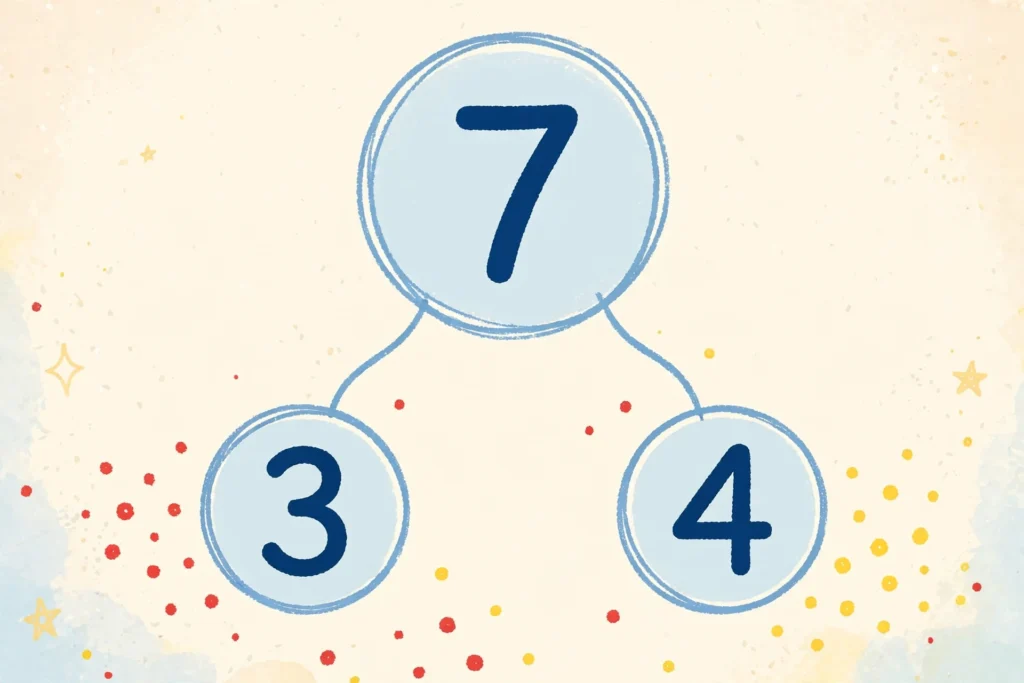
A number bond is a picture that shows how a whole number is built from two smaller parts joined together.
What Is a Number Bond?
Picture three circles connected by lines. The top circle holds one number, called the whole. The two circles below it hold two smaller numbers, called the parts. Together, the parts add up to the whole. That simple picture is a number bond.
For example, a number bond for 7 might show 7 in the top circle, 3 in one part circle, and 4 in the other part circle. Because 3 + 4 = 7, the bond is complete. The same whole can wear many different outfits. The number 7 can also be bonded as 5 and 2, as 6 and 1, or as 0 and 7.
Last spring I watched a first grade teacher, Ms. Patel, tape a giant number bond to her whiteboard on the first day of her addition unit. She put 10 at the top and left the two part circles empty. Then she let her students race to the board with dry erase markers and fill in pairs: 9 and 1, 8 and 2, 7 and 3. The kids cheered for every pair that made 10. By the end of the week, that diagram had become the class mascot. The students had learned the bonds of 10 without a single worksheet.
Why Are Number Bonds Useful in Addition?
Number bonds turn slow counting into fast thinking. When a child knows that 8 and 2 make 10, she can use that bond to solve 8 + 7 without counting on her fingers. She splits the 7 into 2 and 5, gives the 8 its partner to make 10, and adds the leftover 5. So 8 + 7 becomes 10 + 5, which is 15. Teachers call this strategy making ten, and it rests on number bonds.
Number bonds also teach children that numbers are flexible. The number 12 is not only 10 and 2. It is also 9 and 3, 8 and 4, 7 and 5, and 6 and 6. A student who sees all those options can choose the pair that makes a problem easiest. That habit, breaking numbers apart and rebuilding them, is the heart of mental math in the later grades.
What Are the Number Bonds of 10?
The number bonds of 10 are the pairs of whole numbers that add to 10. They are:
- 10 and 0
- 9 and 1
- 8 and 2
- 7 and 3
- 6 and 4
- 5 and 5
The bonds of 10 get special treatment in early math because our number system is built on tens. A kindergarten class usually masters the bonds of 5 first. First graders work toward the bonds of 10. Second graders stretch to the bonds of 20. Each step builds on the one before it, so a child who owns the bonds of 10 has a head start on adding two-digit numbers later on.
Did You Know: many teachers call the number bonds of 10 the most valuable math facts in elementary school. Once a child recalls them automatically, strategies like making ten, adding near doubles, and bridging through ten all become easy.
How Do Number Bonds Help with Subtraction?
A number bond works in reverse, too. If a child knows that 6 and 4 bond to make 10, she also knows that 10 take away 6 leaves 4, and 10 take away 4 leaves 6. One bond carries three facts: the addition fact and both subtraction facts. That is why number bonds are close cousins of fact families. The bond is the picture, and the fact family is the set of number sentences the picture describes.
Try this with a student. Draw a bond with 9 on top, 2 in one part circle, and a blank in the other. Ask for the missing part. Then ask a follow up: what subtraction problem does this bond answer? A child who can travel both directions on a number bond is ready for missing addend problems and early algebra thinking.
Try It: Build a Bond of 10
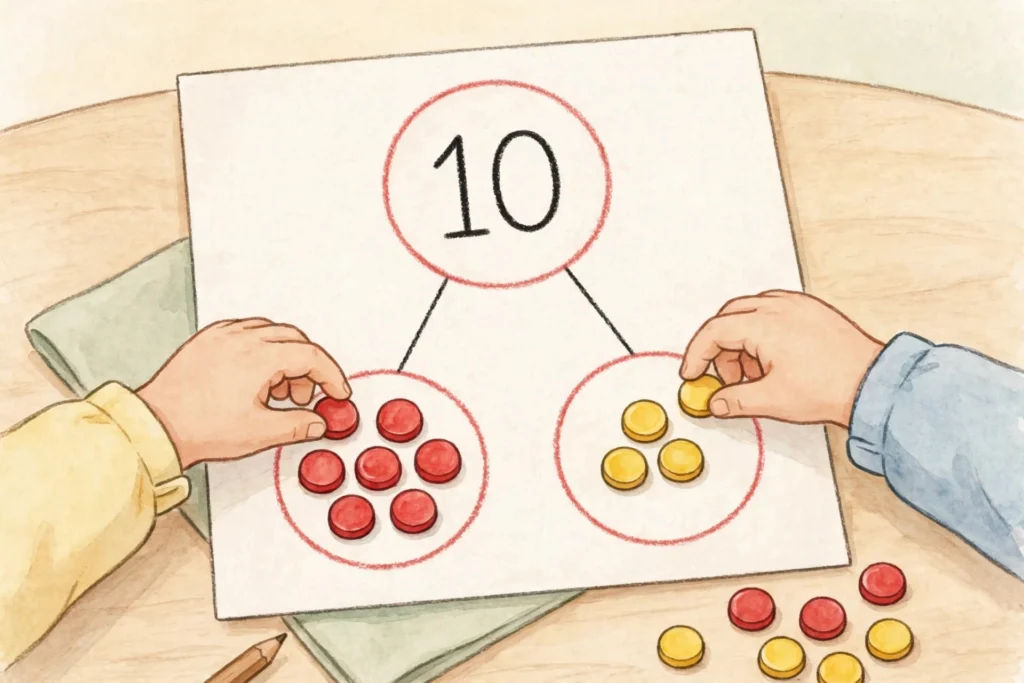
You need: 10 two-color counters (or 10 red and yellow paper dots), a paper plate, and a marker. Draw one big circle on the plate and write 10 inside it. Draw two smaller circles under it, connected to the big circle with lines. Those are your part circles.
Now shake all 10 counters in your hands and drop them on the table. Count the red ones and place them in one part circle. Count the yellow ones and place them in the other. Write the numbers you see under each circle. You just built a number bond of 10.
Shake and drop again. Do you get a new pair? Keep a list of every pair you find. See if you can collect all six bonds of 10. For an extra challenge, try the same game with 12 counters and a whole of 12. How many different pairs can your class find?
Quick Practice
Question: A number bond shows 15 as the whole. One part circle shows 9. What is the missing part?
Worked answer: 6. The parts must add up to the whole, and 9 + 6 = 15. You can check with subtraction too: 15 minus 9 leaves 6. So the missing part is 6, and the bond reads 9 and 6 make 15.
Related Terms
Frequently Asked Questions
What is the difference between a number bond and a fact family?
A number bond is the picture: a whole circle joined to two part circles. A fact family is the set of number sentences that the bond describes, such as 6 + 4 = 10, 4 + 6 = 10, 10 minus 6 = 4, and 10 minus 4 = 6. One bond can produce a whole fact family.
When do students learn number bonds?
Kindergarteners usually start with the bonds of 5. First graders work on the bonds of 10 and related subtraction facts within 20. Second graders extend the idea to bonds of 20 and use bonds to add and subtract two-digit numbers. The bond picture keeps showing up, just with bigger numbers.
Are number bonds the same as addition facts?
They are close, but not quite the same. An addition fact is a single number sentence like 3 + 4 = 7. A number bond shows the part-part-whole relationship behind that fact, and it also carries the matching subtraction facts. Think of the bond as the story and the fact as one sentence from it.
How can I help my child practice number bonds at home?
Use things you already have. Deal out 10 small snacks, like grapes, and ask your child to split them into two groups and name the pair. Play the shake-and-drop counter game from the activity above. Ask for missing parts during car rides: the whole is 8, one part is 5, what is the other part? Short daily practice beats one long session.
Every topic clicks faster with practice. Our Resource Library has free lesson packs with slides, printable worksheets and full answer keys, ready to download and teach.
Members unlock every lesson in the library, including the full Fractions, Multiplication, Place Value, Addition & Subtraction, Time & Money and Geometry & Shapes units. See the full library


