
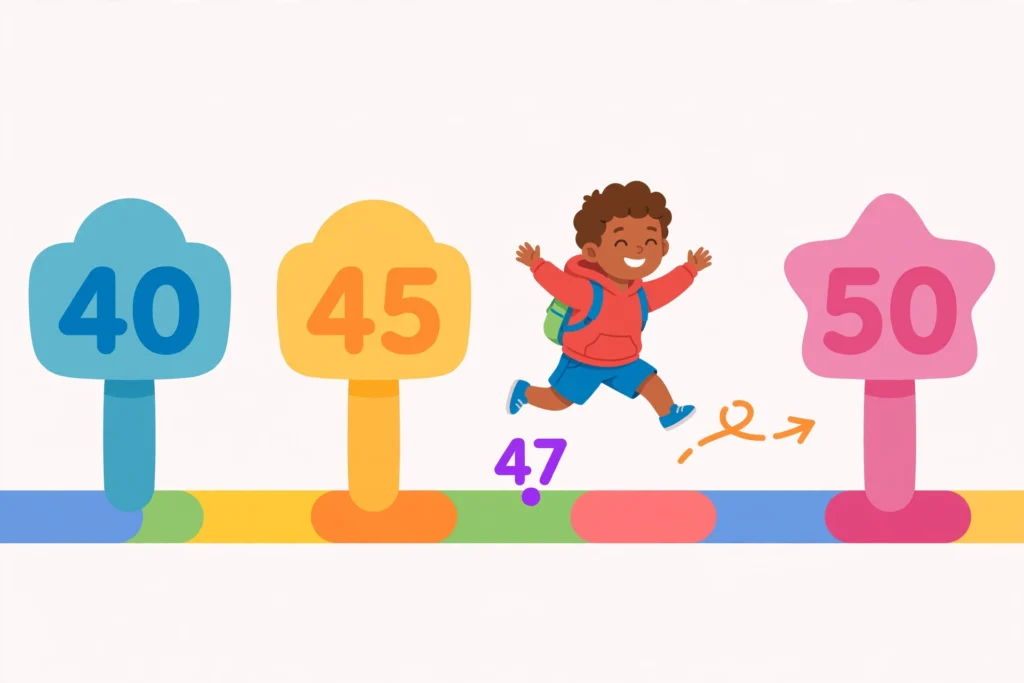
Rounding means changing a number to a simpler nearby value. The number 47 rounds to 50, and 43 rounds to 40.
How Do You Round to the Nearest Ten?
Rounding to the nearest ten is the first rounding skill most kids learn, and it follows a tidy three-step routine. Let us walk through it with the number 47.
Step one: find the rounding digit. When rounding to the nearest ten, that is the digit in the tens place. In 47, the rounding digit is 4.
Step two: peek at the digit to its right, the ones place. That neighbor decides everything. If it is 5 or greater, the rounding digit goes up by one. If it is 4 or less, the rounding digit stays put. In 47, the ones digit is 7, which is greater than 5, so the 4 becomes a 5.
Step three: turn every digit to the right of the rounding digit into a zero. The 7 becomes 0, and 47 becomes 50.
Try 43 for contrast. The rounding digit is 4, the deciding digit is 3, and 3 is less than 5, so the 4 stays a 4. Change the 3 to 0 and you get 40. A quick number line check confirms it: 43 sits closer to 40 than to 50.
Common Mistake: peeking at the wrong digit. When rounding 47 to the nearest ten, some kids stare at the 4 in the tens place and freeze, because 4 is less than 5. The rule looks at the digit to the right of the rounding place, which is the 7. Always ask, “Which place am I rounding to?” first, then look one spot to the right.
What Happens When the Digit Is 5?
Five sits exactly in the middle, so it needs its own rule. In elementary math, the convention is simple: 5 rounds up. The number 45 rounds to 50, 65 rounds to 70, and 135 rounds to 140 when rounding to the nearest ten.
Why up and not down? Picture 45 on a number line between 40 and 50. It sits dead center, exactly five away from each side. Mathematicians needed one consistent tiebreaker, and “round half up” became the classroom standard. Every student rounding the same way keeps answers consistent.
A memory trick many teachers share: “Five or more, raise the score. Four or less, let it rest.” Chant it a few times and the rule sticks.
How Do You Round to the Nearest Hundred?
The same three steps work, just one place bigger. To round 472 to the nearest hundred, find the rounding digit in the hundreds place: 4. Peek right at the tens digit: 7. Seven is greater than 5, so the 4 rounds up to 5. Zero out the rest: 472 becomes 500.
Try 438. The hundreds digit is 4, the deciding tens digit is 3, and 3 is less than 5, so the 4 stays. The answer is 400. On a number line, 438 clearly hugs 400 more closely than 500.
Notice the pattern: rounding to the nearest ten cares about the ones digit, and rounding to the nearest hundred cares about the tens digit. It is always the neighbor one place to the right doing the deciding.
| Number | Round to | Deciding digit | Result |
|---|---|---|---|
| 67 | nearest ten | 7 (ones) | 70 |
| 34 | nearest ten | 4 (ones) | 30 |
| 756 | nearest hundred | 5 (tens) | 800 |
| 721 | nearest hundred | 2 (tens) | 700 |
How Does a Number Line Help With Rounding?
A number line turns rounding from a memorized rule into something kids can see. Mark 40 and 50 on the line, find the midpoint at 45, then plot the number in question. If the dot lands left of 45, it rounds down to 40. Right of 45, it rounds up to 50. Land exactly on 45 and the “five rounds up” rule sends it to 50.
This visual approach rescues kids who mix up the digit rules. Even if they forget whether 7 means up or down, they can see that 47 sits nearer to 50. The number line is the reason behind the rule, not just a decoration for it.
Teachers often start every rounding unit on the number line and only later move to the digit shortcut.
Why Do We Round Numbers in Real Life?
Nobody needs exact change math while rushing through a grocery store. If apples cost $3 and bread costs $4, a shopper rounds and thinks “$3 plus $4 is about $7” without reaching for a calculator. Rounding powers quick estimates everywhere: guessing travel time, checking whether allowance covers a toy, or deciding if a recipe needs doubling.
Rounding also keeps numbers readable. A news report that says “about 2,500 people attended” is kinder to the brain than “2,483 people attended.”
Estimating sums is where classroom rounding meets the real world. Before solving 48 + 31 exactly, a student might round to 50 + 30 = 80. If their exact answer comes out as 79, the estimate confirms they are on track. If it comes out as 790, the estimate waves a red flag.
Try It: The Number Line Hop

All you need is painter’s tape, index cards, and a hallway or living room floor.
- Lay a long strip of tape on the floor and mark tens from 0 to 100, spacing them like giant steps.
- Write numbers like 23, 47, 55, and 81 on index cards and hand them out.
- Each player places their card where it belongs on the line, then physically hops to the nearest ten, counting the hops aloud.
- Ask the group to call out the rounded number together before the next player goes.
For the 5-rule moment, place 55 on the line and let kids see it sitting exactly between 50 and 60. Then chant the class rhyme: “Five or more, raise the score.” The hop to 60 will feel like the obvious choice.
Quick Practice
Question: Round 63 to the nearest ten.
Worked answer: The rounding digit is 6 (tens place). The deciding digit is 3 (ones place). Since 3 is less than 5, the 6 stays put and the 3 becomes 0. The answer is 60. On a number line, 63 sits between 60 and 70, closer to 60.
Related Terms
Frequently Asked Questions
What does “round up” mean?
Rounding up means moving to the next higher ten, hundred, or thousand. When 47 rounds to 50, it rounded up. When 43 rounds to 40, it rounded down. The deciding digit tells you which direction to go.
What is the rule when the digit is exactly 5?
Round up. This is the standard convention taught in elementary school: 45 becomes 50, 75 becomes 80, and 150 becomes 200 when rounding to the nearest ten or hundred. It keeps every classroom consistent.
Can you round to the nearest hundred or thousand?
Yes. The steps never change. Find the rounding digit, check the digit one place to the right, then zero out everything after. Rounding 4,731 to the nearest thousand gives 5,000, because the hundreds digit is 7.
When do kids learn rounding?
Rounding to the nearest ten and hundred is typically a third grade skill, with rounding to larger places and decimals arriving in fourth and fifth grade. Number lines and estimation games make the concept click early.
Reading about it is one thing, practising it is another. Our free What Is Place Value? lesson builds the idea step by step, with slides, a printable worksheet and a full answer key.
Members unlock every lesson in the library, including the full Fractions, Multiplication, Place Value, Addition & Subtraction, Time & Money and Geometry & Shapes units. See the full library


