
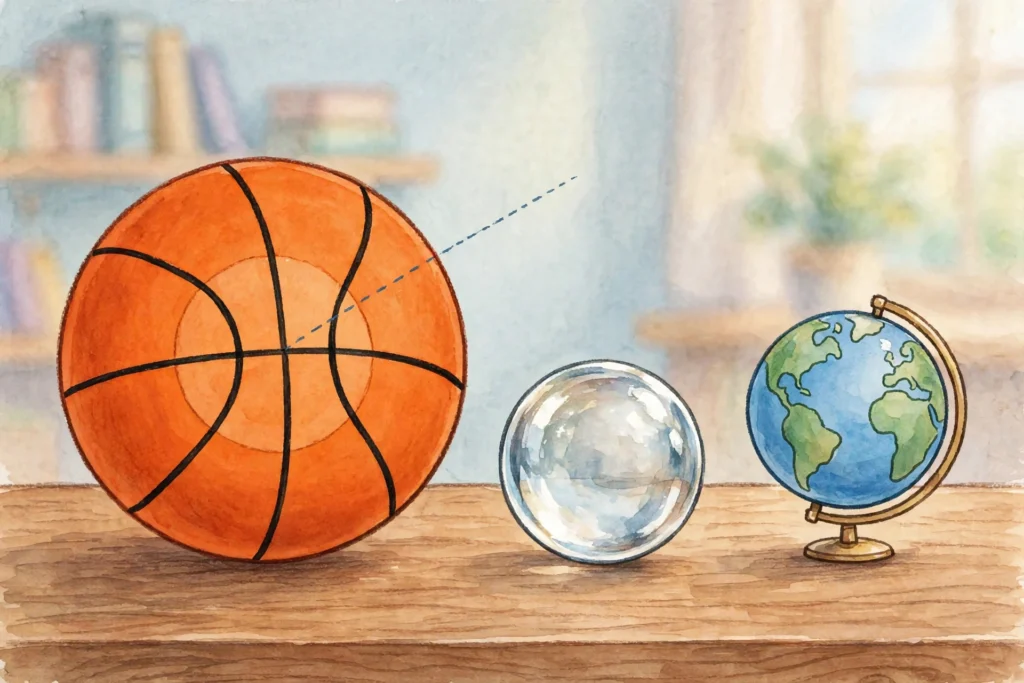
A warm, kid-friendly illustration showing a basketball, a glass marble, and a small globe side by side on a wooden table, with a dotted line from the center of the basketball to its surface to show the radius.
A sphere is a perfectly round three-dimensional shape. Every point on its surface is the same distance from its center.
What Makes a Sphere Different From a Circle?
A circle is flat, like a drawing on paper or a ring on the floor. A sphere is solid and round in every direction, like a ball you can hold. If you draw a circle and cut it out, you can slide it into an envelope. You cannot slide a basketball into an envelope, because a sphere takes up space in three directions: length, width, and height.
Here is a trick to tell them apart. Spin a circle on a table and it stays flat. Toss a sphere and it rolls. A circle is a 2D shape, which means it has only length and width. A sphere is a 3D shape, which means it has depth too.
The distance from the center of a sphere to any point on its surface has a special name: the radius. On a basketball the radius is about 4.8 inches. On a marble it might be half an inch. Big or small, that distance is the same all the way around.
Does a Sphere Have Faces, Edges, or Corners?
A sphere has one curved surface and zero flat faces, zero edges, and zero corners. Run your hand over a smooth ball and you will feel why. There is no flat spot to call a face, no line where two faces meet to call an edge, and no pointy corner anywhere.
Compare that with a cube, like a dice: 6 flat faces, 12 edges, and 8 corners. A pyramid has flat triangular faces that meet at a point. The sphere is the odd one out in the 3D shape family, all curve and no corners.
This is why a sphere rolls so well. A cube thumps and tips as it turns over its edges, but a sphere glides because every point on its surface is the same distance from the center.
| Part of the sphere | How many? |
|---|---|
| Flat faces | 0 |
| Curved surfaces | 1 |
| Edges | 0 |
| Corners (vertices) | 0 |
Where Can You Find Spheres in Real Life?
Spheres are everywhere once you start looking. Sports are full of them: basketballs, soccer balls, tennis balls, baseballs, and bowling balls are all spheres. In the kitchen you can find oranges, peas, grapes, and scoops of ice cream. A marble collection is a whole box of tiny glass spheres.
Look up and you will find the biggest spheres of all. The Earth is almost a perfect sphere, and so are the Moon and the Sun. They look like flat circles in the sky, but they are giant balls of rock and hot gas. Raindrops start out nearly spherical, and soap bubbles are some of the most perfect spheres in nature.
Did You Know: The Earth is not a perfect sphere. It bulges a little at the equator because it spins, so scientists call its shape an “oblate spheroid.” For math class, though, treating the Earth as a sphere works just fine.
Look around any playground and geometry is already there. Every ball a child kicks is a sphere lesson waiting to happen.
A Grade 2 teacher, on real life maths
How Can You Tell a Sphere From Other 3D Shapes?
Use the roll test. Place the object on a table and give it a gentle push. If it rolls smoothly in any direction, it is probably a sphere. A cylinder, like a soup can, rolls too, but only in one direction, and it has two flat circular faces. A cone rolls in a circle and has a pointy tip. Only the sphere rolls freely every way you push it.
Next, count the flat faces. A cube has 6, a rectangular prism has 6, and a pyramid has flat faces plus a point. A sphere has none. If your object has no flat spots at all, that is strong evidence you are holding a sphere.
Finally, turn the object and look at it from different sides. A sphere always looks like a circle, no matter how you turn it.
Try It: Roll Test to Find Spheres Around You
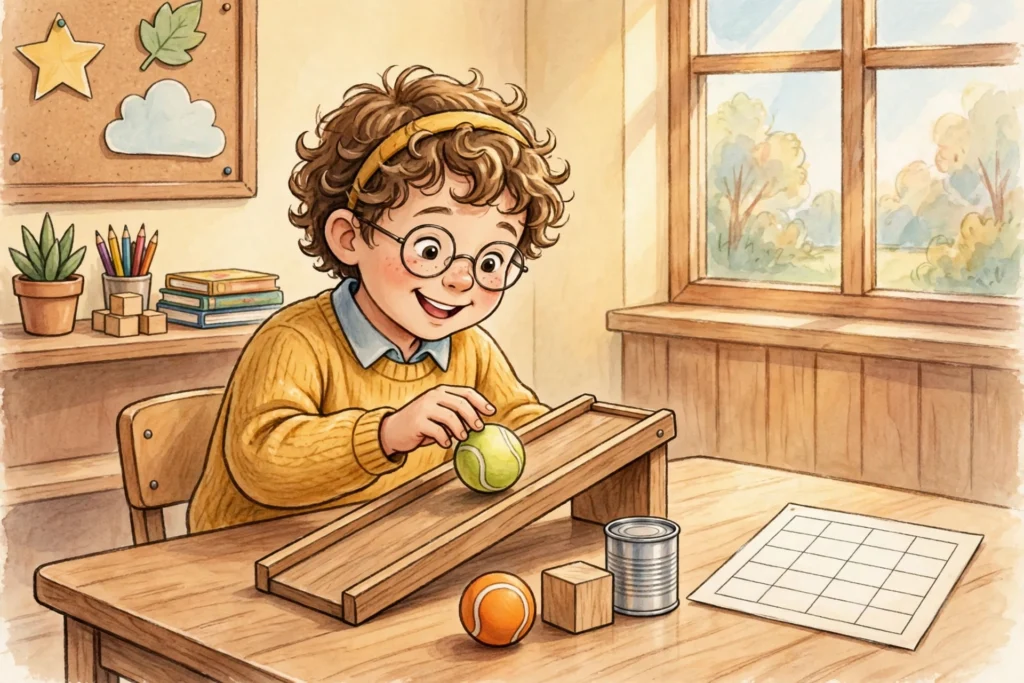
A cheerful classroom illustration of a child at a table with a small ramp, rolling a tennis ball, an orange, a wooden cube, and a soup can, with a chart nearby to record which objects rolled.
Collect a mix of objects: a ball, an orange, a marble, a wooden block, a soup can, a party hat (a cone), and a small box. Build a gentle ramp from a book and a cutting board, or just use a smooth tabletop.
Make a simple chart with two columns: “Rolls smoothly every way” and “Does not.” Roll each object and record what happens. The ball, the orange, and the marble should glide every direction you push them. The block will slide or thump. The soup can rolls only sideways. The party hat wobbles in a circle.
Now sort your objects into spheres and not spheres, and talk about what the spheres have in common: no flat faces, no edges, and no corners.
Quick Practice
Maya has four objects: a tennis ball, a dice, a soup can, and a marble. Which ones are spheres?
Answer: The tennis ball and the marble are spheres, because they are perfectly round with no flat faces, edges, or corners. The dice is a cube with 6 flat faces, and the soup can is a cylinder with 2 flat circular faces, so neither one is a sphere.
A ball has a radius of 6 units. What is its diameter?
Answer: 12 units. The diameter is always twice the radius, and 6 × 2 = 12.
Which of these is a sphere: a soup can, a marble, or a book?
Answer: The marble. It is round in every direction. The can is a cylinder, and the book is shaped like a rectangular prism.
Radius and Diameter of a Sphere
Every sphere has a center. The radius is the distance from the center to any point on the surface. The diameter is the distance straight across the sphere, passing through the center. The diameter is always twice the radius.
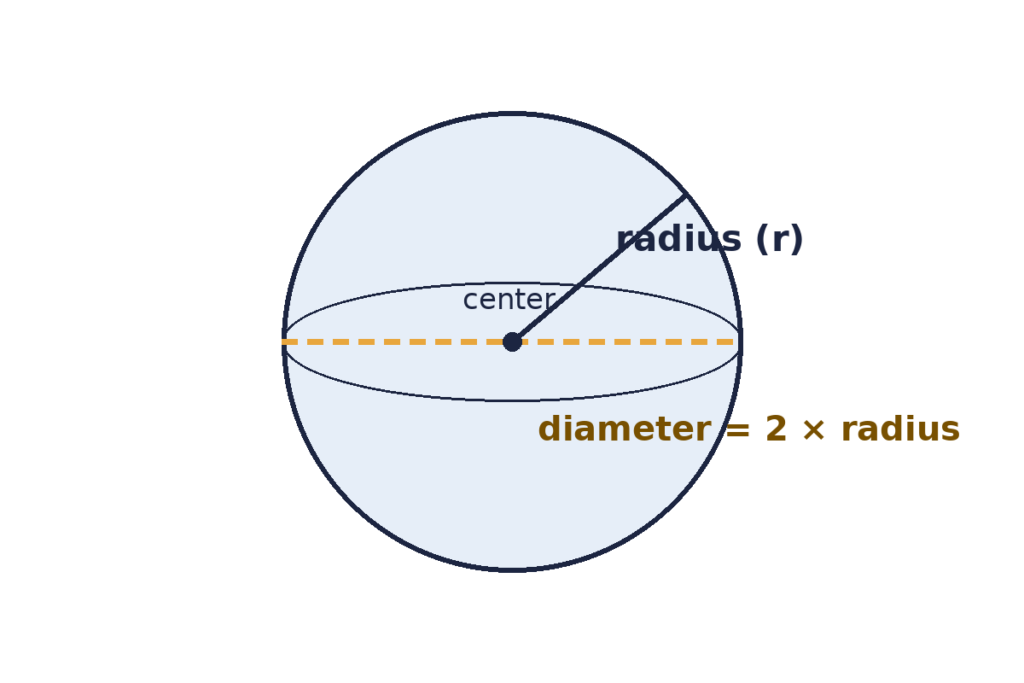
So if a ball has a radius of 4 units, its diameter is 4 × 2 = 8 units. A bigger radius always means a bigger sphere.
What Is the Volume of a Sphere?
In later grades, students learn how much space a sphere holds. This amount is called its volume. The formula is V = 4/3 × π × r³. The letter r stands for the radius, and the small 3 means the radius is multiplied by itself three times.
Try it with a ball that has a radius of 3 units. First work out 3 × 3 × 3 = 27. Then 4/3 × 27 = 36. So the volume is 36 × π, which is about 113.1 cubic units. The Volume page shows how volume works for other shapes too.
What Is the Surface Area of a Sphere?
Older students also learn how much surface a sphere has. This is called its surface area. The formula is A = 4 × π × r². The small 2 means the radius is multiplied by itself, r × r.
Try it with a sphere that has a radius of 5 units. First work out 5 × 5 = 25. Then 4 × 25 = 100. So the surface area is 100 × π, which is about 314.2 square units. Volume tells you the space inside. Surface area tells you the skin that covers it.
What Is a Hemisphere?
Cut a sphere in half and each half is called a hemisphere. Half an orange is a hemisphere, and a dome tent has the same shape. A hemisphere has one flat circular face and one curved surface. The equator splits the Earth into two hemispheres, the Northern Hemisphere and the Southern Hemisphere.
Can You Make a Net of a Sphere?
Most 3D shapes can be unfolded into a flat pattern called a net. A sphere cannot. Its surface curves in every direction, so there are no flat pieces to unfold.
Try this at home. Peel an orange in one piece, then try to lay the peel flat on the table. It tears or folds, because a curved surface does not lie flat. That is also why maps of the Earth stretch some places. The land sits on a sphere, and the map is flat.
A ball teaches geometry the moment a child picks it up. Rolling it, sorting it and peeling an orange teach what a flat picture cannot.
A Grade 3 teacher, on teaching 3D shapes
Teaching Spheres in Class: Three Quick Activities
Teachers, these three short activities help a class feel what makes a sphere special. Each one takes
Sort and roll. Put balls, cans and boxes on one tray. Children sort them into shapes that roll, shapes that slide and shapes that stack. Every sphere lands in the roll group, and the class talks about why.
Trace the face. Children trace around each 3D shape on paper. A sphere always gives a circle. A cube gives a square, and a cylinder can give a circle or a rectangle. The sphere is the only one that can never draw a flat side.
Peel and talk. Do the orange peel test from the net section above. Then ask: if a round peel cannot lie flat, what happens when we draw the round Earth on flat paper? The talk that follows is the real lesson.
Children remember the shapes they have held in their hands long after they forget the ones they only saw on a page.
A Kindergarten teacher, on hands-on learning
Related Terms
Frequently Asked Questions
Is a ball the same as a sphere?
In math class, yes. A ball is the everyday word and a sphere is the math word for the same perfectly round shape. Scientists sometimes use “sphere” for just the surface and “ball” for the solid inside, but in elementary math the two words mean the same thing.
Can a sphere be flat on one side?
No. If it is flat on one side, it is not a sphere anymore. Half a sphere has its own name: a hemisphere. Think of half an orange or a dome tent. A true sphere is round all the way around with no flat spots.
What is the radius of a sphere?
The radius is the distance from the center of the sphere to any point on its surface. Because a sphere is perfectly round, the radius is the same in every direction. If you cut a sphere in half, the radius is half the width of the cut circle.
How many faces does a sphere have?
A sphere has one curved surface and zero flat faces. Some math books say it has one face, meaning the curved surface, and some say it has no faces at all. Either way, the key fact is the same: there are no flat faces, no edges, and no corners.
What grade learns about spheres?
Students usually meet spheres in second grade when they sort 3D shapes, and the ideas grow in third and fourth grade with faces, edges, and vertices. Spheres pop up again in middle school with volume and surface area formulas.
Reading about it is one thing, practising it is another. Our free What Are 2D Shapes? lesson builds the idea step by step, with slides, a printable worksheet and a full answer key.
Members unlock every lesson in the library, including the full Fractions, Multiplication, Place Value, Addition & Subtraction, Time & Money and Geometry & Shapes units. See the full library


