

Subtraction is the math operation we use to take away, find what is left, or figure out the difference between two numbers. The minus sign, a short dash like this, -, is the symbol that tells us to subtract.
What Does Subtraction Mean for Kids?
Subtraction answers one question kids ask all the time: how many are left? Picture a plate with 7 cookies. A child eats 2 of them. Now the plate holds 5 cookies. That whole scene is a subtraction story, and we can write it as a number sentence: 7 – 2 = 5.
But taking away is only one face of subtraction. Sometimes subtraction is about comparing. If Mia has 9 stickers and Sam has 4, subtraction tells us how many more stickers Mia has: 9 – 4 = 5. Nobody took anything away. We just lined up two amounts and measured the gap between them.
Teachers introduce subtraction with real objects first. Kids line up 8 cubes, pull 3 away, and count what remains. Later they trade the cubes for drawings, crossing out the ones they remove. Only after the idea feels solid do they work with the bare numbers. That slow path, from objects to pictures to numbers, is how subtraction stops feeling like a mystery.
What Are the Parts of a Subtraction Problem?
Every subtraction problem has three players, and each one has a name. In 9 – 4 = 5, the 9 is the minuend, the number you start with. The 4 is the subtrahend, the amount you take away. The 5 is the difference, the answer that tells you what is left.
A classroom trick helps kids keep the order straight: the big number almost always comes first. In elementary math, you start with a pile and take from it, so the minuend sits in front of the minus sign. Say it like a story: “I had 9, I took away 4, I have 5 left.” The names minuend, subtrahend, and difference just give that story a math vocabulary.
Common Mistake: Flipping the numbers. A child sees 9 – 4 and writes 4 – 9, or counts 4 take away 9. Order matters in subtraction. The starting number, the minuend, always goes first, because you cannot take 9 cookies from a plate that holds only 4.
How Do Kids Learn to Subtract?
Most classrooms teach three strategies, and kids get to pick the one that clicks. The first is counting back. For 8 – 3, a child starts at 8 and counts back three steps: 7, 6, 5. Fingers work perfectly here, one finger folding down for each step back.
The second is the number line. Start at 8 on the line, hop left 3 spaces, and land on 5. Hopping left becomes the physical picture of “taking away,” and many kids find the landing spot easier to trust than counting in their heads.
The third is thinking addition, and it is a favorite. To solve 9 – 4, a child asks, “4 plus what makes 9?” and lands on 5. This works because subtraction is the inverse of addition. Fact families make the connection visible: 4 + 5 = 9, 5 + 4 = 9, 9 – 4 = 5, and 9 – 5 = 4 all belong together.
Is Subtraction the Opposite of Addition?
Yes. Subtraction undoes addition, which makes the two operations inverses. If you add 3 to 5 and get 8, subtracting 3 from 8 brings you right back to 5. Kids love testing this. A teacher will write 6 + 2 = 8 on the board, then ask the class to undo it. Hands fly up: 8 – 2 = 6.
This inverse link is more than a neat trick. It is how students check their work. After solving 12 – 5 = 7, a quick check adds it back: 5 + 7 = 12. If the addition lands on the starting number, the subtraction was right. That one habit catches more errors than any other.
One difference matters, though. Addition works in any order, but subtraction does not. 3 + 5 and 5 + 3 both equal 8, while 5 – 3 gives 2 and 3 – 5 is a different story entirely. So subtraction is the opposite of addition in what it does, but it plays by its own rules about order.
Try It: Cookie Take-Away
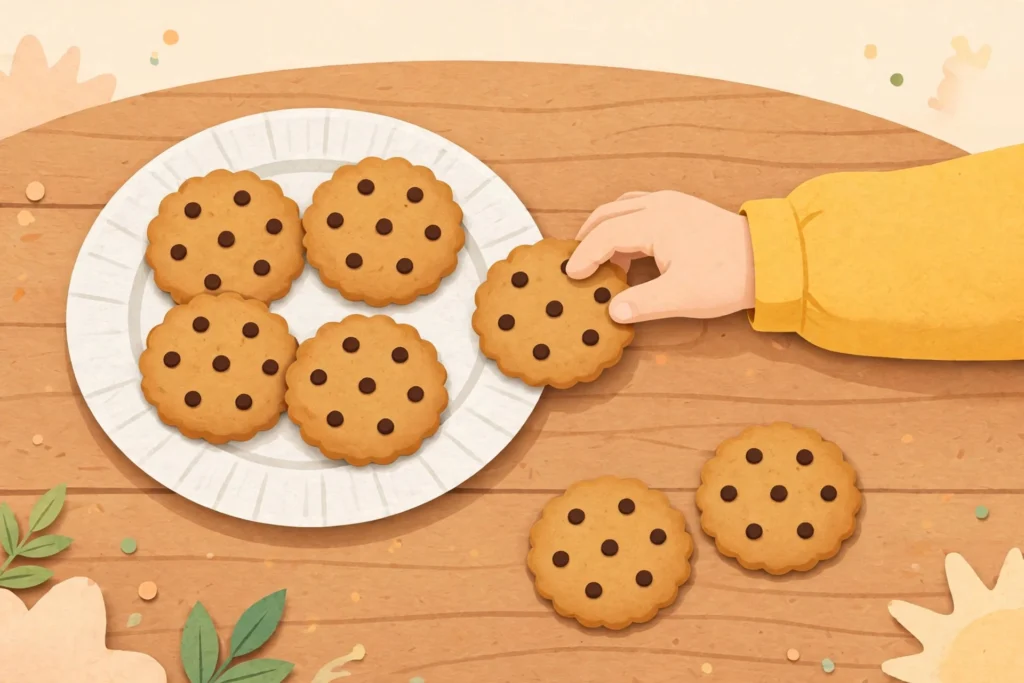
All you need is a paper plate and some paper cookies, real ones work too if snack time follows. This two-minute game makes subtraction physical.
- Place 8 paper cookies on the plate. Ask your child to count them and write the starting number: 8.
- Tell a short story: “You shared 3 cookies with a friend. Slide 3 cookies off the plate.”
- Ask: “How many are left?” Have them count the cookies still on the plate and finish the number sentence: 8 – 3 = 5.
- Switch roles. Let your child invent the story and the take-away number while you slide the cookies.
- Stretch it: start with 10 cookies and take away a bigger number, like 6. Count back to check the answer.
For a comparison round, put cookies on two plates, say 7 and 4, and ask how many more are on the fuller plate. That is subtraction as a difference.
Quick Practice
Question: There are 10 birds on a fence. 4 birds fly away. How many birds are left?
Worked answer: Start with 10, the minuend, and take away 4, the subtrahend. Count back from 10: 9, 8, 7, 6. The difference is 6, so 10 – 4 = 6 birds are left. Check with addition: 6 + 4 = 10.
Related Terms
Frequently Asked Questions
What is subtraction in simple words?
Subtraction is taking a number away from another number to find what is left. In 7 – 2 = 5, you take 2 away from 7 and 5 remain.
What is the answer to a subtraction problem called?
The answer is called the difference. In 10 – 6 = 4, the difference is 4.
What is an example of subtraction in real life?
Spending money is subtraction. If you have 10 dollars and spend 3, you subtract to find the 7 dollars left. Sharing snacks and counting down days work the same way.
When do kids learn subtraction?
Subtraction with objects starts in kindergarten. First and second grade build fluency within 10, then within 20, using strategies like counting back, number lines, and fact families.
Why is subtraction harder than addition for kids?
Order matters in subtraction, and the direction feels less natural. Counting back is trickier than counting forward, so kids need more practice with the strategies before facts become automatic.
Reading about it is one thing, practising it is another. Our free What Is Addition? lesson builds the idea step by step, with slides, a printable worksheet and a full answer key.
Members unlock every lesson in the library, including the full Fractions, Multiplication, Place Value, Addition & Subtraction, Time & Money and Geometry & Shapes units. See the full library


