
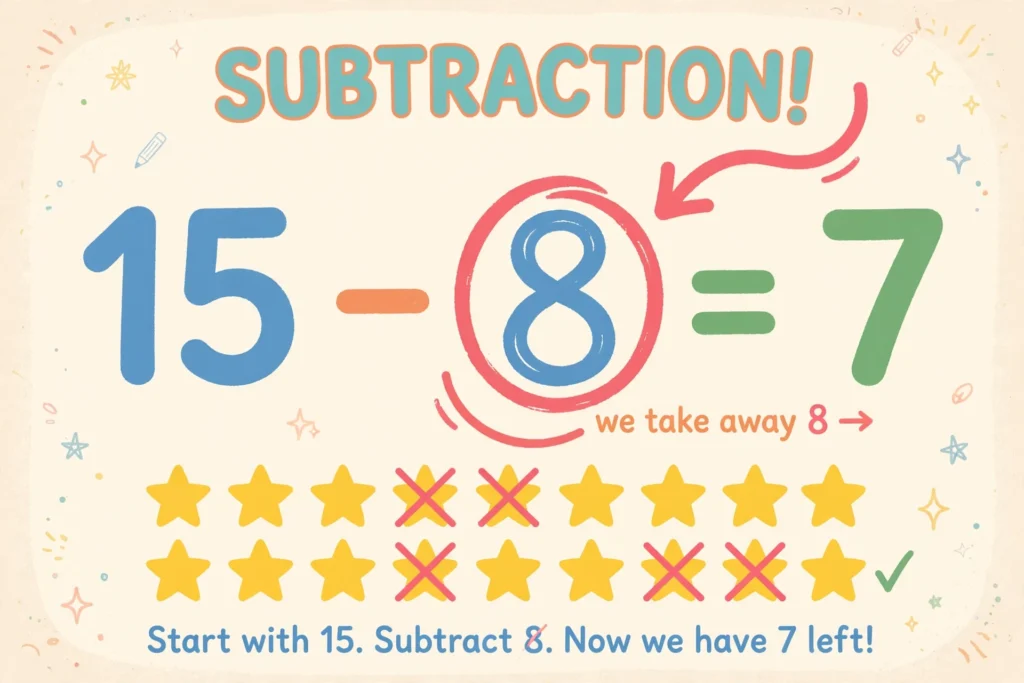
The subtrahend is the number being subtracted in a subtraction problem. In 8 – 5 = 3, the subtrahend is 5, because 5 is the amount taken away from 8.
How Do You Find the Subtrahend in a Problem?
Look for the number right after the minus sign. In 20 – 7 = 13, the subtrahend is 7. In 100 – 45 = 55, the subtrahend is 45. The spot after the minus sign always belongs to the subtrahend.
Try reading a subtraction sentence out loud with the names included. Take 12 – 4 = 8. Say: the minuend is 12, the subtrahend is 4, and the difference is 8. Hearing all three names in order helps them stick. Many students practice this the way they practice spelling words, one sentence at a time.
What Is the Difference Between the Minuend and the Subtrahend?
The minuend and the subtrahend have opposite jobs. The minuend is the starting number, the amount you begin with. The subtrahend is the amount you take away. The answer, called the difference, is what remains.
The full pattern looks like this:
Minuend – Subtrahend = Difference
Picture a pizza with 8 slices. You eat 3 slices. The 8 is the minuend because it is the starting amount. The 3 is the subtrahend because it is the amount taken away. The 5 slices left on the plate are the difference. Keep that pizza picture in mind and the names will rarely get mixed up.
Common Mistake: calling the answer the subtrahend. The subtrahend is the number taken away, and the answer is the difference. In 9 – 6 = 3, the subtrahend is 6 and the difference is 3.
Can the Subtrahend Be Bigger Than the Minuend?
In elementary subtraction, the subtrahend is usually smaller than the minuend, because you cannot take away more than you start with and still have a whole number left. That is why problems like 10 – 4 work so smoothly.
In later math, the rule bends. When students learn about negative numbers, a bigger subtrahend gives a negative difference. The problem 5 – 8 = -3 has a subtrahend of 8 that is larger than the minuend of 5. The minus sign in front of the answer shows the difference went below zero. So the short answer is: in grade-school subtraction the subtrahend is smaller, and in later math it can be larger.
What Happens When You Swap the Subtrahend and the Minuend?
You get a different answer, because subtraction is not commutative. Addition lets you swap numbers freely: 7 + 3 and 3 + 7 both equal 10. Subtraction does not work that way.
Compare 10 – 3 = 7 with 3 – 10 = -7. Swapping the minuend and the subtrahend changed the answer from 7 to -7. The order of the numbers is part of the problem itself. This is why teachers stress that the minuend comes first and the subtrahend comes second, every single time.
Why Does the Subtrahend Matter When You Regroup?
The subtrahend’s digits decide whether you need to regroup. Look at 52 – 27. In the ones column, you need to take 7 away from 2, which is not possible with whole numbers. That 7, sitting in the subtrahend, is what forces you to borrow 1 ten from the 5. After regrouping, the problem becomes 42 – 27 in the ones column, and 12 – 7 = 5.
Watch for this pattern when you practice. Before you start subtracting, scan the subtrahend’s digits. Any column where the bottom digit is bigger than the top digit will need a regroup. Spotting those columns first turns a tricky problem into a planned one.
Try It: Label the Parts of a Subtraction Sentence
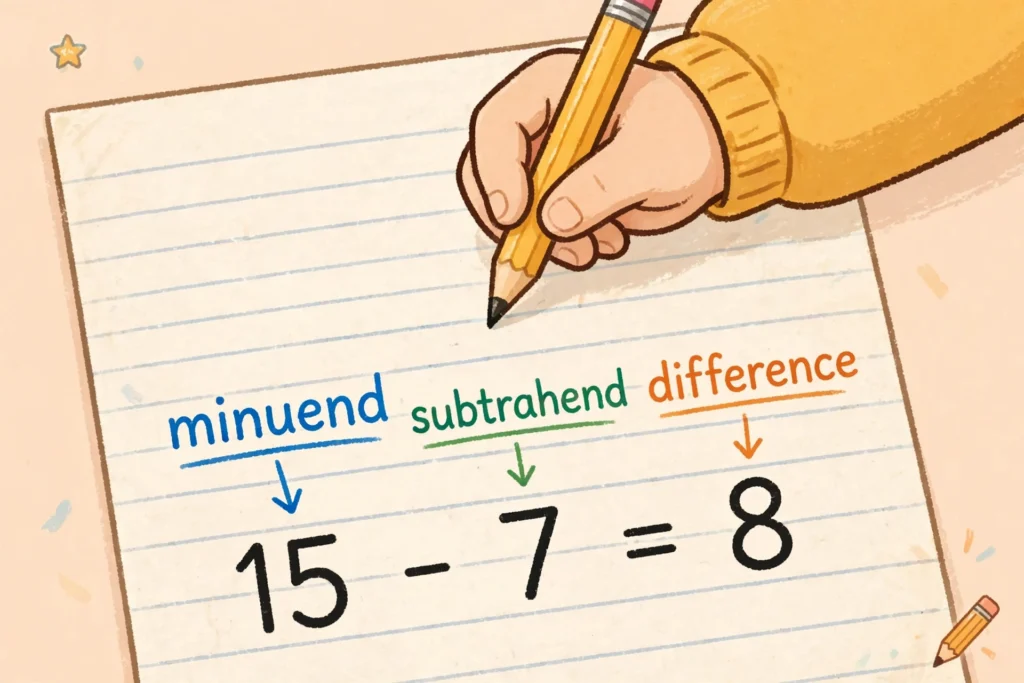
Write these subtraction sentences on a sheet of paper: 14 – 6 = 8, 25 – 9 = 16, and 30 – 12 = 18. Leave space above each number.
Above each starting number, write the word minuend. Above each number after the minus sign, write the word subtrahend. Above each answer, write the word difference. Use three different colors if you have them, one color per part.
Now make up three subtraction sentences of your own and label them the same way. Trade papers with a partner and check each other’s labels. If you both agree on every label, you know the parts cold.
Quick Practice
Question: In the subtraction sentence 42 – 17 = 25, name the minuend, the subtrahend, and the difference.
Answer: The minuend is 42, the starting number. The subtrahend is 17, the number being taken away. The difference is 25, the answer.
Related Terms
- Regrouping: The borrowing step you use when a subtrahend digit is bigger than the minuend digit above it.
- Fact Family: A group of related addition and subtraction facts, where the subtrahend in one fact becomes part of the sum in another.
- Zero Property: When the subtrahend is 0, the difference equals the minuend, as in 9 – 0 = 9.
Frequently Asked Questions
Is the subtrahend always the smaller number?
In elementary subtraction with whole numbers, yes. You start with the minuend and take away the subtrahend, so the subtrahend is smaller. Once you learn negative numbers, the subtrahend can be larger, and the difference becomes negative.
Where does the word subtrahend come from?
It comes from a Latin word that means to be taken away. The minuend comes from a Latin word that means to be lessened. Both names are centuries old, and both describe exactly what happens in the problem.
What is the answer to a subtraction problem called?
The answer is called the difference. It shows the difference, or the gap, between the starting number and the amount taken away. In 15 – 8 = 7, the difference is 7.
Can the subtrahend be zero?
Yes. If you take away nothing, nothing changes. In 9 – 0 = 9, the subtrahend is 0 and the difference equals the minuend. Any number minus zero is the number itself.
Every topic clicks faster with practice. Our Resource Library has free lesson packs with slides, printable worksheets and full answer keys, ready to download and teach.
Members unlock every lesson in the library, including the full Fractions, Multiplication, Place Value, Addition & Subtraction, Time & Money and Geometry & Shapes units. See the full library


