
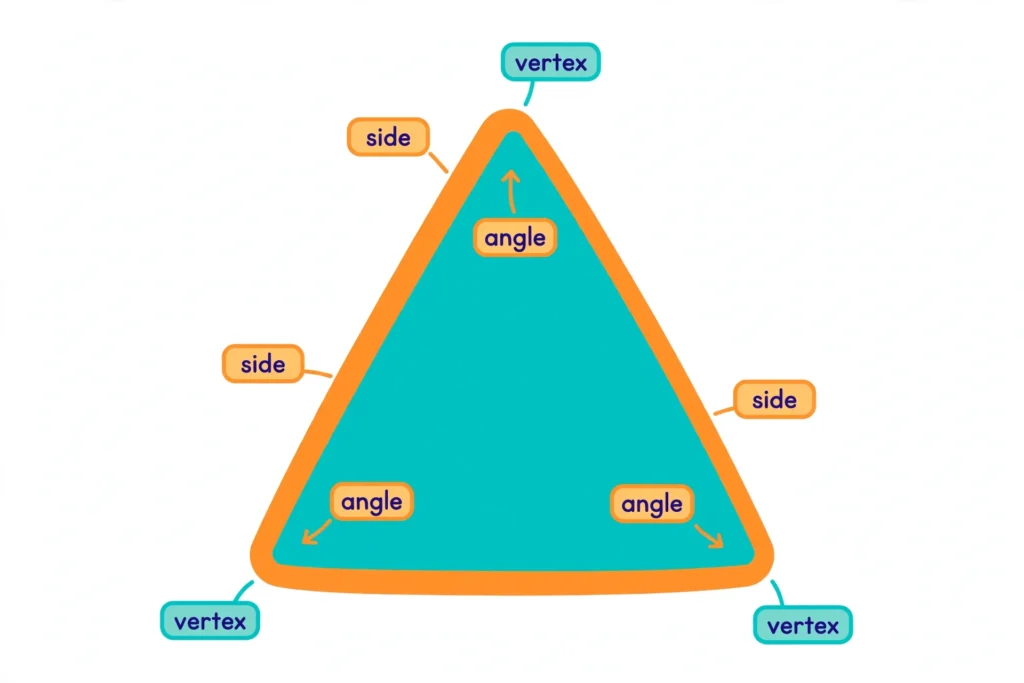
A bright classroom-style illustration of a triangle with labeled sides, vertices, and angles to introduce what a triangle is.
A triangle is a flat, closed shape made of three straight sides that meet at three corners.
Draw three straight lines on paper so they connect end to end. If they close up into a loop, you have made a triangle. This shape shows up everywhere: on a slice of pizza, on a yield sign, and on a sailboat sail. The word triangle even tells you what it is. Tri means three, and angle means corner. Three corners. Three sides. That is the whole secret.
What Are the Parts of a Triangle?
Every triangle has the same three parts, no matter how big or small it is, and no matter which way it points. Learning these parts helps you talk about triangles the way mathematicians do.
- Sides: the three straight line segments that form the border. Each side is straight. No curves allowed.
- Vertices: the three corners where two sides meet. One corner is a vertex, and more than one are vertices. Think of a vertex as the point where two sides shake hands.
- Angles: the three inside corners formed by the sides. Each angle measures how much the sides open up at a vertex.
Mrs. Alvarez, a second-grade teacher in Ohio, keeps a triangle poster by her door. She points to each corner during morning meeting and asks, “Side, vertex, or angle?” Her students tap the right word. After a week, even her quietest student called out the parts without thinking.
Here is a quick way to check your work. Every real triangle passes this test:
| Part | How many | What to check |
|---|---|---|
| Sides | 3 | All straight, all connected |
| Vertices | 3 | Corners where two sides meet |
| Angles | 3 | Inside corners between the sides |
What Are the Different Types of Triangles?
Triangles come in several kinds. You can sort them by their sides or by their angles. Most classroom sorting games use the side rule first because it is easy to see.
Types by sides
- Equilateral triangle: all three sides are the same length, like a perfectly even slice of pie.
- Isosceles triangle: two sides are the same length, like the two matching sides of a party hat.
- Scalene triangle: all three sides are different lengths. Nothing matches, and that is fine.
Types by angles
- Right triangle: one angle is exactly a right angle, a perfect corner like the corner of a book.
- Acute triangle: all three angles are smaller than a right angle. Sharp little points everywhere.
- Obtuse triangle: one angle is wider than a right angle, like a book opened a bit too far.
A triangle can belong to both lists at once. An isosceles right triangle has two matching sides and one right angle. Kids love catching these double members, and Mrs. Alvarez claps every time.
How Many Degrees Are in a Triangle?
Here is a fact that surprises many students. The three inside angles of any triangle always add up to 180 degrees. Always. Big triangle, small triangle, skinny triangle, tall triangle. The total never changes.
Want proof you can touch? Take a paper triangle and tear off its three corners. Push the torn corners together, point to point. They line up into one straight line, which measures 180 degrees. That is why the rule works.
So if a triangle has a 90-degree angle and a 45-degree angle, the third angle must be 45 degrees, because 90 + 45 + 45 = 180. Mathematicians lean on this rule all the time to find missing angles.
Did You Know: the word triangle comes from the Latin words tri (three) and angulus (corner). That same tri shows up in tricycle (three wheels) and tripod (three legs). Once you hear it, you start spotting tri everywhere.
Where Do We See Triangles in Real Life?
Triangles are nature’s and builders’ favorite shape because they are strong. Four-sided frames wobble when you push them, but a triangle holds its shape. That is why you see triangles in bridge supports, in bike frames, and in the roof of a house.
A quick kitchen hunt turns up even more. Cut a sandwich on the diagonal and you get two triangles. A tortilla chip is a triangle. Traffic signs use triangles too: the yield sign is an upside-down triangle that drivers can spot from far away.
Try It: The Triangle Shape Hunt

Illustration of the Triangle Shape Hunt activity showing a child with a magnifying glass spotting triangles on a worksheet.
Grab a piece of paper and draw three columns: Triangle, Not a Triangle, and Not Sure. Now walk around your classroom or home and look for shapes. A book corner folded? The letter A on a poster? A hanger in the closet? Check each shape against the triangle test: three straight sides, closed shape.
Here is the fun part. Draw a quick sketch of each find in the right column. When you spot something for the Not Sure column, bring it to the class. Talk it through together. A circle is a no, because it has no straight sides. A square is a no, because it has four sides. An open shape is a no, because a triangle must close. That debate is where the real learning happens.
After ten minutes, count your Triangle column. Most classes find eight to fifteen triangles hiding in plain sight. Circle your favorite and write one sentence about why it passed the test.
Quick Practice
A triangle has two angles. One measures 70 degrees and the other measures 50 degrees. What does the third angle measure? Show your work.
Worked answer: Start with what you know. The angles of a triangle add up to 180 degrees. Add the two known angles first: 70 + 50 = 120. Now subtract that from 180: 180 – 120 = 60. The third angle measures 60 degrees. You can double-check by adding all three: 70 + 50 + 60 = 180. It works.
Related Terms
Frequently Asked Questions
Is a circle a triangle?
No. A triangle must have three straight sides, and a circle has none. A circle also has no vertices, so it fails the triangle test twice.
Can a triangle have two right angles?
No. Two right angles already add up to 180 degrees, and a triangle needs three angles that add up to 180. There would be nothing left for the third angle, and the shape cannot close.
What is the difference between a triangle and a pyramid?
A triangle is flat, a 2D shape you can draw on paper. A pyramid is solid, a 3D shape with a triangle (or another polygon) base and triangular faces that meet at a point on top. You can pick up a pyramid. You can only trace a triangle.
How do you name a triangle?
Mathematicians name a triangle by its vertices. A triangle with corners A, B, and C is called triangle ABC, written with a small triangle symbol in front. You can list the letters in any order, so triangle ABC and triangle BCA are the same shape.
Reading about it is one thing, practising it is another. Our free What Are 2D Shapes? lesson builds the idea step by step, with slides, a printable worksheet and a full answer key.
Members unlock every lesson in the library, including the full Fractions, Multiplication, Place Value, Addition & Subtraction, Time & Money and Geometry & Shapes units. See the full library


