
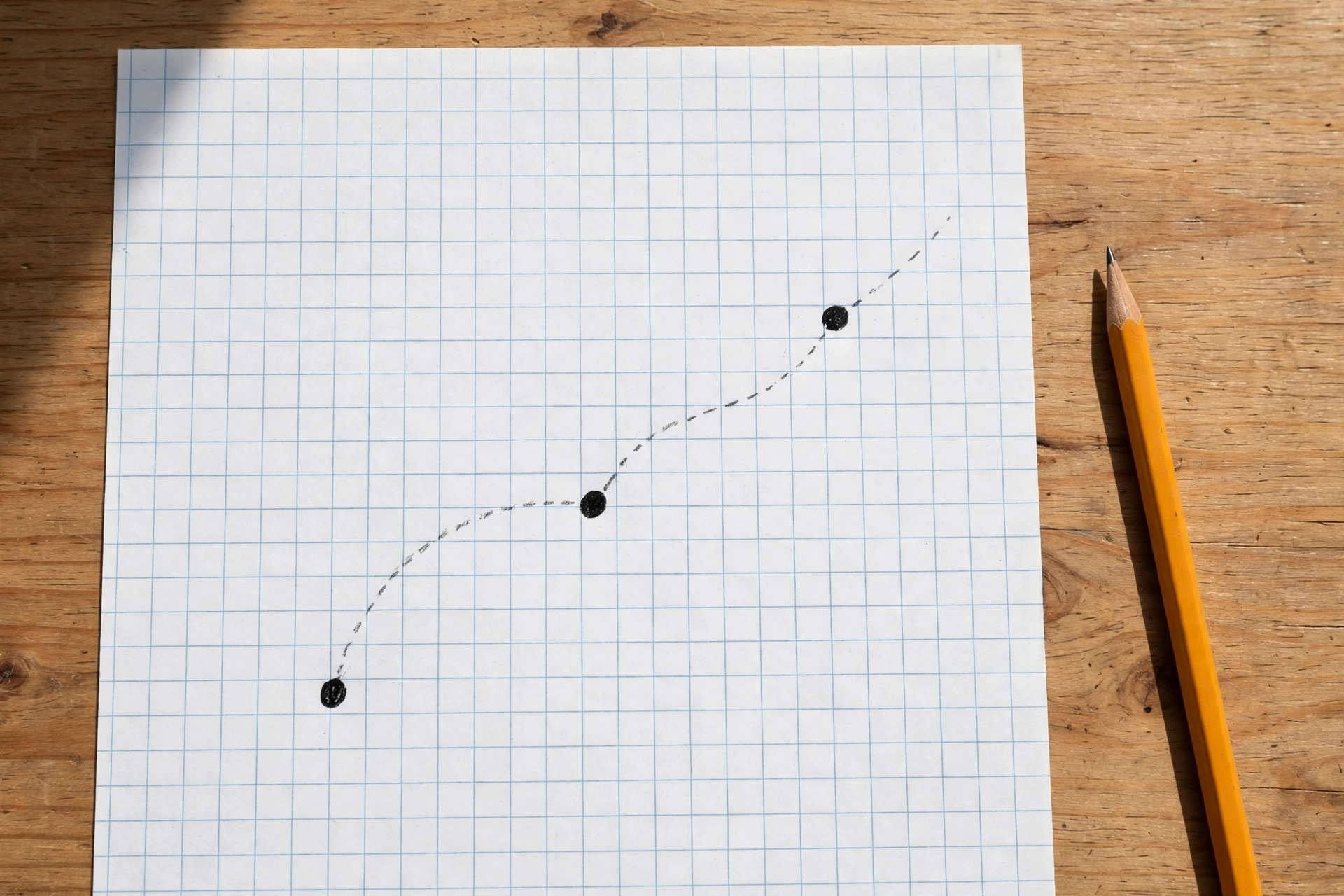
To teach the coordinate plane so it sticks, teach one idea and say it the same way every day: an ordered pair is an address. The first number moves you across, the second number moves you up, and every trip starts at the origin, (0, 0).
A coordinate plane, also called the Cartesian plane, is two number lines crossed at right angles. The line that runs across is the x axis, the line that runs up and down is the y axis, and the point where they cross is the origin.
Grade 5 works in the first quadrant only, the corner where both numbers are positive, and that small corner is enough. When a child can start at the origin without being reminded, run along the hall first and then climb the stairs, and explain why (3, 5) and (5, 3) are different places, the topic is learned.
Everything in this guide serves those three habits.

What an Ordered Pair Really Means

An ordered pair is two numbers in parentheses, written (x, y), and the word ordered is the whole point. The first number is the x coordinate. It tells how far to move across from the origin, along the x axis. The second number is the y coordinate.
It tells how far to move up from the origin, along the y axis. Swap the numbers and you have a different point, every time. The pair (3, 5) sits three across and five up. The pair (5, 3) sits five across and three up.
Hold those two points up side by side on the board in the first lesson and let the class argue about whether they match. They do not, and the argument teaches more than the definition does.
The address comparison works because children already live with it. A house address names the street first and the house second, and nobody delivers mail by reading it backward. On the grid, across comes first for the same reason a street comes first.
It is a shared agreement, not a law of nature, and saying so honestly helps. Mathematicians agreed long ago that x comes before y, the way drivers agreed which side of the road to use. The agreement only works if everyone keeps it, which is exactly why the order matters.
Build the plane out of things children already know. Each axis is a number line, one lying flat and one standing up, and they share their zero at the corner. A child who can find 4 on a number line can find 4 on the x axis.
The only new job is holding two numbers in mind at once and using them one at a time, in order. Keep the first grids small, 0 to 10 on each axis, and keep the language identical from problem to problem until the routine runs itself.
How to Plot a Point, Step by Step
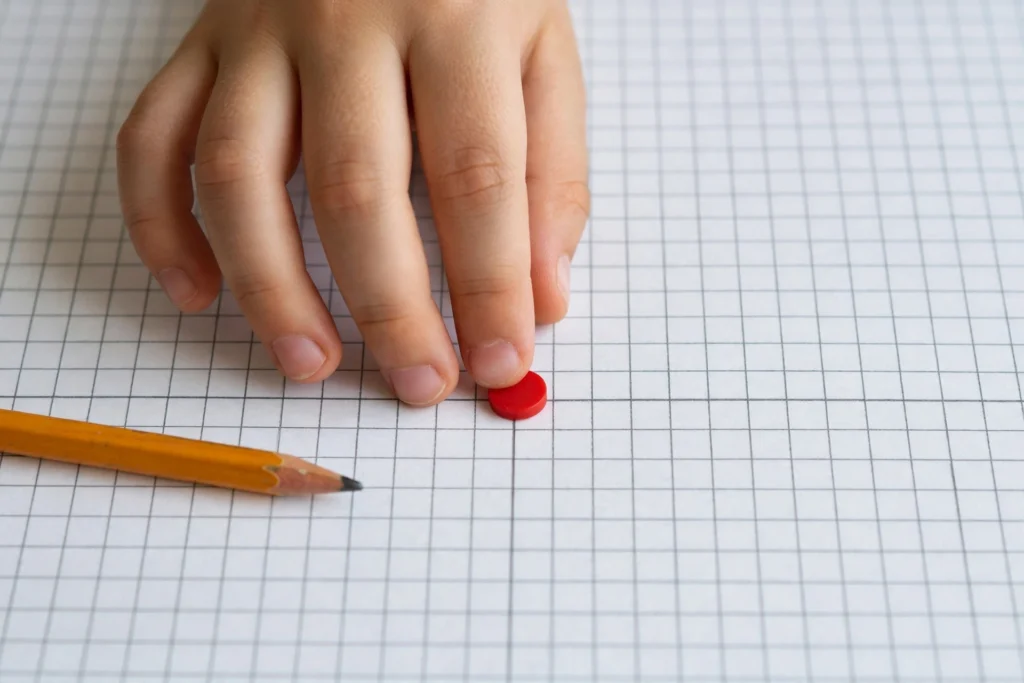
Plot (3, 5) together, slowly, narrating out loud, and then make the class narrate it back while you plot it again. Start at the origin, (0, 0). Run along the hall first: move across to 3 on the x axis.
Then climb the stairs: move straight up until you are level with 5 on the y axis. Mark the point where you stop and label it (3, 5). The hall and stairs picture gives the two moves a body.
Children who would happily climb before they run in a real building rarely do, and the silliness of climbing stairs that are not there yet is what makes the order memorable.
| Step | What to do | What to say for (3, 5) |
|---|---|---|
| 1 | Put your finger on the origin, where the axes cross | Start at (0, 0). Every point starts here. |
| 2 | Read the first number and move across along the x axis | First number is 3. Run along the hall to 3. |
| 3 | Read the second number and move straight up | Second number is 5. Climb the stairs to 5. |
| 4 | Mark the point and write its ordered pair beside it | Stop, dot it, label it (3, 5). |
| 5 | Check by reading the finished point back | Across 3, up 5. That matches the pair. |
Step 5 is the one teachers skip when the lesson runs long, and it catches nearly every error while catching it is still cheap. Reading a plotted point back is the reverse skill, naming a point instead of finding one, and grade 5 asks for both.
A child who plots (3, 5) and then reads the dot as (5, 3) has just shown you the exact misconception to fix, on a problem they got half right, which is the kindest moment to fix it.
One more counting rule prevents the other classic slip. You count moves, not lines you touch, and you never count the origin as one. Watch a new plotter count the corner as the first step and land one short on every point, neatly, all lesson long.
The fix takes ten seconds: hop your finger and count the hops out loud, zero at the start because no hop has happened yet. Zero means no movement, and that same idea returns when points land on an axis.
Why Grade 5 Stays in the First Quadrant
The grade 5 standard, 5.G.A, asks students to build the coordinate system from two perpendicular number lines and to plot and name points in the first quadrant. It stops there on purpose. Negative numbers have not been taught yet, so the other three quadrants would ask children to read number lines they have never seen.
Staying in the first quadrant is not a shortcut or a watered down version of the topic. It is the topic, sequenced so the order habit and the origin habit are automatic before signs enter in grade 6 and the plane opens up in all four directions.
That boundary is worth stating to parents, because a search for extra practice will serve four quadrant worksheets to a fifth grader who has met one quadrant.
If your child brings home a grid with numbers running left from the origin or below it, that sheet belongs to next year. Put it aside without worry.
Depth in the first quadrant, points read both ways and shapes drawn by joining points in order, is the full grade 5 job.
Common Mistakes on the Coordinate Plane
| Mistake | What it looks like | Fix |
|---|---|---|
| Swapped pair | (3, 5) plotted as (5, 3) | Hall first, stairs second, every time, then read the point back |
| Starting somewhere else | Counting from the last point, or from 1 | Return the finger to the origin before every point |
| Counting the origin as one | Landing one short on every point | Count hops, not lines, and start at zero |
| Marking a line, not a crossing | A dot sitting on a grid line, or between crossings | Points live where lines cross; use a counter to choose the crossing |
When a mistake appears, name it in the same words every time. Swapped pair, not wrong. Started from the wrong place, not careless. The shared language lets a child hear the fix without hearing a judgment, and that is what makes them willing to try the next point.
Points That Sit on an Axis
Points on an axis are the test of whether the origin habit is real. The point (0, 4) sits on the y axis, because across is zero, so there is no hall to run. The point (4, 0) sits on the x axis, because up is zero, so there are no stairs to climb. Children who count the origin as one will miss both, and children who learned that zero means no movement will place both without drama.
Teach axis points deliberately, not as an afterthought. Put (0, 3) and (3, 0) on the board together and ask why one sits on a line and the other sits on a different line. The answer, one number is zero, is the whole lesson, and it prepares the ground for negative numbers later, when the same idea will carry children into the other quadrants.
Practice Away From Screens

Screens are useful, and they are not the whole lesson. A treasure map on graph paper turns ordered pairs into a hunt: hide an X, write its pair, swap maps, and find the other map’s treasure. A pegboard grid, a counter on a paper grid, and a game of Battleship all teach the same two moves with different hands. The point is not the game. It is that plotting happens with fingers, counters and paper, not only with a mouse, so the skill survives when the screen is off.
Keep the practice short and varied. Three points plotted carefully, read back, and checked beat a page of rushed dots. A shape drawn by joining points in order, a letter, a house, a star, gives the work a reason to be accurate, because a swapped pair bends the picture and the child can see it. Accuracy becomes visible, not just marked.
A Free Game That Practices the Same Two Moves
When the routine is steady, a game can add speed without adding confusion. Our Coordinate Plane Practice game asks children to plot points in the first quadrant, with the same hall first, stairs second language, and it gives feedback on swapped pairs immediately, while the mistake is still fresh. Use it after the paper work, not instead of it, and keep sessions short.
If you want to check whether the skill is ready for the game, or whether a gap sits underneath it, a math placement test for grades 3 to 5 can show where your child stands by skill, and a fraction number line tool can refresh the number line habit that the coordinate plane is built on. Both sit in our free math tools collection, and the Resource Library has printable grids and treasure map sheets if you want paper to go with them.
Frequently Asked Questions
What is an ordered pair in grade 5?
An ordered pair is two numbers in parentheses, (x, y), that name a point.
The first number tells how far to move across from the origin, and the second tells how far to move up. Order matters, because (3, 5) and (5, 3) are different points.
Why do children swap x and y?
Because both numbers look the same on the page. The hall first, stairs second picture, plus reading every finished point back, makes the order a habit instead of a rule to remember.
What does the origin mean?
The origin is (0, 0), the point where the x axis and y axis cross. Every point starts there, and zero means no movement in that direction.
Why does grade 5 only use the first quadrant?
Because negative numbers have not been taught yet. The first quadrant, where both numbers are positive, lets children master order and origin before signs enter in grade 6.
How do I help a child who counts the origin as one?
Count hops, not lines, out loud, starting at zero. Hop once to 1, again to 2, and so on. Zero at the start means no hop has happened yet.
What is a good first practice activity?
Plot (3, 5) together, slowly, then have your child narrate it back while you plot again. Then try a treasure map: hide an X, write its pair, swap maps, and find the treasure.
Every topic clicks faster with practice. Our Resource Library has free lesson packs with slides, printable worksheets and full answer keys, ready to download and teach.
Members unlock every lesson in the library, including the full Fractions, Multiplication, Place Value, Addition & Subtraction, Time & Money and Geometry & Shapes units. See the full library


