

The best math lesson I ever watched started with a picture book. No worksheet, no warm-up, just a teacher, a rug full of second graders, and a story about cookies that kept splitting into smaller shares.
By the last page, the class had divided, multiplied, and argued about fractions, and nobody had noticed they were doing math. That is the quiet power of a math read-aloud.
Why Read Aloud During Math Time?
A story gives numbers a home. When math lives inside a plot with characters students care about, the ideas stick longer and feel safer to explore. Struggling students who freeze at a bare equation will happily argue about how to share twelve cookies fairly. The story lowers the stakes while the math stays real.
Read-alouds also build math language. Picture books repeat key words in context: share, group, half, estimate, pattern. Hearing those words in a story, then using them in discussion, moves vocabulary from the page into students’ own explanations. Ten minutes of a good math read-aloud can seed a week’s worth of math talk.
5 Math Read-Alouds That Earn Their Shelf Space
1. The Doorbell Rang by Pat Hutchins. Two children plan to share twelve cookies, and then the doorbell keeps ringing. Each new guest means re-dividing the batch. It is division as fair sharing in its purest form, perfect for kindergarten through second grade, and a favorite math read-aloud for introducing division.
2. Each Orange Had 8 Slices by Paul Giganti, Jr. A counting book that quietly grows into multiplication. If each orange has 8 slices and there are 5 oranges, how many slices? First through third graders practice grouping and repeated addition without a single drill.
3. The Grapes of Math by Greg Tang. Rhyming riddles push students to group objects in clever ways instead of counting one by one. It teaches the heart of mental math: look for a smarter group before you start counting.
4. Math Curse by Jon Scieszka and Lane Smith. A student wakes up seeing math problems in everything, from breakfast cereal to the classroom clock. It is funny, slightly wild, and ideal for showing grades 2 through 4 that math hides in ordinary life.
5. Sir Cumference and the First Round Table by Cindy Neuschwander. A medieval tale that introduces circles, diameter, and radius through a genuine problem: building a table where every knight fits. Geometry lands harder when the shape solves something, which is why this math read-aloud is a keeper.
How Do You Turn a Math Read-Aloud Into a Math Lesson?
Read first for joy, then reread for math. On the first pass, let students enjoy the plot with no agenda. On the second pass, pause at the math moments. In The Doorbell Rang, stop before each re-dividing and ask, “Twelve cookies, six friends. How many each? How do you know?” Let students model with counters before anyone answers.
Then extend. After Each Orange Had 8 Slices, have students write their own counting riddle in the same style: “Each nest had 4 eggs, and there were 3 nests.” After Sir Cumference, hand out string and have students find the diameter of real circles in the room. The math read-aloud opens the door, and the activity walks through it.
What If You Only Have Ten Minutes?
You still have enough. Pick one spread from your math read-aloud, not the whole book. Read the two pages where the cookies get re-divided, solve that one problem together, and close the book. A single juicy page beats a rushed full story every time.
Quick Answer: You do not need a separate math library. Five well-chosen math read-alouds, reread across the year, can carry counting, operations, geometry, and measurement. Keep them in a small basket near your meeting area so grabbing one takes seconds, not a trip to the library.
How Do You Choose the Right Book for the Math You Are Teaching?
Match the book’s mathematical heart to your learning goal, not just the topic. Teaching counting? You want a book where the numbers grow or shrink as the story moves, so children feel the quantity changing. Teaching patterns? Look for stories with repeating structures a child can predict. The best math books do not mention math at all. They tell a story where mathematics is the engine, and children absorb the concepts while caring about the characters.
Read the book yourself first with a mathematician’s eye. Where does the math live? Is it in the illustrations, the text, or the structure? A book about a bear sharing honey might look like a fraction book, but if the sharing is never shown in parts, it will not teach fractions. The math must be visible and discussable, not just thematic. Flip through and ask: “What could students count, compare, or predict on this page?” If you cannot answer, keep looking.
Build a small, excellent collection rather than a large, mediocre one. Five books you know deeply beat twenty you have only skimmed. Learn where the math moments are in each, plan your pause points, and prepare one good question per book. A teacher who has rehearsed the read-aloud will always outperform one with a bigger shelf and no plan.
What Do You Do After the Last Page?
The book is the launch, not the lesson. After closing the cover, put the math into students’ hands immediately. Read a counting book? Hand out counters and let them build what the character built. Read a shape book? Send them on a shape hunt around the room. The story creates the desire, and the activity satisfies it. Skip the activity and the math evaporates with the story’s ending.
Revisit the book across the week. On Monday, read for enjoyment. On Wednesday, reread the key pages and solve the math problem the character faced. On Friday, let students change the story: “What if the character had twice as many?” Repeated readings deepen both the literacy and the mathematics, and children love noticing new things in familiar pages.
Let students become the authors. After a week with a pattern book, challenge them to write and illustrate their own page following the pattern. After a measurement story, have them document a measurement adventure at home with drawings. Creating mathematics in story form cements understanding in a way that solving problems rarely does. The child who writes the book owns the concept.
Try It: Pair One Math Read-Aloud With Counting
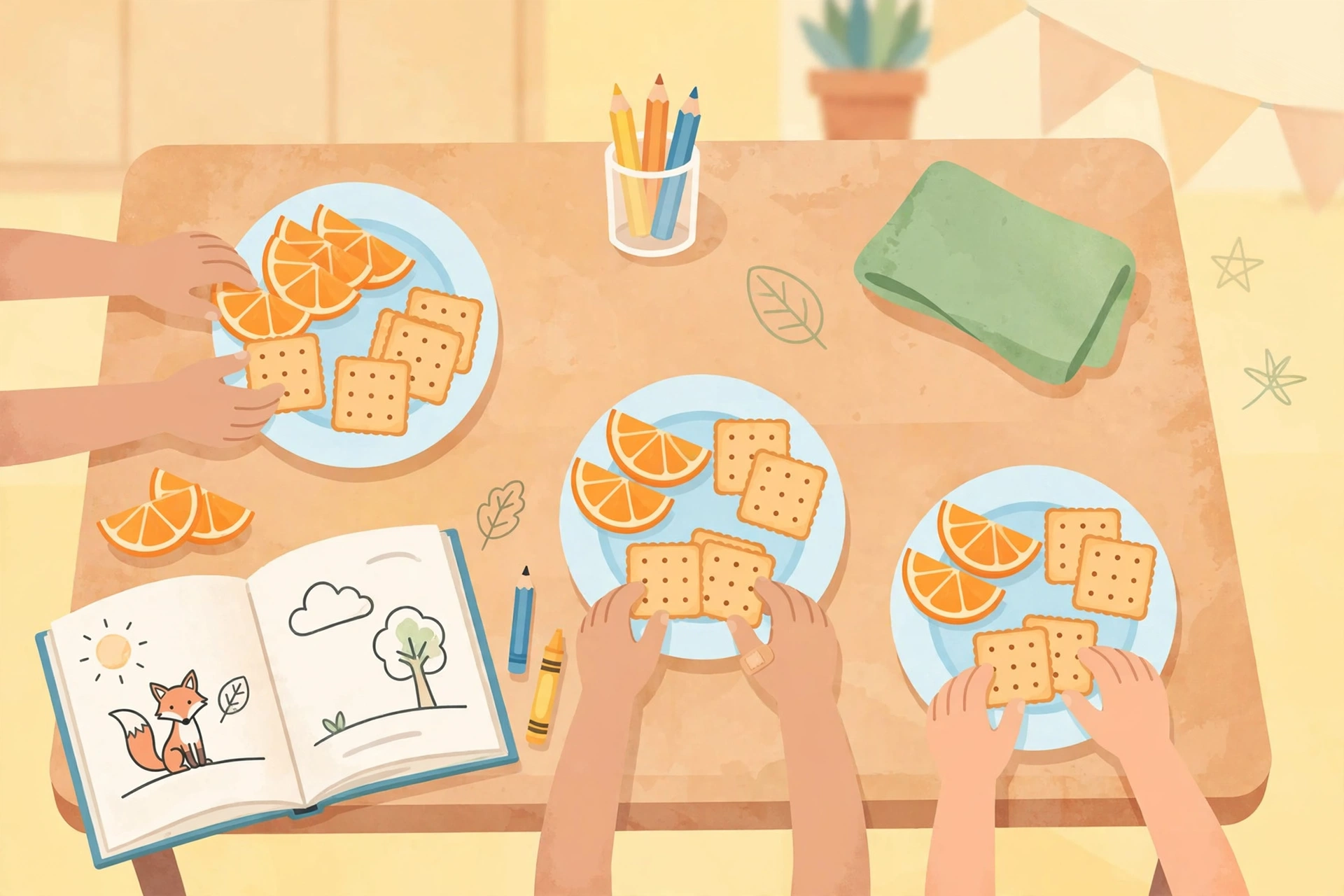
Choose The Doorbell Rang or Each Orange Had 8 Slices for this week’s math read-aloud. After reading, put real objects on each table: twelve crackers, or orange slices if your school allows food. Reread the key pages and have students act out the sharing or grouping with the real items.
Next, flip it. Ask students to set up their own sharing problem for a partner: choose a number of crackers and a number of friends, then let the partner solve it. Collect the best student-made problems on an anchor chart titled “Our Math Stories.” You now have a week of warm-ups written by the class itself.
Quick Practice
Question: After reading The Doorbell Rang, a student says twelve cookies shared among four friends means each friend gets two cookies. How do you respond?
Answer: Ask the student to act it out with twelve counters and four plates. Dealing one cookie per plate, three rounds, shows 3 each, not 2. The counters correct the error gently, and the student sees why dealing in rounds works.
Related Terms
- Array – objects arranged in equal rows and columns, a visual model for multiplication.
- Skip Counting – counting by a number other than one, like 2, 5, or 10.
- Number Line – a line marked with numbers in order, used to model counting and operations.
- Not Equal – the symbol and idea showing that two amounts are different.
Frequently Asked Questions
At what age should math read-alouds start?
Birth to kindergarten is ideal for counting books, and the habit should continue through fifth grade. Older students still light up for a good story, especially one with a puzzle inside.
Should I read the whole book or just the math parts?
Read the whole book the first time so the story lands. On later readings, zoom in on the math-rich pages. Students enjoy revisiting a favorite book with a new job to do.
How do math books help struggling readers?
Math picture books lean on illustrations, so students can follow the math through the pictures even when the text is hard. Acting out the story with objects removes the reading barrier entirely.
Can one book teach a full lesson?
One book can launch a full lesson, but the book alone is not the lesson. Pair the story with objects to manipulate, a problem to solve, and time to discuss, and you have a complete learning cycle.
Where do I find good math picture books?
Start with the five above, then ask your school librarian for the math picture book shelf. Series by authors like Greg Tang, David Adler, and Stuart Murphy cover nearly every elementary topic.
What if my school has no budget for math books?
Start with the library, which is free and vast. Many classic picture books have strong math hiding inside: counting, patterns, size comparisons. You can also project free digital read-alouds. One excellent book, used deeply across a week, teaches more than a shelf of books read once.
How do read-alouds help older students?
Picture books work beautifully through fifth grade when chosen well. Older students enjoy the nostalgia, and the simple stories often illuminate complex ideas: a picture book about infinity can launch a profound fifth-grade discussion. Never assume your students are too old for a good story.
Can families do math read-alouds at home?
Absolutely, and they should. Bedtime stories with math woven in build positive associations that last for years. Encourage families to ask “what do you notice?” during the story instead of quizzing. The goal is joyful mathematical conversation, not a lesson.
Every topic clicks faster with practice. Our Resource Library has free lesson packs with slides, printable worksheets and full answer keys, ready to download and teach.
Members unlock every lesson in the library, including the full Fractions, Multiplication, Place Value, Addition & Subtraction, Time & Money and Geometry & Shapes units. See the full library


