
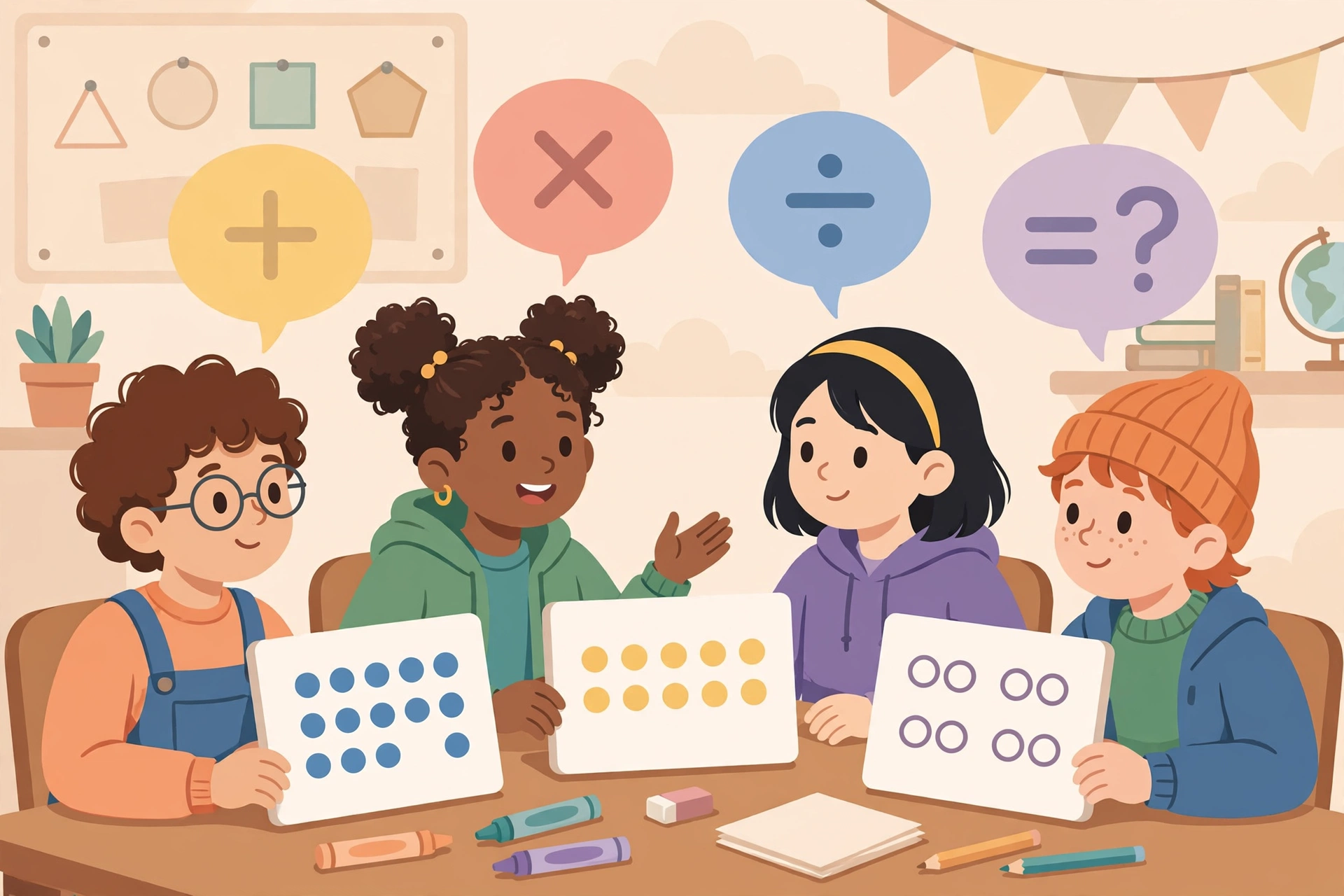
In most math classrooms, the teacher talks for forty minutes and students talk for four. Flip that ratio and something remarkable happens. Students start catching their own errors mid-sentence, borrowing each other’s strategies, and defending ideas like young mathematicians.
The shift does not require a new curriculum. It requires conversation, structured with purpose. Researchers call this kind of talk math discourse, and its impact is hard to overstate.
What Is Math Discourse?
Math discourse is the purposeful talk, gestures, and writing through which a class builds mathematical meaning together. It is not chatter and not a quiz show where the teacher fires questions at raised hands. In true discourse, students explain their reasoning, question each other’s ideas, and revise their thinking in public.
Think of math discourse as the difference between recitation and conversation. Recitation asks, “What is 7 x 8?” and waits for “56.” Discourse asks, “How do you know 7 x 8 is 56?” and waits for the thinking. One checks memory. The other builds it.
How Does Math Discourse Change Learning?
First, math discourse deepens understanding. When students justify their thinking and make sense of peers’ ideas, they connect concepts instead of collecting procedures. Explaining why 7 x 8 equals 56 forces a student to confront what multiplication means, which is learning that silent practice rarely produces.
Second, it builds equity. Research on math discourse shows that moves like revoicing student ideas and asking peers to repeat them position every child as a knower and doer of mathematics. In two longitudinal studies, Jo Boaler (2002) found that discussion-based classrooms posted significant achievement gains, and the gains spread across student groups instead of clustering among the already advantaged.
Third, math discourse doubles as formative assessment. When students voice their thinking daily, misconceptions surface in real time. You hear the wrong turn while you can still redirect it, not three days later on a quiz. Talk is the fastest diagnostic tool a teacher owns.
What Are the 5 Talk Moves That Power Math Discourse?
Researchers Sarah Michaels and Cathy O’Connor identified talk moves that shift classrooms from recitation to real discussion. Studies link these moves to significant learning gains. Here are the five that matter most.
1. Revoicing. Repeat a student’s idea back with slight clarifying: “So you are saying you broke 56 into 50 and 6?” Revoicing honors the thinker, checks your understanding, and gives the class a clean version of the idea to work with.
2. Repeat or rephrase. Ask, “Can someone say Maya’s idea in their own words?” This keeps listeners listening and spreads ownership of ideas. A quiet student who rephrases well has participated as a mathematician.
3. Agree or disagree, with reasons. “Do you agree with Jamal, and why?” Disagreement with justification is where reasoning sharpens. Teach students to challenge ideas, never people, and disagreement becomes safe.
4. Add on. “Who can add to Priya’s thinking?” Adding on teaches students to build rather than just broadcast. Chains of added ideas often reach insights no single student would have found alone.
5. Wait time plus think-pair-share. Pause three to five seconds after a question, then let partners talk before anyone speaks to the class. Wait time raises the quality of answers, and pair talk gives every student a rehearsal before the spotlight.
How Do You Get Quiet Students Talking?
Start small and private. In math discourse, think-pair-share lets a shy student test an idea with one partner before facing thirty listeners. Sentence starters on the wall (“I agree because…”, “I see it differently…”) give hesitant speakers a script until the language feels natural.
Quick Answer: Math discourse is not just “turn and talk.” Unstructured partner chat drifts off task fast. Real discourse has a clear prompt, a job for the listener, and a whole-class harvest where ideas get compared. Structure is what turns talking into learning.
Protect every voice. When a quiet student’s idea gets revoiced and built upon, the class learns that good thinking comes from everywhere. Call on a range of students deliberately in the early weeks until participating feels normal, not brave.
What Does Math Discourse Look Like in a Real Lesson?
Picture a third grade lesson on 4 x 6. The teacher poses the problem and gives thirty seconds of silent think time. Partners share strategies for two minutes while the teacher circulates, noting who used arrays, who skip-counted, and who added 6 four times.
Then the harvest. The teacher invites three students with different strategies to share, using revoicing and “add on” moves between each. The class compares: which strategy would you use for 4 x 16, and why? Fifteen minutes of talk, and every student has seen multiplication from three angles. That is math discourse transforming a routine lesson.
What Does Discourse Sound Like Across Different Grades?
In kindergarten, discourse is physical. The teacher holds up two towers of blocks and asks, “How can we tell which is taller?” Children gesture, stack, and argue with their hands. The teacher narrates: “Jamal is lining up the bottoms to compare fairly.” She is giving them the language of mathematical argument before they can write a sentence. This is discourse at its most basic: noticing, comparing, and explaining with whatever tools you have.
By third grade, the talk has structure. Students present strategies at the board while classmates ask questions: “Why did you break the 27 into 20 and 7?” The teacher’s role shifts from narrator to conductor, making sure every voice is heard and every claim is examined. A quiet student who never raised her hand in September is now defending her method in November, because the classroom made it safe to be wrong in public.
In fifth grade, discourse goes abstract. Students debate whether two different strategies will always give the same answer, effectively doing proof without the formal language. “Will Jamal’s way work for any numbers, or just these?” That question, from an eleven-year-old, is mathematical reasoning at a high level. It grew from years of being asked to explain, justify, and connect. Discourse is not a separate activity. It is the soil everything else grows in.
How Do Talk Moves Work in the Heat of a Lesson?
Revoicing is your most-used tool. When a student says something important, repeat it back: “So you are saying we should break the 47 into 40 and 7 first?” This does three things: it validates the student, it gives the class a second chance to hear the idea, and it gives you a moment to think. Use it constantly, especially with quiet students whose ideas deserve a louder hearing.
Pressing for reasoning is how you go deeper. When a student gives an answer, ask “How do you know?” or “Can you prove it?” The first time, they will stare at you. The tenth time, they will start justifying before you ask. You are building a habit, and habits take repetition. Never accept an answer without a reason, and never let a wrong answer pass without examination.
Getting students to respond to each other is the hardest move and the most transformative. Instead of the teacher mediating every exchange, teach students to address each other: “I disagree with Maya because…” or “I want to add to Jamal’s idea.” Start by requiring it once per discussion, then twice. Within months, the classroom runs itself, and you become what you always wanted to be: a facilitator of brilliant young minds talking mathematics.
Try It: The Revoice and Repeat Routine
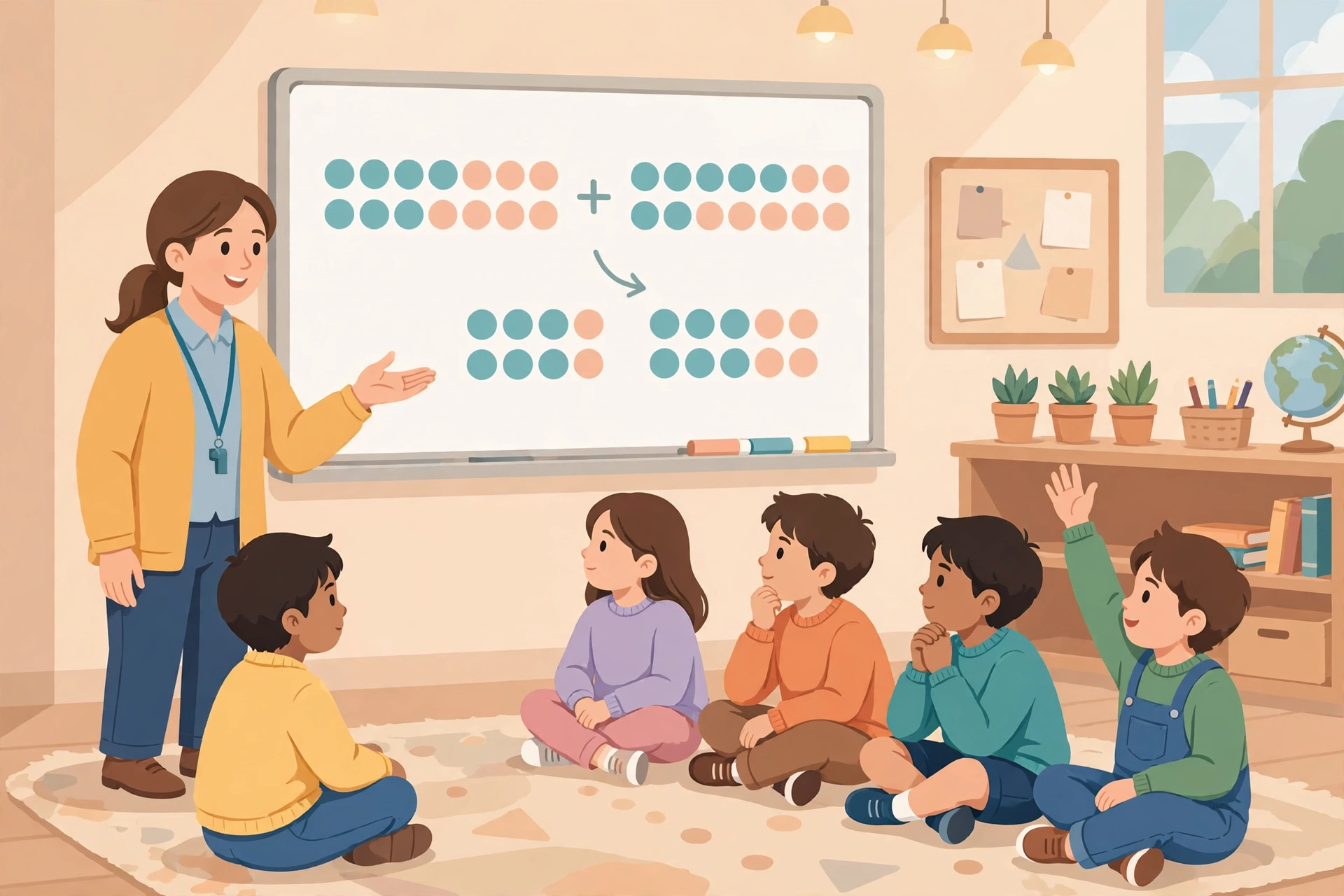
Pick one number talk this week and commit to three math discourse moves only: revoice, repeat, add on. Pose a problem like 18 + 27. When a student shares, revoice: “So you made 20 + 25? Did I get that right?” Then ask the class, “Who can say that strategy in their own words?” Then, “Who can add to it?”
Resist adding your own explanation until at least three students have spoken. Tally how many students talk during the number talk and compare it with last week’s count. Most teachers see participation double within two weeks, and the strategies students share get sharper as the routine settles in.
Quick Practice
Question: During a discussion of 3/4 vs 2/3, Leo says 2/3 is bigger “because 3 is less than 4.” Give a talk-move response that surfaces the reasoning without shaming Leo.
Answer: Revoice first: “So you are thinking about the bottom numbers. Did I hear you right?” Then invite reasoning: “Who agrees or disagrees with Leo, and why?” Let a peer offer the fraction-bar comparison. Leo’s idea gets examined, not mocked, and the class does the correcting.
Related Terms
- Justify – to explain why an answer makes sense using reasons and evidence.
- Word Problem – a math problem told as a short story from real life.
- Array – objects arranged in equal rows and columns, a visual model for multiplication.
- Tape Diagram – a bar model that shows the parts and whole of a problem visually.
Frequently Asked Questions
How much class time should discourse take?
Ten to fifteen minutes of focused discussion per lesson is plenty. A daily number talk or a short strategy share after independent work keeps talk consistent without swallowing the period.
What if students just shout answers without explaining?
Set the norm early: an answer without reasoning does not count yet. Respond to bare answers with “How do you know?” until explaining becomes the class habit.
Does discourse slow down coverage of the curriculum?
It feels slower per lesson but faster per unit. Students who discuss deeply retain more and need less reteaching, so the class often finishes stronger despite fewer problems per day.
How do I manage dominant talkers?
Use structures that spread airtime: think-pair-share, talking chips, or inviting specific students by name. Praise good listening as loudly as good talking.
Can discourse work in kindergarten?
Absolutely. Five-year-olds can explain how they counted, agree or disagree with a partner’s tower, and rephrase a friend’s idea. Keep prompts concrete and sessions short.
What if my students just will not talk?
Start smaller. Pair-share before whole-group, so everyone has rehearsed. Use writing first: “Write your idea, then read what you wrote.” Provide sentence starters on the wall. And examine whether the questions deserve discussion: “What is 7 plus 5?” has one answer and no discussion. “How many ways can you make 12?” has a conversation.
How do I keep discourse from being dominated by a few voices?
Track who speaks with tally marks for one week. The data will shock you. Then use structured turns: “Let’s hear from someone who has not spoken yet.” Try the “each person speaks once before anyone speaks twice” rule. Equity in discussion requires the same intentionality as equity in everything else.
Does discourse take time away from learning procedures?
The research says the opposite. Classrooms with rich discourse outperform traditional ones on procedural tests too, because students who understand deeply compute more accurately. Discussion is not the enemy of skills. It is the engine that makes skills stick.
Every topic clicks faster with practice. Our Resource Library has free lesson packs with slides, printable worksheets and full answer keys, ready to download and teach.
Members unlock every lesson in the library, including the full Fractions, Multiplication, Place Value, Addition & Subtraction, Time & Money and Geometry & Shapes units. See the full library


