
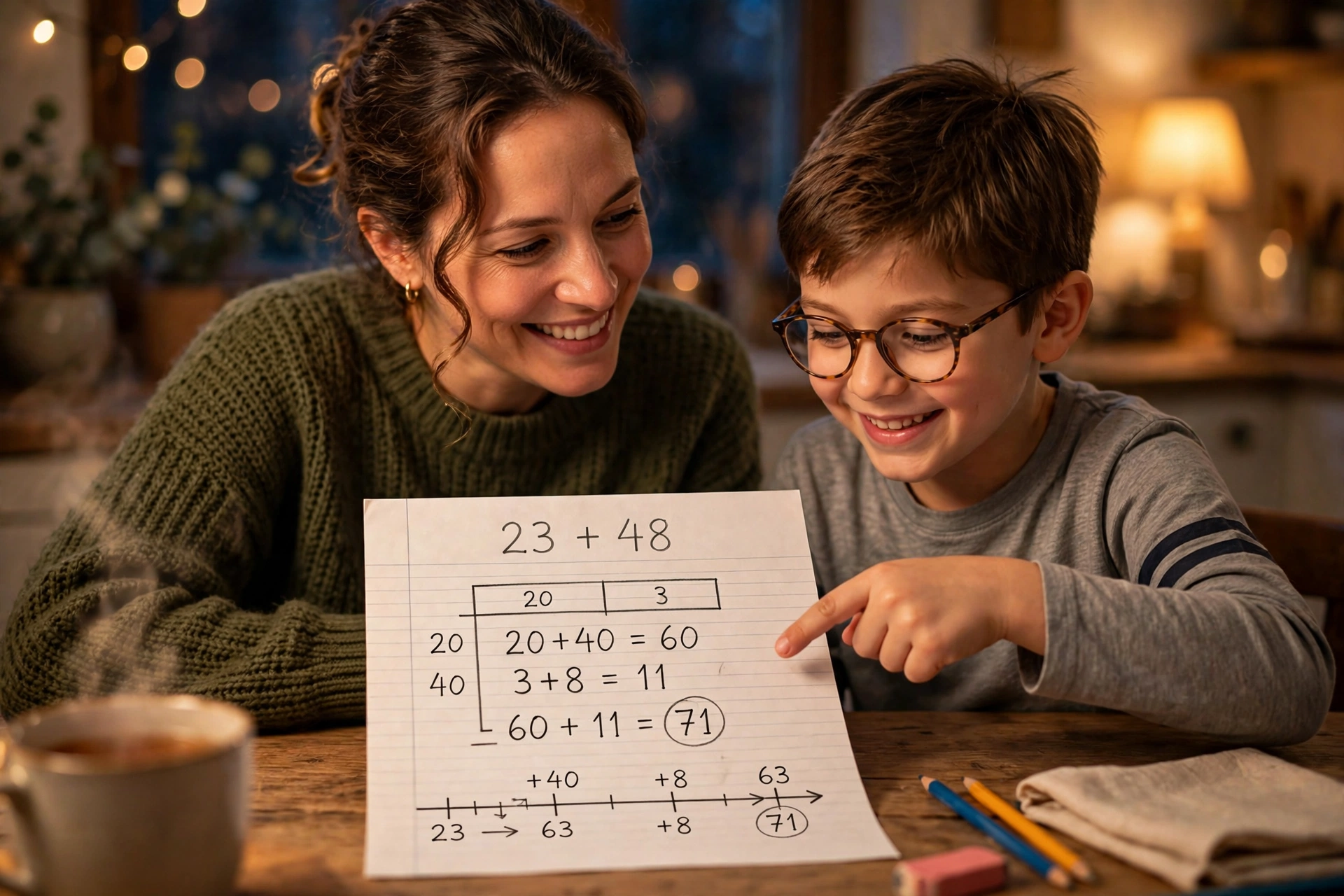
If you’ve ever asked, “Why did math change?” — you’re not alone. Math teaching changed because schools shifted from memorizing steps to building number sense: children now learn why methods work, show their thinking with pictures and words, and try more than one way to solve a problem.
What Do People Mean by “New Math”?
Picture the scene: it is 9 PM, your child stares at a worksheet covered in number lines and box drawings, and nothing looks like the math you learned. That nightly moment is what parents mean by “new math.”
The math itself did not change: two plus two still makes four. What changed is the teaching. Where your generation often learned one procedure and practiced it fifty times, today’s children learn several strategies, draw what they mean, and explain their thinking in words. That shift in teaching is the short answer to why did math change.
Think of learning to cook. The old way handed you a recipe and said, follow it exactly. The new way first teaches you what each ingredient does, so you can adjust when the recipe changes.
Why Did Math Change in Schools?
For years, math leaders watched students who followed memorized steps freeze the moment a problem looked unfamiliar. A child who only memorized “carry the one” had no backup plan. Educators, led by groups like the National Council of Teachers of Mathematics, pushed for teaching that builds understanding first and speed second.
Then came 2010, when most states adopted the Common Core State Standards. Their three aims: focus (deeper work on fewer topics), coherence (each grade builds on the last), and rigor (understanding why, doing it fluently, and applying it).
Classrooms that asked children to explain and connect ideas produced students who held onto math longer. Teach the why alongside the how, because the why survives when memory of the steps fades.
What Is the Difference Between Old Math and New Math?
The clearest way to see the difference is to watch one problem solved both ways. Take 23 + 48.
The old way stacks the numbers: 3 + 8 is 11, write 1, carry 1, then 2 + 4 + 1 is 7, landing on 71. Fast, tidy, and mysterious: a child can do it without knowing why the carried 1 means ten.
The new way might break the numbers apart: 20 + 40 is 60, 3 + 8 is 11, 60 + 11 is 71.
Or jump on a number line: start at 23, hop 40 to 63, then hop 8 to 71. Or round and adjust: 23 + 50 is 73, minus 2 is 71. Same answer, three windows into how numbers behave.
What the new ways share: place value does the heavy lifting. Children see that 23 breaks into 20 + 3, an insight that powers everything from mental math to algebra. The old way hid that structure inside the steps. The new way puts it on display.
Do Kids Still Learn the Standard Algorithm?
Yes, and this myth deserves retiring first. The standard algorithm, the stacking method you learned, is still taught. It arrives after children understand the steps, usually around fourth grade for multi-digit multiplication.
The order flipped, not the content: understanding first, efficiency second. A child who knows why the carried 1 is one ten will use the algorithm with confidence. So when homework shows three strategies for one problem, it is not busywork.
It says: find the way that clicks for you, and prove you understand it. Your way from school is still welcome at the kitchen table.
The Goal Never Changed — So Why Did Math Change?
If you are wondering whether schools lowered the bar, they raised it. The goal moved from “get the right answer fast” to “get the right answer and know why it is right.” That is a harder goal, and it looks messier on paper, because thinking is messier than repeating. That higher bar is the deeper answer to why did math change.
It also matches how adults use math. Nobody at a restaurant lines up numbers to figure a tip. They round, double the tax, and adjust. That everyday number sense is what the new teaching builds, years earlier than most of us learned it.
How Can Parents Help With Math Homework?
You do not need to learn every strategy. You need a few moves that work no matter what the worksheet shows.
Ask your child to teach you. “Show me how your teacher did it” beats “let me show you my way” every time. Teaching cements learning, and you see the classroom method without a manual.
Never say “that is wrong, do it my way.” If the method is unfamiliar, it is not broken. Say, “I learned it differently. Walk me through yours?” Two valid methods can share one kitchen table.
Ask “why” and “how do you know.” These two questions are the whole curriculum in disguise. “How do you know 7 + 5 is 12?” invites a drawing, a number line hop, or a make-ten story. You are doing new math just by asking.
Reach for real life. Doubling a recipe, splitting a bill, estimating groceries: real application, no worksheet needed.
Call the teacher before frustration hardens. A five-minute chat or a photo of the confusing page gets you the classroom language fast. Teachers would rather explain a strategy in October than repair homework dread in March.
What Does the Research Actually Show About New Methods?
The shift toward visual and conceptual math teaching did not come from fashion. It came from decades of watching students fail in predictable ways. Researchers found that children who memorized procedures without understanding could not apply them to new problems, forgot them over summer break, and froze on standardized tests that asked “why.” Meanwhile, students who learned the why alongside the how retained skills longer and transferred them to unfamiliar problems.
One well-known line of research followed students who learned multiple strategies for multi-digit addition. Compared to peers who learned only the standard algorithm, these students were more accurate, not less, and far better at estimating whether an answer was reasonable. The extra time spent on understanding paid for itself in fewer errors. This is the finding that changed curricula: understanding is not the enemy of fluency. It is the foundation of it.
None of this means old methods were worthless. The standard algorithms survived because they are efficient and general. The research consensus is more subtle: teach the algorithm, but only after the concept is solid, and keep connecting the steps back to what they mean. A student who can explain why “carrying” works will never be confused by it again.
How Should Parents Talk to Teachers About Math Concerns?
Start with curiosity, not complaint. Instead of “Why aren’t you teaching them the normal way?”, try “Can you show me how my child is learning to add? I want to support it at home.” Teachers hear the first version as an attack and the second as a partnership. The difference in what you learn will be enormous.
Ask to see your child’s math thinking, not just their answers. A notebook full of drawings, number lines, and written explanations is evidence of a brain at work, even if it looks messy. If every page is just bare answers, that is worth a conversation regardless of which method the school uses. Understanding leaves tracks.
If your child is genuinely struggling, ask the teacher which specific concept is shaky. “She’s bad at math” is too vague to act on. “She doesn’t yet see that 10 ones make 1 ten” points to exactly what to practice. The new methods, for all their unfamiliarity, make diagnosis easier because the thinking is visible on the page. Use that visibility.
Try It: Solve 23 + 48 Three Ways
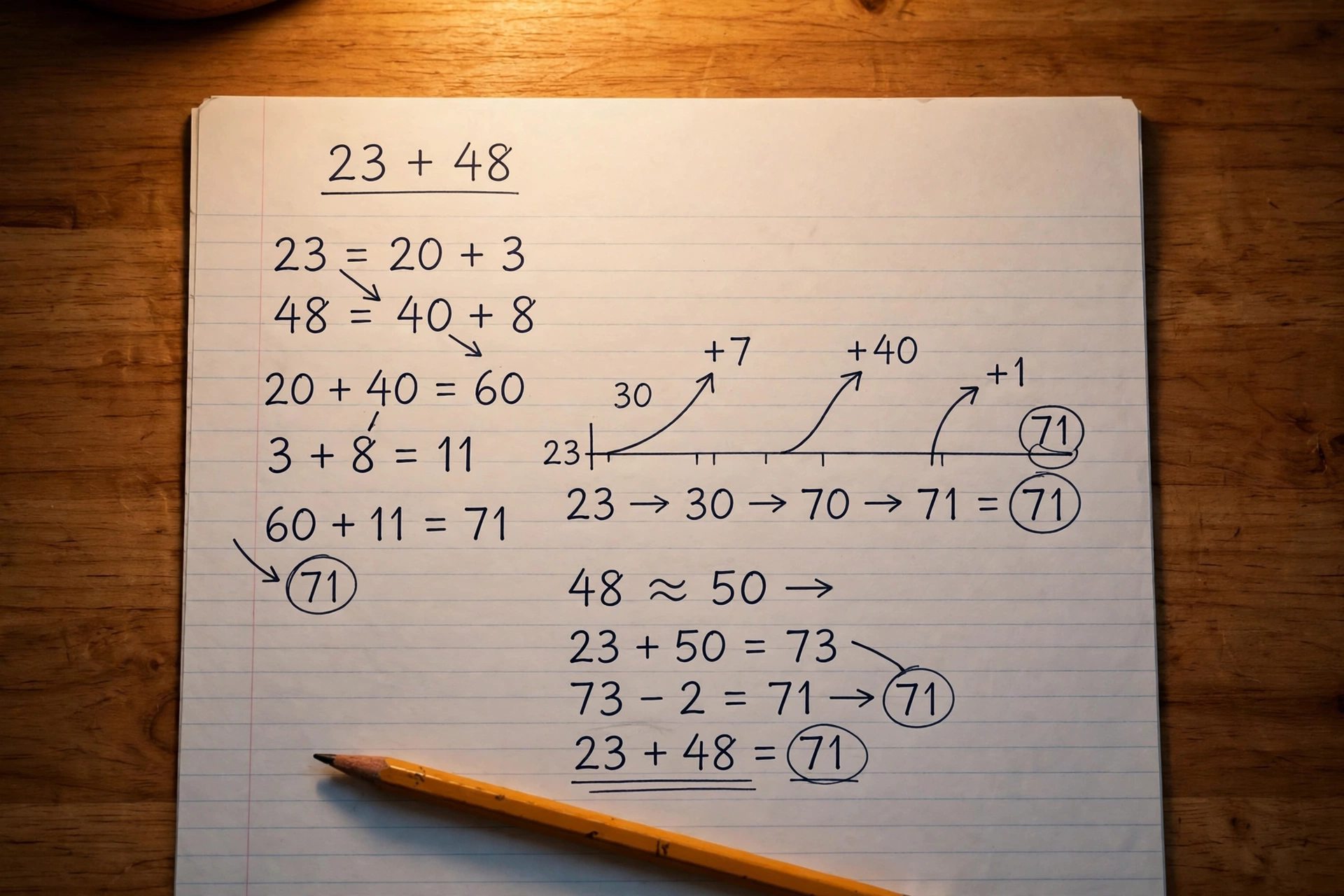
Grab paper and try the problem from this article yourself: 23 + 48. First, solve it the way you learned in school and write down 71. That is path one, and it still counts.
Now break the numbers apart: 20 + 40 = 60, 3 + 8 = 11, 60 + 11 = 71. Say out loud what the carried 1 meant in your school method. It was this 10, hiding inside the 11. Path two just made the hiding place visible.
Finally, draw a number line: mark 23, hop 40 to 63, then hop 8 to 71. Three paths, one answer. Next time homework looks like this, you will recognize the landscape.
Quick Practice
Homework shows 36 x 14 in an area model: a rectangle split into 30×10, 30×4, 6×10, and 6×4, summed to 504. You learned to stack and multiply. What do you say?
Answer: say, “Walk me through your rectangle.” The four parts give 300, 120, 60, and 24, which sum to 504. The box shows place value doing the work your stacked steps did silently. Praise the explanation, then share your way as a fourth path, not a correction.
Related Terms
Explore place value, regrouping, and array.
Frequently Asked Questions
Is Common Core a curriculum?
No. The Common Core State Standards are goals for each grade. The curriculum, textbooks, and daily lessons are chosen by districts and schools.
Why does my child have to show work in three ways?
Not forever. Early on, teachers ask for multiple strategies so children find one that clicks. Over time, each child settles on a favorite method, just like adults do. It feels strange at first — one more reason parents ask why did math change — but fluency comes faster when understanding comes first.
Will this hurt my child’s test scores?
The strategies connect directly to the algebra and reasoning that tests measure. The adjustment period is real, but the destination is stronger problem solving. Keep that destination in mind when you wonder why did math change.
What if I truly cannot help with the homework?
Say so out loud: “I don’t know this method yet. Let’s figure it out together.” Then email the teacher for the classroom language or look at the worked examples in the textbook. Modeling how to learn something unfamiliar is itself a powerful lesson.
Will colleges and employers care how my child learned math?
No. They care whether your child can think quantitatively, estimate, spot unreasonable answers, and persist through hard problems. Those are exactly the skills the new methods target. Nobody has ever been asked in a job interview to show their long division work from fourth grade.
Is it true that some countries still teach the old way and score higher?
The highest-performing countries, like Singapore and Japan, actually pioneered many of the visual and conceptual methods American schools are now adopting. Their textbooks are full of bar models, number bonds, and deep exploration of a few topics. When people praise “how they do it over there,” they are usually praising the new methods without realizing it.
My child says “we don’t do it your way, Mom.” How do I help without confusing them?
Ask them to teach you their way. Say, “Show me how your teacher does it.” This does three things: it respects their learning, it reveals whether they actually understand the method, and it often teaches you something. If they cannot explain it, that is useful information to share with the teacher.
Every topic clicks faster with practice. Our Resource Library has free lesson packs with slides, printable worksheets and full answer keys, ready to download and teach.
Members unlock every lesson in the library, including the full Fractions, Multiplication, Place Value, Addition & Subtraction, Time & Money and Geometry & Shapes units. See the full library


