
One hundred multiplication facts look like a mountain as a memorization list. Taught as nine strategies built on facts students already know, they become a puzzle with the edges done. Here is the strategy path from skip-counting to true multiplication and division fluency.
What Does Multiplication and Division Fluency Within 100 Look Like?
The Common Core sets the bar clearly. By the end of grade 3, students should fluently multiply and divide within 100 and know from memory all products of two one-digit numbers (3.OA.C.7). Grades 4 and 5 then extend that fluency into multi-digit multiplication, long division, and fractions. This is the grade-level benchmark for multiplication and division fluency.
Fluency means accuracy, efficiency, and flexibility. A fluent fourth grader answers 7 x 8 = 56 and can also explain it as double 7 x 4 or as 7 x 10 minus 7 x 2. That flexibility transfers to 70 x 80 and to dividing 560 by 7.
Which 9 Strategies Build Multiplication and Division Fluency?
Teach facts easiest-first, not in number order. Each strategy below builds on facts students already own, so new facts feel like small steps instead of leaps. This step-by-step path is how lasting multiplication and division fluency is built.
1. Zero and one facts. Any number times 0 is 0, and any number times 1 stays itself. Two rules knock out 36 facts at once, which is a thrilling start for students.
2. Doubles (x2). Twice a number is just double the addition fact students already know: 7 x 2 = 7 + 7 = 14. Skip-counting by twos backs it up.
3. Groups of ten (x10). Multiplying by 10 is place value in action: 4 x 10 is 4 tens, or 40. Fast, visual, and the foundation for the next strategy.
4. Half of ten (x5). Since 5 is half of 10, 6 x 5 is half of 6 x 10 = 60, which is 30. One known fact births a whole family.
5. Double-doubles (x4). Doubling twice: 6 x 4 is double 6 x 2 = 12, doubled again to 24. Students who own their twos own their fours.
6. One more group (x3). Add a single group to a known double: 7 x 3 is 7 x 2 = 14, plus one more 7, which is 21.
7. Double once more (x8). Double a known x4 fact: 6 x 8 is double 6 x 4 = 24, which is 48. The doubling chain now covers 2, 4, and 8.
8. Ten minus one group (x9). Take one group away from a ten fact: 7 x 9 is 7 x 10 = 70, minus 7, which is 63. The nines stop being scary.
9. Break-apart facts (x6 and x7). Split the unknown factor: 7 x 6 is (7 x 5) + (7 x 1) = 42, and 7 x 7 is (7 x 5) + (7 x 2) = 49. The distributive property does the heavy lifting.
How Does Division Fluency Grow From Multiplication?
Division facts should never be memorized alone. Every division fact hides a multiplication fact, and students who know 8 x 5 = 40 already know 40 / 5 = 8 and 40 / 8 = 5. Teach each fact family as one package, and multiplication and division fluency grow together.
Common Mistake: Teaching multiplication facts in order (2s, then 3s, then 4s) and saving division for later. The 3s and 7s taught early are the hardest facts with the fewest connections. Start with 0s, 1s, 2s, 10s, and 5s, pair every multiplication fact with its division partners from day one, and watch both operations grow together.
What Role Do Arrays and Skip Counting Play?
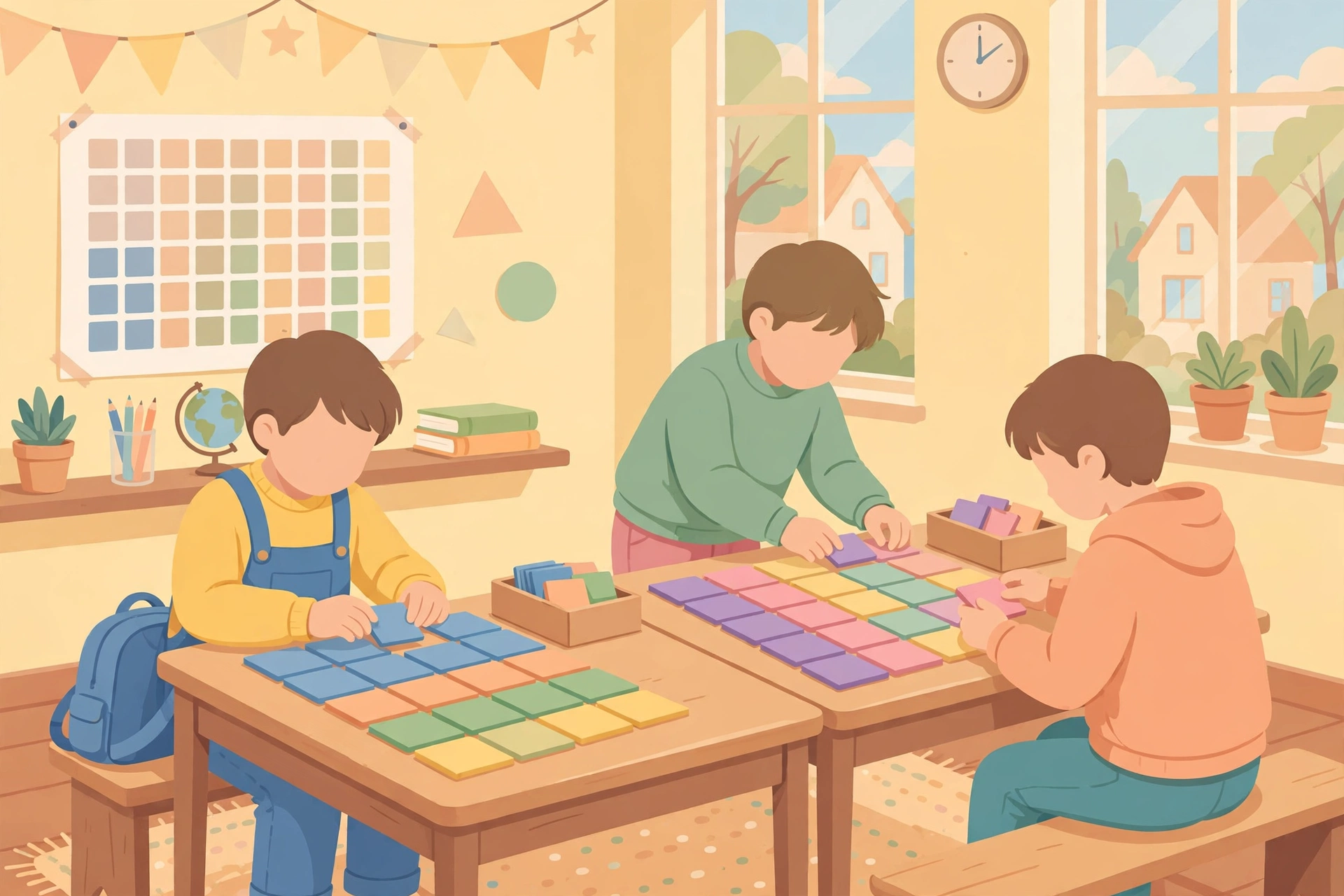
Arrays make multiplication visible. A 6-by-4 rectangle of tiles shows why 6 x 4 = 24 and also why 4 x 6 gives the same product, which is the commutative property students can see. When facts get shaky, students can rebuild them from the picture instead of guessing.
Skip counting bridges addition and multiplication. Counting by 3s rehearses the 3s facts in rhythm, and it later unlocks division: to solve 56 / 7, skip-count by 7s to 56. Keep arrays and skip counting in the weekly rotation even after facts feel solid.
How to Practice for Multiplication and Division Fluency Without Timed-Test Tears
Keep practice short, social, and strategy-named. Five-minute partner games where students say the strategy aloud (“I doubled my fours”) build recall and flexibility at once. Fact sorts, where students group cards by strategy used, turn review into thinking.
Track personal bests, not class rankings. A simple chart where each student records their own known facts turns practice into a self-competition everyone can win. Celebrate strategy discoveries as loudly as speed gains, and fluency grows without the anxiety that timed tests so often bring.
How Do the 9 Strategies Fit Together as a System?
The nine strategies are not nine separate things to memorize. They are a connected network, and the connections are what make fluency stick. At the center sit the anchor facts: twos, fives, tens, and squares. Every student masters these first because they are the most visual and the most patterned. A child who truly owns 5 times 7 holds a key that unlocks dozens of other facts.
Radiating outward are the derived strategies, each one a short walk from an anchor. Six times 7 is just 5 times 7 plus one more 7. Eight times 6 is double 4 times 6. Nine times anything is ten times anything minus one group. Teach these as bridges, always naming the anchor: “We know 5 sevens. How does that help with 6 sevens?” The naming matters because it trains students to search their memory for useful anchors instead of panicking.
The outer ring is strategic choice. A fluent student does not use the same strategy every time. They glance at 7 times 8 and think, “I know 8 times 8 is 64, so one less group is 56,” while their neighbor thinks, “7 times 4 is 28, doubled is 56.” Both are fluent. Fluency is not one path. It is the ability to find a path, and the nine strategies give students nine different doors into every fact.
What Does Division Fluency Actually Feel Like?
Forget long division for a moment. Real division fluency sounds like this: “48 divided by 6? Well, 6 times 8 is 48, so it is 8.” The student did not divide. They thought of the missing factor, found it through multiplication, and answered. This is how fluent mathematicians actually work, and it is why division fluency grows directly from multiplication fluency instead of from separate practice.
Build this connection explicitly with fact families. Show 6, 8, and 48 together and ask for all four facts: 6 times 8, 8 times 6, 48 divided by 6, 48 divided by 8. Let students discover that they already know the division facts hiding inside their multiplication facts. The moment a student says “Oh, division is just backwards multiplication,” a huge chunk of memorization work vanishes.
Use the “how many groups” language relentlessly. “How many 6s are hiding in 48?” is a question students can act out, draw, and reason about. “What is 48 divided by 6?” is a question they can only compute. The first builds understanding that transfers. The second builds a procedure that breaks. Language shapes thinking, so choose language that shapes it well.
Try It: The Known-Fact Relay
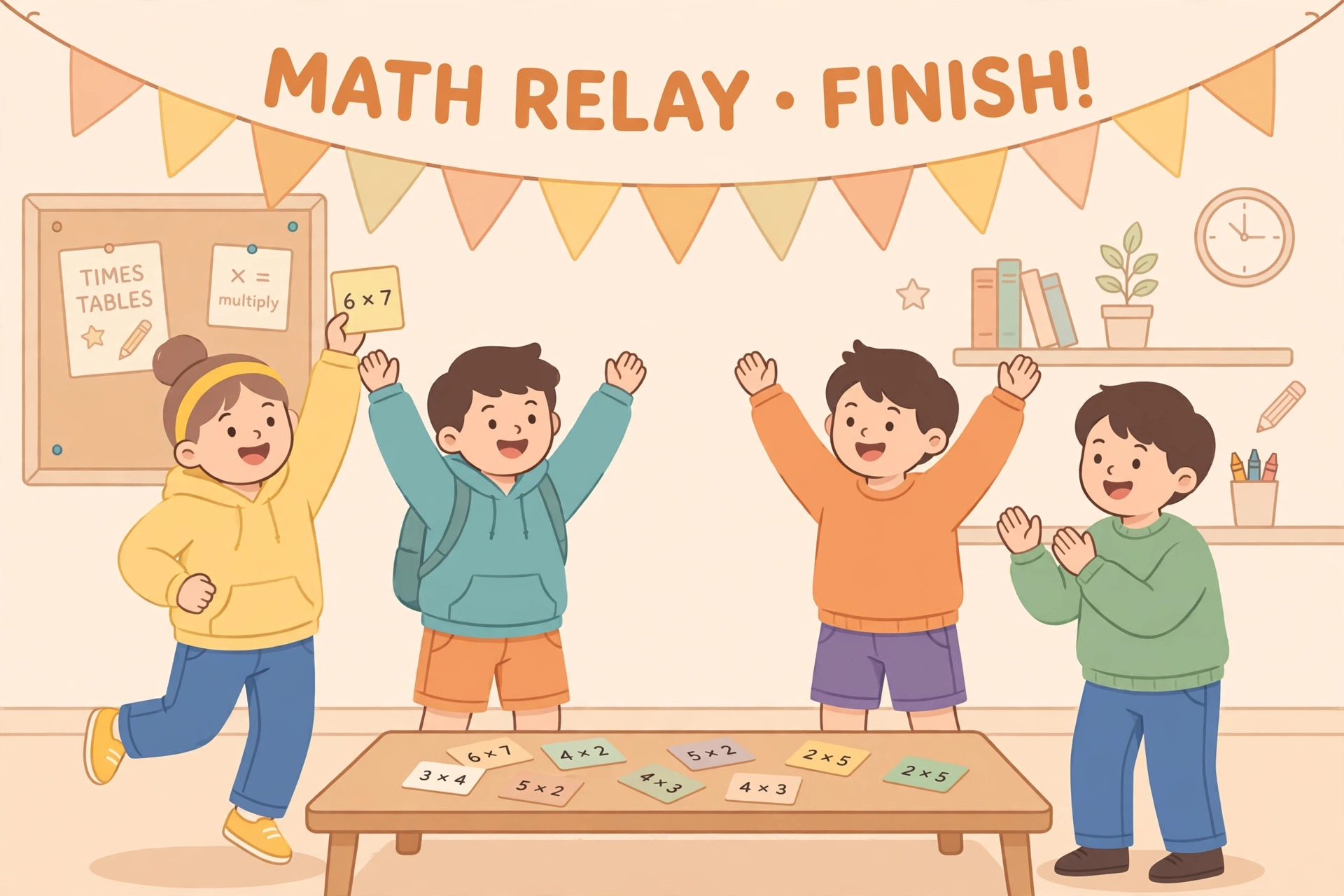
Split the class into teams of four and give each team a set of fact cards from 0 through 10.
The first runner draws a card, solves it aloud naming the strategy (“6 x 4: I doubled 6 x 2”), and tags the next runner.
A wrong answer sends the card to the back of the deck for a retry later.
After one round, swap in the division partners: 24 / 6, 24 / 4. Runners must name the multiplication fact that unlocks each division. Retry cards guarantee every team finishes and no fact gets skipped.
Quick Practice
Question: A student knows 6 x 5 = 30 but freezes on 6 x 6 and 36 / 6. Which strategies unlock both, and what do you say?
Answer: One more group: 6 x 6 is 6 x 5 = 30 plus one more 6, which is 36. Then the fact family gives 36 / 6 = 6. Say: “You already own the 5s. Add one group and the 6s are yours, and division comes free.”
Related Terms
- Array – objects arranged in equal rows and columns, a visual model for multiplication.
- Fact Family – a set of related multiplication and division facts built from the same three numbers.
- Commutative Property – the rule that order does not change a product: 4 x 6 = 6 x 4.
- Skip Counting – counting by a number other than one, like 7s to rehearse division facts.
- Quotient – the answer to a division problem.
- Zero Property – the rule that any number multiplied by zero equals zero.
Our Multiplication and Division Fact Families lesson turns that link into practice, with slides, a worksheet and a full answer key.
Frequently Asked Questions
Should students memorize times tables?
Memory matters, but it should be the finish line. Build facts through the nine strategies first, then let repeated use harden into recall.
What order should I teach the multiplication facts?
Easiest first: 0s, 1s, 2s, 10s, 5s, then 4s, 3s, 8s, 9s, and finally 6s and 7s via break-apart. This order keeps early wins coming and lets each strategy fund the next.
When should division facts be introduced?
Alongside multiplication from the start. When students learn 7 x 8 = 56, teach 56 / 7 = 8 and 56 / 8 = 7 in the same breath. Separating them doubles the work.
How do I help a fifth grader who never learned their facts?
Return to the strategy path, not to first grade worksheets. Daily work on arrays, fact families, and break-apart rebuilds facts fast at any age, without shame.
Are timed tests ever appropriate?
Brief self-checks where students beat their own past scores can motivate. Public timed tests that rank students raise anxiety without building lasting recall.
How do I help students who confuse multiplication and division?
They are confusing the question, not the operation. Teach them to always ask first: “Am I finding the total, or am I finding how many groups?” Act it out with objects until the distinction is physical. Once the situations feel different in their hands, the symbols stop blurring together.
What about the really hard facts like 7 times 8?
There are no hard facts, only facts far from anchors. Seven times 8 sits near 8 times 8 (just subtract 8) and near 7 times 7 (just add 7). Teach students to find the nearest anchor instead of staring at the hard fact. Every fact is easy when you approach it from something you know.
How much daily practice do students need?
Ten to fifteen minutes of strategic practice daily, where students explain their thinking, beats thirty minutes of silent worksheet work. The explaining is not extra. It is the mechanism by which strategies become automatic. A student who can teach a strategy owns it forever.
To practise division facts with steps, use our free long division calculator.
Reading about it is one thing, practising it is another. Our free What Is Division? lesson builds the idea step by step, with slides, a printable worksheet and a full answer key.
Members unlock every lesson in the library, including the full Fractions, Multiplication, Place Value, Addition & Subtraction, Time & Money and Geometry & Shapes units. See the full library



1 thought on “Multiplication and Division Fluency: 9 Proven Strategies”