

Spring term is when percent walks into the classroom as a brand new language for amounts children already know. The child who can shade three fourths of a grid in October meets 75 percent in January and thinks it is a new topic. It is not. It is the same amount with a third name, and this pack teaches the three names as one idea. These fractions decimals and percentages worksheets were built for that exact moment.
Start free. The first lesson, Percent Basics, is free and it teaches the whole starting idea on the hundredths grid. Get it here: Percent Basics free lesson. If your class met percents for the first time on the 100th day, the grid work in our 100th Day of School pack is the first look this pack builds on.
What FDP Means, in Plain Words
FDP is short for fractions, decimals and percentages. Three forms, one amount. One half can be written as the fraction 1/2, the decimal 0.5, or 50 percent, and all three name the exact same part of the same whole.
The bridge between the three forms is hundredths. A percent is parts out of 100. A decimal to hundredths counts the same parts. A fraction with denominator 100 names them too. Once a child can move an amount onto the hundredths grid, every swap between the forms becomes a short walk instead of a new rule. Pupils can test that walk on screen with the free Fraction Number Line tool, where halves, tenths and hundredths sit on the same line.
Three names, one amount. Teach the amount first and the names follow.
Percent grows out of ratio and unit rate work, so if your class is not there yet, start with our Grade 6 Ratios and Rates guide. And when your class is ready for percent problem solving in full, our Grade 6 Percent guide is the step that follows this readiness work.
Fractions Decimals and Percentages Worksheets: The Benchmark Amounts
Some amounts come up so often that children should know all three names on sight. This table is the heart of the whole topic, and the first two lessons build it row by row.
| Fraction | Decimal | Percent |
|---|---|---|
| 1/2 | 0.5 | 50% |
| 1/4 | 0.25 | 25% |
| 3/4 | 0.75 | 75% |
| 1/5 | 0.2 | 20% |
| 2/5 | 0.4 | 40% |
| 4/5 | 0.8 | 80% |
| 1/10 | 0.1 | 10% |
| 3/10 | 0.3 | 30% |
Percent Starts on the Hundredths Grid
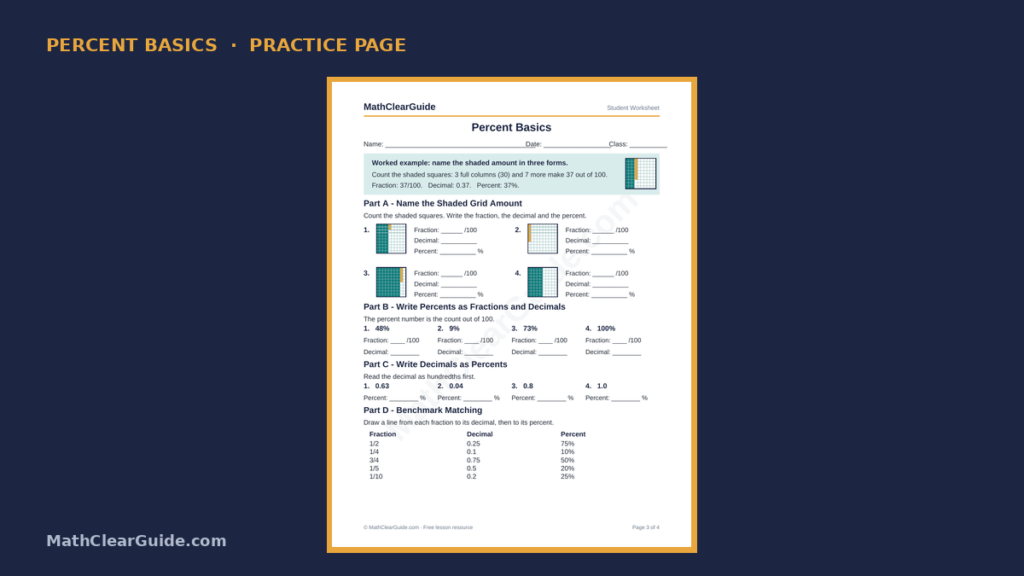
The free lesson starts where percent starts: parts out of 100. Pupils shade a hundredths grid, then write the three names for the shaded amount at once, so 37 shaded squares become 37/100, 0.37 and 37 percent in one breath. The lesson then builds the benchmark rows from the table above on grids and on a number line, and it teaches the trap by name early: 50 percent is one half, not 50 out of 50. The pack does not start with bare fraction to decimal swapping, because two live lessons already teach that step well, Fractions to Decimals and Fractions as Decimals. This pack starts at the third form.
Download the free lesson: Percent Basics
Any Form to Any Form
The second lesson is the full conversion lesson. Given any one form, pupils find the other two, in every direction. The method never changes: rename the fraction with denominator 100 first, and then the decimal and the percent follow. Fifths and quarters arrive through equivalent fractions, twentieths join through 1/20 = 5/100, and the Challenge page takes the honest step past one whole, where 5/4, 1.25 and 125 percent name the same amount. Pupils who want to check a swap can type it into the Fraction Calculator and see the working.
Download this lesson: FDP Conversions

Which Is More: Mixed Forms Side by Side
Comparing is where mixed forms cost marks. Is 0.45 more than 48 percent? Is 9/20 less than both? The third lesson teaches the one safe method: turn every form into the same form first, then compare, and check on the number line. The famous traps are taught by name. A pupil who learns that 0.5 beats 45 percent even though 45 is the bigger number has learned the real skill, because the forms stop shouting and the amounts start talking. Decimal Place Value and Comparing and Ordering Decimals carry the decimal half of this work all year, and this lesson extends it to all three forms at once.
Download this lesson: Comparing Fractions, Decimals and Percentages
Percent of an Amount: Start With 10 Percent
The fourth lesson is the Year 6 money skill. There is no formula to memorise. Find 10 percent by dividing by 10, find 1 percent by dividing by 100, and then build any percent out of those two parts. Thirty percent is three lots of 10 percent. Five percent is half of 10 percent. Fifteen percent is 10 percent plus 5 percent. The amounts are friendly numbers, money and real classroom counts: a test score out of 50, a price cut in a sale, a survey of 200 pupils where 10 percent is 20 children.
Download this lesson: Percentage of Amounts
Find 10 percent first. Every other percent is built out of that one move.
Word Problems That Mix All Three
The fifth lesson is the pack review, and it is honest about being one. Test style problems mix the forms the way real tests do: a score of 42 out of 50 read as a percent, a survey reported as a fraction in one line and a decimal in the next, a sale price with a percent off. Pupils read the problem, choose the form that makes it easy, convert, and solve. The second half is a short answer review of the whole pack, so a teacher can see in one page which of the four skills still needs work before the block ends.
Download this lesson: FDP Word Problems and Review
Support and Challenge in the Same Pack
Differentiation in this pack changes the thinking, not the page count. In the percentage of amounts lesson, the support level finds only 50, 25 and 10 percent, with the hundredths grid printed beside the amount. The Challenge page takes the grid away and asks for 15 percent of a price in two steps: find it, then take it off and give the new price. Same lesson, same day, two honest levels of work.
The support level keeps the grid. The challenge level takes it away and adds a step.
What England and the US Ask, Said Plainly
This pack is UK led, and it says so. Percent is a named spring topic in England, while the US standards hold percent back until Grade 6. Here is the honest map.
| Who asks | What they ask |
|---|---|
| England Year 5 | Understand percent as parts out of 100. Write percentages as fractions with denominator 100 and as decimals. Know the matches for one half, one fourth, one fifth, two fifths and four fifths. |
| England Year 6 | Recall and use matches between simple fractions, decimals and percentages. Solve problems involving percentages, including percentages of amounts. |
| United States | No percent standard before Grade 6, where 6.RP.A.3c asks for percents of amounts. This pack is Grade 5 extension and Grade 6 readiness, built on the Grade 4 hundredths work in 4.NF.C.5, 4.NF.C.6 and 4.NF.C.7. |
The same honesty runs through the rest of the library. The Grade 3 Fractions pack builds the equal parts idea two years earlier, our Equivalent Fractions lesson teaches the renaming move this pack leans on, and the Mid-Year Benchmark papers show where FDP questions sit inside a whole test.
Common Questions
What does FDP mean? Fractions, decimals and percentages. They are three forms that name the same amounts, and FDP work is swapping between them and using them together.
When do children learn percentages? In England, percent starts in Year 5 and grows in Year 6, both in the spring term. In the US, percent is a Grade 6 standard, so Grade 5 work with percent is extension and readiness.
How do you turn a fraction into a percent? Rename the fraction with denominator 100 first. The top number is then the percent. So 3/5 becomes 60/100, and that is 60 percent.
Is percent part of Grade 5 math in the US? Not as a standard. The first US percent standard is 6.RP.A.3c in Grade 6. This pack frames its US use as Grade 5 extension and Grade 6 readiness, and it anchors the conversion work on real Grade 4 hundredths standards.
Is the first lesson free? Yes. Percent Basics is free with an email signup, and it teaches the whole starting idea, grid, three names and benchmarks.
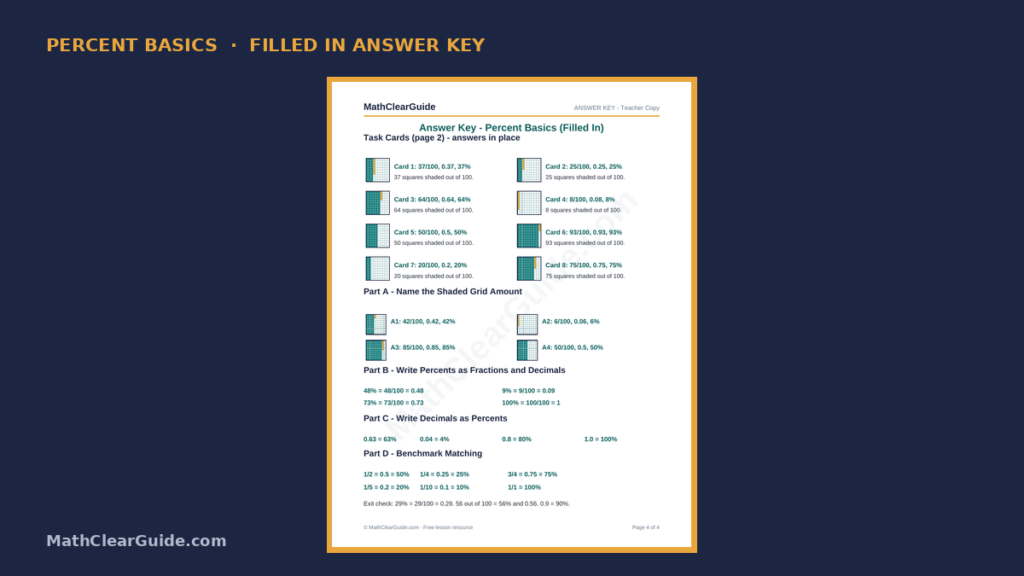
Is the answer key in? Yes. Every lesson has a filled in answer key. The answers sit on the page in the same place as the pupil work, and the word problems lesson shows the worked steps.
Start with the free lesson. Print Percent Basics, shade the first grid with your class, and watch the three names land as one idea. When you are ready for conversions, comparing, amounts and the mixed review, join MathClearGuide and unlock the full pack of five lessons, each with slides, task cards, a practice page, a challenge page and filled in answer keys.
Get the free lesson: Percent Basics
Reading about it is one thing, practising it is another. Our free What Is a Fraction? lesson builds the idea step by step, with slides, a printable worksheet and a full answer key.
Members unlock every lesson in the library, including the full Fractions, Multiplication, Place Value, Addition & Subtraction, Time & Money and Geometry & Shapes units. See the full library


2 thoughts on “Percentages and FDP Conversions: A Year 5 and 6 Guide for Teachers”