
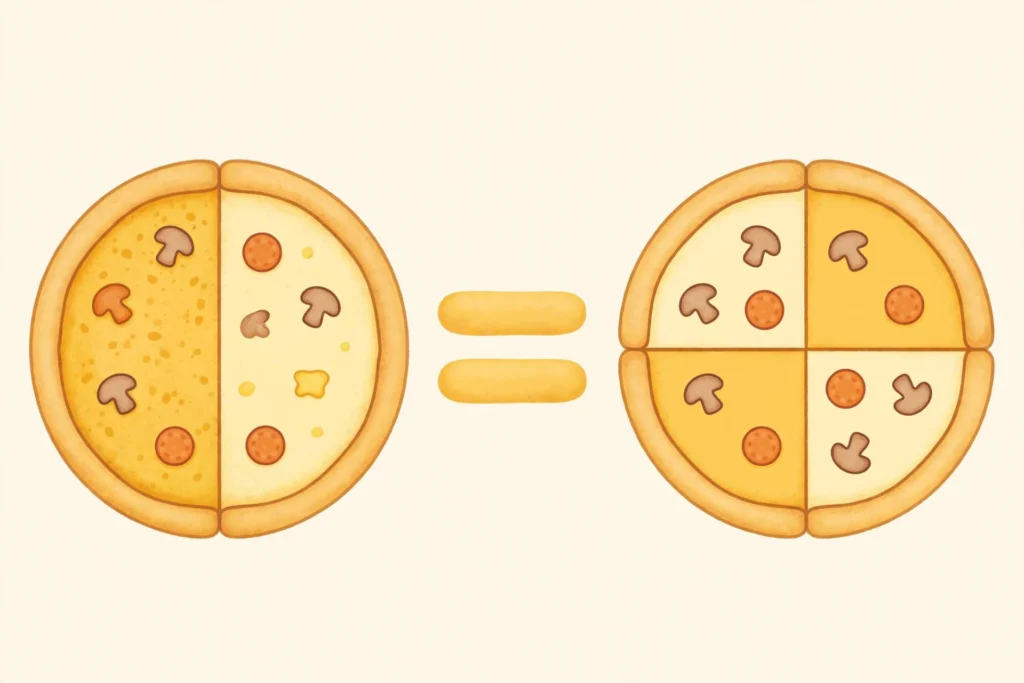
In math, equivalent means having the same value or amount, even when two things look different. The words “same value, different look” sum up the whole idea.
Did You Know: The equals sign we use to show equivalence was introduced in 1557 by the Welsh mathematician Robert Recorde. He chose two parallel lines because, as he wrote, no two things can be more equal.
What Does Equivalent Mean in Simple Words?
Equivalent is a fancy word for a simple idea: two things that match in value. A dollar bill and four quarters are equivalent because both are worth one dollar. The bill and the coins look nothing alike, but their value is the same.
Math is full of these disguises. The expression 2 + 2 is equivalent to 4. The fraction 1/2 is equivalent to 2/4. The words “twelve” and “12” are equivalent names for the same number. Once kids grasp that the same amount can wear many outfits, a lot of math gets easier.
What Is the Difference Between Equal and Equivalent?
Equal means identical in every way. Two copies of the same book are equal. Equivalent means the same in value but not necessarily in form. A hardcover book and its paperback twin are equivalent in story but not equal as objects.
In math class the words overlap, and teachers often use them as partners. Still, the shade of meaning helps. We say 2 equals 2 because both sides are exactly alike. We say 1 + 1 is equivalent to 2 because the left side takes a different shape to reach the same value. The equals sign covers both cases, which is why it shows up in nearly every lesson.
What Are Examples of Equivalent in Math?
Start with numbers. The number 10 is equivalent to 5 + 5, to 20 / 2, and to the words “ten.” Each form names the same amount. Kids who see this early stop fearing long expressions, because they recognize old friends in new clothes.
Money is a natural playground. One dime is equivalent to ten pennies. Three nickels are equivalent to fifteen cents. A dollar is equivalent to one hundred cents. Then come fractions: 1/2 is equivalent to 2/4 and to 3/6. Measurement follows: 1 foot is equivalent to 12 inches, and 1 hour is equivalent to 60 minutes. The pattern repeats across every unit of math.
How Do You Find Equivalent Values?
For fractions, there is a reliable trick. Multiply or divide both the top and bottom numbers by the same number, and the value stays put. Starting with 1/2, multiply top and bottom by 2 to get 2/4. Multiply by 3 instead to get 3/6. All three name the same amount.
The trick works because you are multiplying by 1 in disguise. Multiplying by 2/2 or 3/3 changes the look without changing the value, just as cutting a pizza into more slices and taking more slices leaves you with the same meal. Dividing works the same way in reverse, which is how we simplify fractions like 4/8 down to 1/2.
What Is the Equals Sign Telling Us?
The equals sign is a balance scale. It says the value on the left matches the value on the right, even when the two sides look different. When a student writes 7 = 3 + 4, the sign announces that seven and three-plus-four are equivalent.
A common trap is reading the equals sign as “the answer comes next.” That habit makes equations like 5 + 3 = 4 + 4 feel wrong, even though both sides equal 8. Teach kids to read the sign as “is the same value as,” and true and false number sentences become a favorite game. Ask the class to vote true or false on 6 + 2 = 5 + 3, then prove it with blocks.
Try It: Match the Pairs

Make twelve cards. On six cards draw or write values: 1/2, 15 cents, 10, 1 foot, 60 minutes, and 3 + 4. On the other six write their matches: 2/4, three nickels, 5 + 5, 12 inches, 1 hour, and 7. Shuffle and lay them face down.
Players flip two cards at a time. A pair stays only if the two cards are equivalent, showing the same value in different form. When a pair is claimed, the player must say the match out loud: “Two quarters and one half are equivalent.” The player with the most pairs wins, and the whole class practices spotting sameness in disguise.
Quick Practice
Which of these is equivalent to 3/6: 1/2, 2/3, or 1/3? Explain your thinking.
The answer is 1/2. Divide the top and bottom of 3/6 by 3, and you get 1/2, so the two fractions name the same amount. The fraction 2/3 is larger than 1/2, and 1/3 is smaller, so neither one matches.
Related Terms
Frequently Asked Questions
What does equivalent mean for kids?
Equivalent means the same value wearing a different look. A dollar bill and four quarters are equivalent because both are worth one dollar.
Are equal and equivalent the same thing?
They are close partners. Equal means identical in every way, while equivalent means the same in value but different in form. In most elementary lessons, the equals sign covers both.
What are equivalent fractions?
Equivalent fractions are fractions that look different but name the same amount, like 1/2 and 2/4. You can make them by multiplying or dividing the top and bottom by the same number.
Is 2 + 2 equivalent to 4?
Yes. Both sides have the same value, even though one side is an expression and the other is a single number. That is exactly what equivalent means.
How can I tell if two things are equivalent?
Check whether they share the same value. For fractions, draw a picture or multiply and divide to compare. For expressions, compute each side and see if the answers match.
Reading about it is one thing, practising it is another. Our free What Is a Fraction? lesson builds the idea step by step, with slides, a printable worksheet and a full answer key.
Members unlock every lesson in the library, including the full Fractions, Multiplication, Place Value, Addition & Subtraction, Time & Money and Geometry & Shapes units. See the full library


