
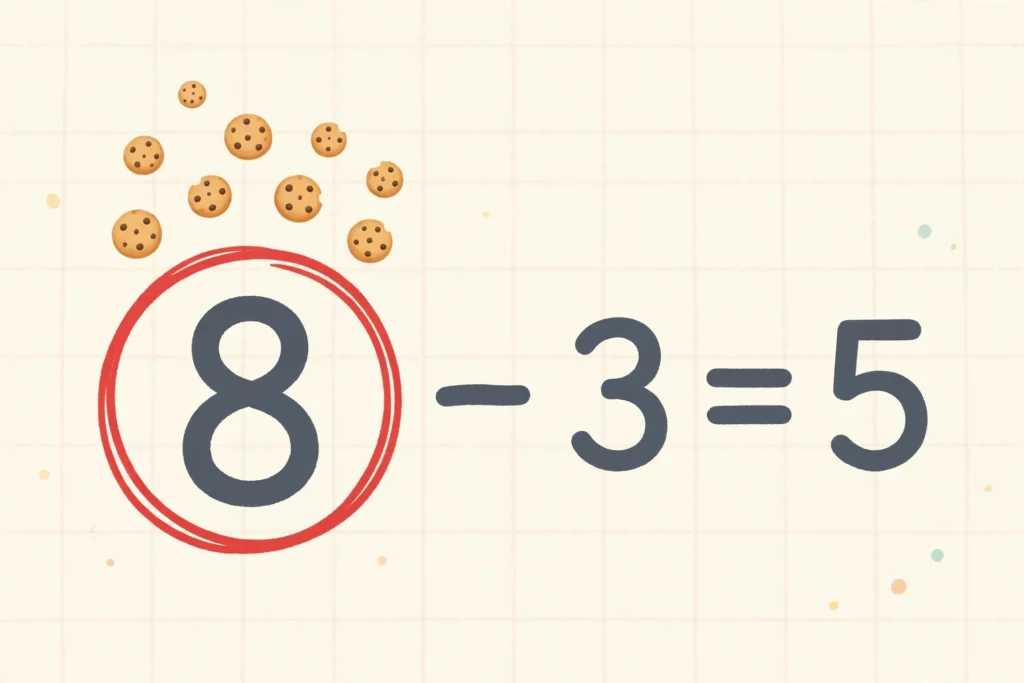
A minuend is the number you subtract from in a subtraction problem. It is the first number in the sentence and the whole that you take parts away from.
Common Mistake: Students often mix up the minuend and the subtrahend. The minuend is the number being diminished, while the subtrahend is the number being taken away. In 9 minus 4 equals 5, the minuend is 9, not 4.
How Do You Find the Minuend?
Look at the left side of the minus sign. In a horizontal problem like 12 minus 5 equals 7, the minuend is 12. In a stacked problem written in column form, the minuend is the top number. There is one rule that never changes: the minuend sits first, before anything is taken away.
Picture a plate with ten cookies. A friend takes three. The ten cookies are the minuend, the whole you started with. The three cookies taken are the subtrahend. The seven cookies left are the difference. Every subtraction story starts with a minuend, because you must have something before you can take something away.
What Are the Three Parts of a Subtraction Problem?
Every subtraction problem has three parts, and each has a name. The formula goes like this: minuend minus subtrahend equals difference. Say the words out loud with your class a few times. They roll off the tongue once you hear them in action.
Take 15 minus 6 equals 9. The 15 is the minuend, the number you start with. The 6 is the subtrahend, the number you subtract. The 9 is the difference, the answer left over. Knowing each name makes word problems easier, because clues like how many are left point straight to the difference, and clues like how many there were at first point to the minuend.
Is the Minuend Always the Bigger Number?
In the subtraction you meet in elementary school, yes. You start with the whole and take part of it away, so the minuend is the biggest number in the sentence. Ten minus three equals seven: ten tops the list.
That is why a quick check works so well. If your answer comes out bigger than the number you started with, something went sideways. In K-5 math, the difference is never larger than the minuend. This check catches many slip-ups before they reach the teacher’s desk.
Where Does the Word Minuend Come From?
Minuend comes from a Latin word, minuendus, which means a value that has to be made smaller. It is a fitting name, because the minuend shrinks every time you subtract from it. The subtrahend takes, and the minuend gives. Together they form a pair, like the addends in addition.
Math vocabulary works this way on purpose. Just as addition has addends and sum, subtraction has a minuend, a subtrahend, and a difference. Division has a dividend and a divisor. Learning the names now builds a habit that helps in every grade ahead, when problems grow longer and naming the parts keeps your thinking organized.
Why Does Naming the Minuend Matter?
Order matters in subtraction. Switch the numbers and the answer changes or stops making sense. Twelve minus five equals seven, but five minus twelve is a problem elementary math leaves alone. Naming the minuend tells your brain which number goes first and why.
The habit pays off in word problems too. A story says Maria had 20 stickers and gave 8 to her brother. Spotting that 20 is the minuend, the starting whole, leads you straight to the subtraction 20 minus 8. Students who can name the minuend rarely set up the problem backward.
Try It: Minuend Detective
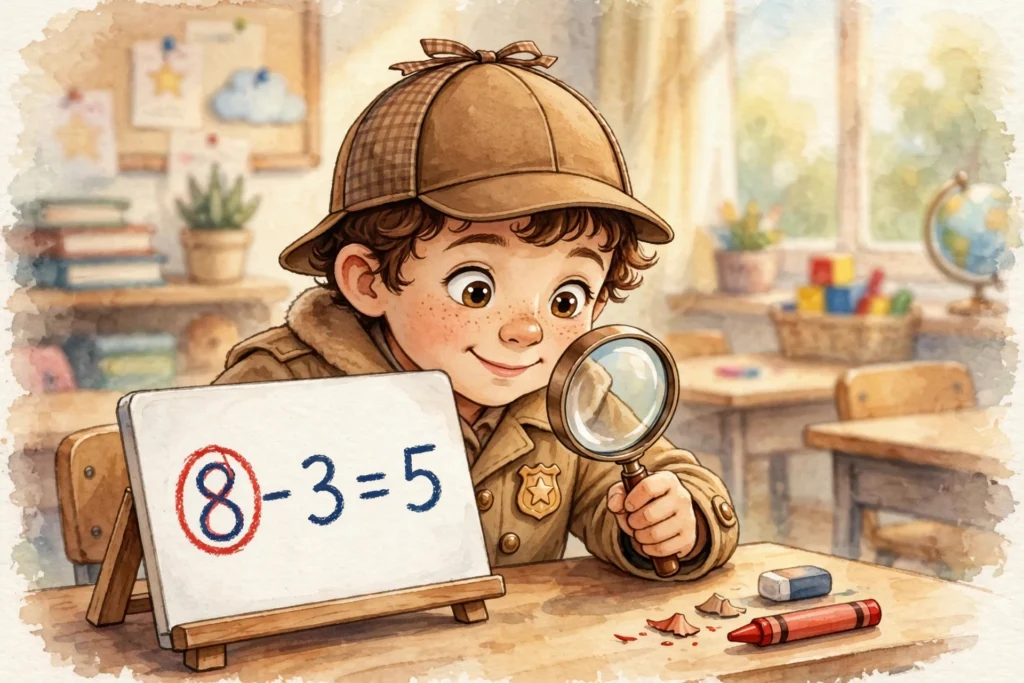
Write five subtraction problems on the board or on a sheet of paper. Mix horizontal and column form. Hand each student a red crayon or marker. Their job is to circle only the minuend in each problem.
Walk the room as they work and ask them to defend each choice. A strong answer sounds like, “I circled the 14 because it is the number we subtract from.” Then flip the script: give them a subtrahend and a difference, like 4 and 9, and ask what the minuend must have been. Solving backward shows real mastery of the three parts.
Quick Practice
In the problem 56 minus 28 equals 28, name the minuend, the subtrahend, and the difference.
The minuend is 56, the first and largest number, which sits at the top in column form. The subtrahend is 28, the number being taken away. The second 28 is the difference, the answer left over. Notice the minuend minus subtrahend equals difference pattern holds: 56 minus 28 equals 28.
Related Terms
Frequently Asked Questions
What is a minuend in simple words?
The minuend is the number you start with in a subtraction problem. It is the whole amount before anything is taken away.
How is the minuend different from the subtrahend?
The minuend is the number subtracted from, and it comes first. The subtrahend is the number being subtracted, and it comes second, after the minus sign. In 10 minus 3, 10 is the minuend and 3 is the subtrahend.
Where is the minuend in column subtraction?
In column form, the minuend is the top number. The subtrahend sits below it, and the difference goes on the answer line at the bottom.
Can the minuend be smaller than the subtrahend?
In elementary school math with whole numbers, no. The whole must be at least as big as the part taken from it. Later grades introduce negative numbers, where the rules expand.
Is the minuend always the answer to a word problem clue?
Often the minuend hides in phrases like “had at first,” “started with,” or “had in all.” Spotting those clues tells you which number goes first in your subtraction sentence.
Every topic clicks faster with practice. Our Resource Library has free lesson packs with slides, printable worksheets and full answer keys, ready to download and teach.
Members unlock every lesson in the library, including the full Fractions, Multiplication, Place Value, Addition & Subtraction, Time & Money and Geometry & Shapes units. See the full library


