
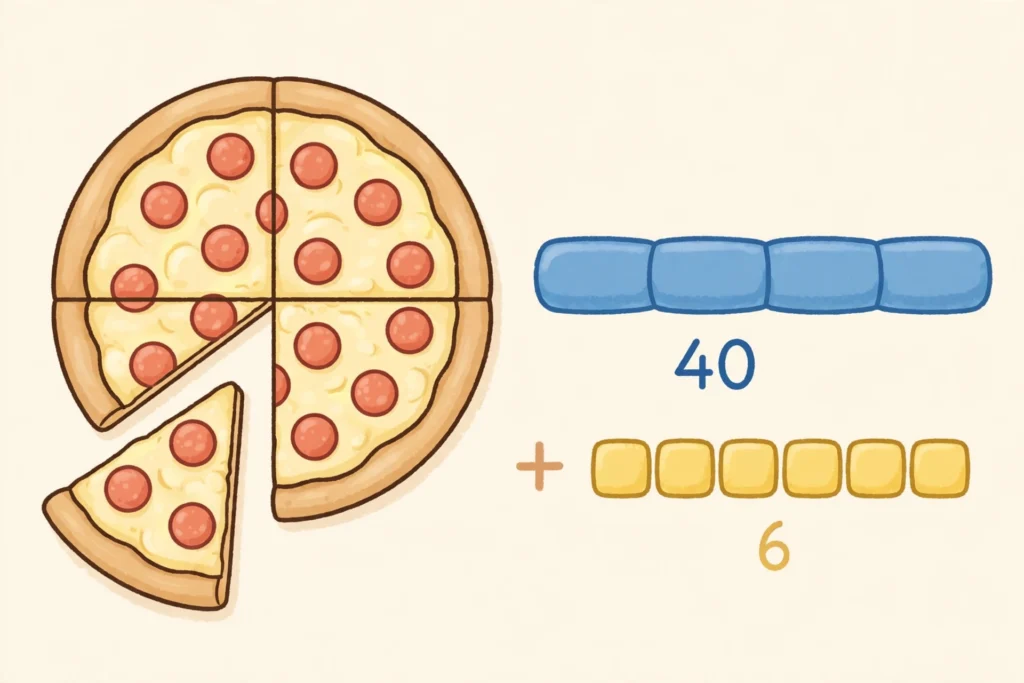
To partition means to split a whole thing into parts. You can partition a shape into equal shares, or split a number into smaller pieces that are easier to work with.
What Does Partition Mean in Math?
In math, partition is a fancy word for a simple idea: breaking something into parts. Picture a teacher holding up a granola bar at snack time. She snaps it into three pieces and hands one to each student at her table. She just partitioned the granola bar.
Splitting a pack of crayons among table groups or sorting marbles by color counts too. The parts do not have to be the same size. Mathematicians care about two big kinds: splitting numbers into smaller numbers, and splitting shapes into smaller regions. Both show up from kindergarten counting games to third-grade fractions.
How Do You Partition a Number?
Partitioning a number means breaking it into a sum of smaller numbers. The most common way to do this is by place value. Take the number 46. It has 4 tens and 6 ones, so you can partition it as:
46 = 40 + 6
Try a bigger number. The number 327 has 3 hundreds, 2 tens, and 7 ones:
327 = 300 + 20 + 7
But place value is not the only way. You can partition 46 as 30 + 16 or 20 + 20 + 6. Any split that adds back up to the original number is a fair partition, and there is no single right answer.
This flexibility pays off in mental math. Look at 36 + 48. Partition each number first: 36 = 30 + 6 and 48 = 40 + 8. Add the tens (30 + 40 = 70) and the ones (6 + 8 = 14), then put the pieces back together: 70 + 14 = 84. Partitioning turned one hard problem into two easy ones.
How Do You Partition a Shape?
Partitioning a shape means cutting or drawing lines to split it into regions. In the early grades, the goal is usually equal shares. First graders practice partitioning circles and rectangles into halves and fourths. Second graders add thirds, and third graders connect partitioning to fractions.
Here is a classroom moment you might recognize. A teacher hands each student a paper circle and asks, “How can we share this cookie fairly between two friends?” Kids fold the circle in half, crease it, and open it to see two equal halves. Then she asks about four friends, and they fold it in half again to make fourths.
Pattern blocks give another great picture. Six small green triangles fit together to make one hexagon, and two red trapezoids make the same hexagon. Each arrangement partitions the hexagon differently, and students can see that the same whole can be split in more than one way.
Notice something important: when we partition shapes for fractions, the parts must be equal in size. A pizza cut into one giant slice and three tiny slivers is partitioned, but it is not partitioned into fourths. Equal shares only happen when every piece matches.
Is Partitioning the Same as Dividing?
Quick Answer: Not quite. Partitioning is the bigger idea. It means splitting anything into parts, and the parts can be equal or unequal. Dividing is one special kind of partitioning where a number is shared into equal groups.
Think of it this way. Writing 46 = 40 + 6 is partitioning, but nobody would call it division. On the other hand, splitting 12 cookies equally among 4 friends gives 3 cookies each. That is both partitioning and division, because the parts came out equal.
So every division partitions a number, but not every partition is a division. When your teacher says “partition,” she might mean “split it however makes sense.” When she says “divide,” she always means “split it into equal groups.”
Why Is Partitioning Useful in Math?
Partitioning sits behind the scenes in almost every math topic. Students partition numbers to add and subtract mentally, break tricky word problems into smaller steps, and split rectangles into rows to see multiplication facts. It also builds number sense: a child who sees 46 as “40 and 6” understands the number more deeply than one who only sees the digits 4 and 6, and can estimate and check answers with confidence.
Try It: Pizza Partition Challenge

Grab some paper circles (paper plates work too), crayons, and scissors. You are going to run a pizza shop where every pizza must be partitioned fairly.
Round 1: Halves. Fold a paper circle in half and crease it. Open it up and trace the fold line with a crayon. You just partitioned your pizza into halves. Label each half with the word “half.”
Round 2: Fourths. Take a fresh circle. Fold it in half, then fold it in half again. Open it and trace both fold lines. Count the regions. You should see four equal parts. Label each one “fourth” or “quarter.”
Round 3: The fairness test. Cut along the fold lines of your fourths pizza and stack the four slices. Do they match exactly? If one slice hangs over the edge, your partition was not equal. Try again until every slice lines up.
Bonus challenge. Partition a circle into thirds without folding it in half first. Hint: draw lines from the center like spokes on a wheel. Thirds are trickier than fourths, and that is exactly why second graders practice them.
Quick Practice
Question: Partition the number 57 in two different ways.
Worked answer: The standard place-value partition splits 57 into its tens and ones: 57 = 50 + 7. A second way moves ten from the tens pile to the ones pile: 57 = 40 + 17. Both are correct because 50 + 7 and 40 + 17 each add up to 57. Any two numbers that sum to 57 form a valid partition.
Related Terms
- Decompose – breaking a number into its parts, a close cousin of partitioning numbers.
- Place Value – the tens-and-ones structure that makes partitioning numbers work.
- Regrouping – trading tens for ones, which reshuffles a partition.
- Equivalent Fractions – different partitions of the same whole that name the same amount.
- Tape Diagram – a bar picture that shows a whole partitioned into parts.
Frequently Asked Questions
What is an example of partitioning in math?
A classic example is partitioning 46 into 40 + 6. For shapes, cutting a circle into four equal fourths is partitioning. Sorting 10 counters into groups of 7 and 3 is partitioning a set.
What grade learns about partitioning?
It starts in kindergarten with sorting and sharing. First graders partition shapes into halves and fourths, second graders add thirds, and third graders connect partitioning to fractions and multi-digit addition.
What is the difference between partitioning and factoring?
Partitioning breaks a number into a sum of parts, like 46 = 40 + 6. Factoring breaks a number into a product of factors, like 12 = 3 x 4.
Can you partition something into unequal parts?
Yes. Partitioning only means splitting into parts. The parts can be equal, like fourths of a pizza, or unequal, like splitting 46 into 40 + 6. Equal parts are required only when the goal is fractions or fair sharing.
Every topic clicks faster with practice. Our Resource Library has free lesson packs with slides, printable worksheets and full answer keys, ready to download and teach.
Members unlock every lesson in the library, including the full Fractions, Multiplication, Place Value, Addition & Subtraction, Time & Money and Geometry & Shapes units. See the full library


