

Watch a first grader solve 8 + 5. One counts every finger twice. Another says, “8 and 2 make 10, plus 3 more is 13.” Same answer, different math brains. The second child owns a strategy. Here are the eight strategies that build addition and subtraction fluency, moving students from finger-counting to real fluency.
What Does Addition and Subtraction Fluency Within 20 Look Like?
The Common Core draws a clear line. By the end of grade 1, students should add and subtract within 20 and show fluency within 10 (1.OA.C.6). By the end of grade 2, they should fluently add and subtract within 20 using mental strategies, and know from memory all sums of two one-digit numbers (2.OA.B.2). These benchmarks define what addition and subtraction fluency looks like in the early grades.
Notice the order. Fluency within 10 comes first, then the facts to 20. A student who truly owns 8 + 2 = 10 can stretch that fact to reach 8 + 5.
That is why the strategies below start small and build outward. Skipping the within-10 foundation to drill facts to 20 is like building the second floor before the first.
Which 8 Strategies Build Addition and Subtraction Fluency?
Teach these in order and let each one settle before adding the next. This steady layering is how lasting addition and subtraction fluency develops.
1. Counting on. Start at the bigger number and count up: for 6 + 3, think “6… 7, 8, 9.” It beats counting both sets from one.
2. Doubles. Facts like 4 + 4 and 9 + 9 become anchors. Children memorize doubles quickly, and doubles unlock the next strategy.
3. Near doubles. Turn 6 + 7 into the known double 6 + 6, then add one more. Hard facts start to feel like easy facts with a small twist.
4. Make ten. For 8 + 6, take 2 from the 6 to complete the 10, leaving 8 + 2 + 4 = 10 + 4 = 14. This is the single most powerful addition strategy in early math, so give it extra days.
5. Break apart to subtract. For 13 – 4, take away 3 to land on 10, then take away 1 more: 13 – 3 – 1 = 10 – 1 = 9. It mirrors make-ten in reverse.
6. Think addition. For 12 – 8, ask “8 plus what makes 12?” Students who know 8 + 4 = 12 get the subtraction fact free. This inverse thinking is the heart of fact families.
7. Compensation. Round to a friendly number, then adjust: 9 + 7 becomes 10 + 7 = 17, minus the extra 1, which is 16.
8. Known fact families. If 5 + 7 = 12 is known, then 7 + 5 = 12, 12 – 5 = 7, and 12 – 7 = 5 come along. Each family of three numbers yields four facts, which cuts memorization nearly in half.
How Do You Teach the Make-Ten Strategy?
Start concrete. Put 8 red counters on a ten frame and 6 yellow counters beside it. Ask how many reds are needed to fill the frame: 2. Move 2 yellows over, and the frame shows 10 + 4. Say the equation out loud together: 8 + 6 = 8 + 2 + 4 = 10 + 4 = 14.
Then go visual: draw the same move with circles before numbers appear. Only after the picture feels obvious do students write the bare equation. Rushing to symbols is the top reason make-ten fails.
What About Subtraction Facts?
Subtraction facts lag behind addition, and that is normal. The fix is not more subtraction drills. It is stronger addition. Every subtraction fact hides an addition fact, and “what plus 8 makes 15?” beats memorizing 15 – 8 alone. That is why addition and subtraction fluency grows best when the two operations are taught as partners.
Common Mistake: Teaching subtraction facts as a separate list to memorize. The two operations share one set of number relationships. Teach 7 + 8 = 15 and 15 – 7 = 8 in the same breath, on the same ten frame, in the same lesson. Split them apart and you double the memory load for no reason.
How Much Daily Practice Is Enough?
Five to ten focused minutes beat thirty distracted ones. Pick one strategy and a small set of facts, then rotate through partner games, quick sorts, and whiteboard flashes. End each session by asking one student to explain the strategy aloud. That explanation is where the learning locks in.
Track the facts each child knows, not just scores. A simple grid of names and mastered fact sets shows growth and tells you which strategy to teach next. Celebrate when a fact moves from “I can figure it out” to “I just know it.”
How Do the 8 Strategies Connect Into a Learning Path?
The strategies are not eight separate tricks. They form a ladder. At the bottom sit the anchor strategies every child learns first: doubles and make-ten. These are the facts students truly memorize, the solid ground everything else stands on. A child who knows 6 plus 6 and 10 plus 4 without thinking has the raw material for every other fact.
The middle rungs are the derived strategies: near-doubles, adding 9 by adding 10 and adjusting, breaking apart. Each one says, “You already know something close. Let me show you the bridge.” This is why the order matters. Teaching “add 9” before “make ten” is like teaching someone to run before they can walk. The derived strategy only feels easy if the anchor is automatic.
At the top is the most powerful strategy of all: choosing. A fluent student looks at 8 plus 5 and thinks, “I could make ten, or I could do double 5 plus 3.” They pick the path that feels fastest and go. That moment of choice, not the speed of any single strategy, is what fluency actually is. Teach the strategies in order, practice the choosing daily, and fluency follows.
What Does Subtraction Fluency Really Require?
Subtraction fluency is addition fluency wearing a disguise. Every subtraction fact is an addition fact with a missing piece: 13 minus 5 is just “5 plus what makes 13?” Students who see this connection learn subtraction in half the time, because they are not memorizing a second set of facts. They are applying what they already know.
The bridge strategy is think-addition. Show 12 minus 7 and ask, “7 plus what is 12?” Let students use their addition strategies: make ten from 7 to reach 10, then 2 more, so 5. The first time they do this, it feels slow. By the tenth time, it feels obvious. By the fiftieth, it feels instant. That is fluency forming in real time.
Watch for the students who try to memorize subtraction separately. They will learn the easy ones and stall on the hard ones, because subtraction facts have fewer natural anchors than addition. Gently redirect them every time: “What addition fact could help here?” Within weeks, they stop seeing two operations and start seeing one relationship. That shift is the whole game.
Try It: The Make-Ten Card Game
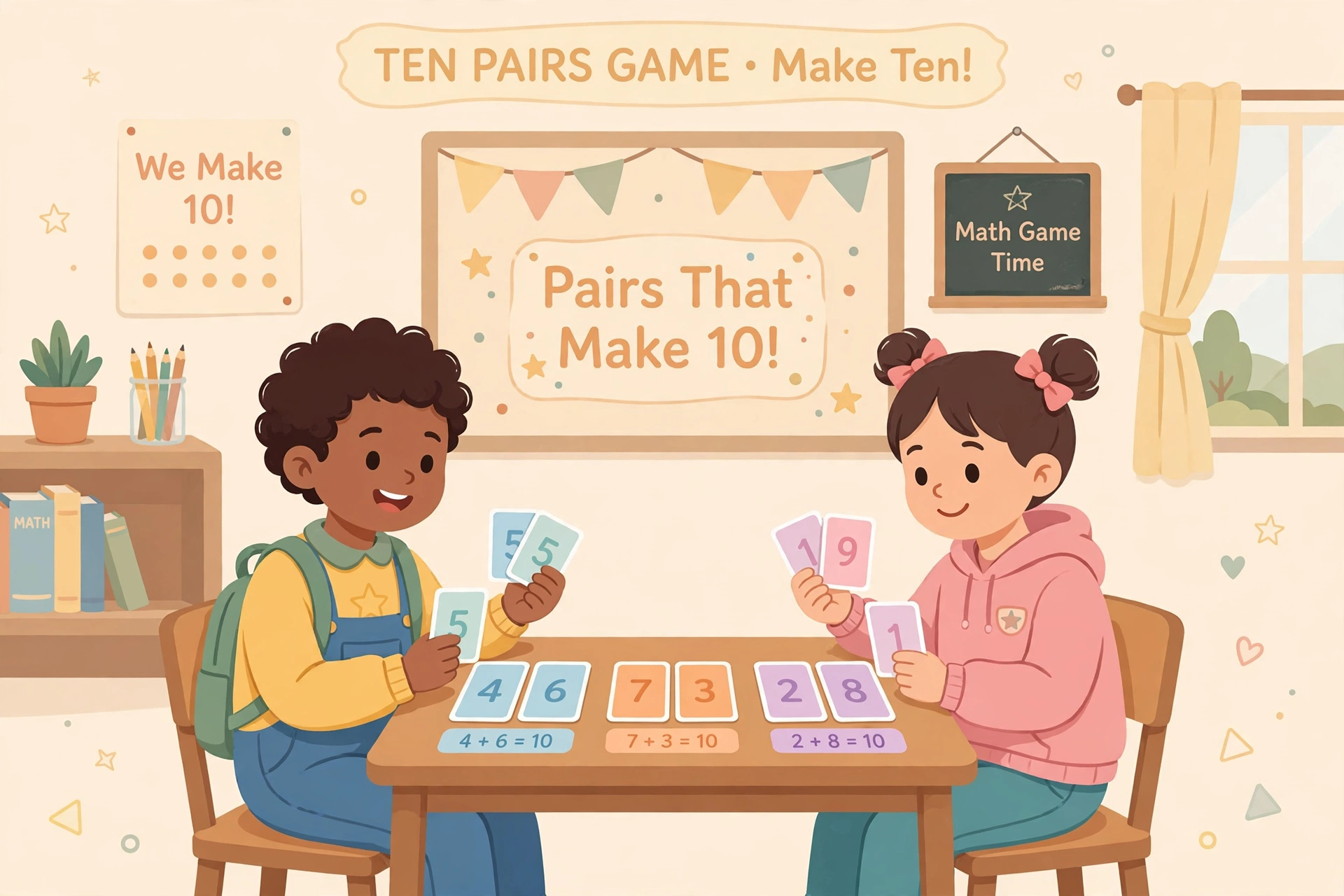
Each pair needs number cards 0 through 10. Deal five cards to each player and stack the rest face down. On a turn, a player lays down two cards that add to 10 and says the fact aloud: “7 and 3 make 10.”
After laying down a ten-pair, the player draws back up to five cards. Play continues until the deck runs out, and the player with the most pairs wins. For a harder round, deal cards 0 through 13 and let students make pairs that add to 13. The rule never changes: name the fact before you keep the pair.
Quick Practice
Question: Show two ways to solve 9 + 7 using the strategies above, and name each strategy.
Answer: Make ten: 9 + 7 = 9 + 1 + 6 = 10 + 6 = 16. Near doubles: 9 + 7 is one less than the double 8 + 8 = 16, or think 7 + 7 = 14 plus 2 more = 16.
For daily timed practice that tracks which facts are mastered, use our free Math Fact Practice tool at home or in class.
Related Terms
- Fact Family – a set of related addition and subtraction facts built from the same three numbers.
- Decompose – to break a number into smaller parts, like splitting 6 into 2 and 4.
- Number Line – a line marked with numbers in order, used to model counting on and jumps.
- Regrouping – trading ten ones for one ten, or one ten for ten ones, when adding or subtracting.
Our Addition and Subtraction Word Problems lesson puts that fluency to work in stories, with bar models and a full answer key.
Frequently Asked Questions
Should kindergarteners memorize addition facts?
No. Kindergarten builds foundations: composing numbers to 10 and adding within 5. Memorization pressure backfires at this age. Play with number combinations instead.
What is the difference between fluency within 10 and within 20?
Fluency within 10 means instant recall of facts like 4 + 5 or 9 – 3. Fluency within 20 means using strategies like make-ten to solve facts like 8 + 7 smoothly. The first is recall, the second is skilled strategy use.
How do fact families help with subtraction?
A fact family links addition and subtraction through the same three numbers. Knowing 6 + 9 = 15 gives 15 – 6 = 9 and 15 – 9 = 6, so students learn four facts for the price of one.
Are timed tests okay for addition facts?
Use them sparingly. Timed tests measure speed under pressure and can raise anxiety. Short untimed partner games build the same recall with less stress.
What if a student still counts on fingers in second grade?
Finger counting shows they understand what addition means. Bridge forward with ten frames and make-ten, one small fact set at a time, until the fingers retire on their own.
How many facts should students practice at once?
Fewer than you think. Five to seven new facts per week is plenty, with constant review of old ones. Cramming twenty facts at once produces the illusion of learning: good on Friday’s quiz, gone by Monday. Small sets, deeply learned, accumulate into full fluency by year’s end.
What about students who still count on fingers in third grade?
Finger counting is a strategy, not a failure. It means the student has not yet found a more efficient path they trust. Teach them one derived strategy explicitly, practice it until it feels safe, and the fingers will retire on their own. Never shame the fingers. Replace them.
Should families drill flashcards at home?
Only if the child already knows a strategy for each fact on the card. Flashcard drilling without strategies is memorization without understanding, and it fades fast. Instead, ask families to play the card games from this article, where explaining the strategy is part of every turn.
Reading about it is one thing, practising it is another. Our free What Is Addition? lesson builds the idea step by step, with slides, a printable worksheet and a full answer key.
Members unlock every lesson in the library, including the full Fractions, Multiplication, Place Value, Addition & Subtraction, Time & Money and Geometry & Shapes units. See the full library


1 thought on “Addition and Subtraction Fluency: 8 Strategies That Work”