
There is no single best homeschool math curriculum for struggling learners, because “struggling” is not one problem. One child never understood the concepts. Another understands and forgets. A third knows the math and shuts down anyway.
The right program depends on which child is sitting at your table, so this guide starts with the cause and then matches the curriculum to it.
The short version: Math-U-See for hands-on learners with concept gaps, RightStart for rebuilding a young child’s number sense, CTCMath when gaps span several levels, Teaching Textbooks or Math Lessons for a Living Education when anxiety is the wall, and Learn Math Fast or Denison Algebra for older students who need to catch up.
All prices were checked on publisher sites in October 2026.

Quick answer: For a child who never understood the concepts: Math-U-See. For a young child whose number sense is shaky: RightStart Mathematics. For gaps scattered across several grade levels: CTCMath. For math anxiety and shutdown: Teaching Textbooks from grade 3, or Math Lessons for a Living Education for younger children.
For a teen who is far behind: Learn Math Fast. For high school algebra that has already failed once: Denison Algebra. If you are not sure which kind of struggle you are looking at, the section after the table will help you tell them apart.
All 7 Programs at a Glance
| Program | Best for | Grades | Format | Parent role | Price (approx.) |
|---|---|---|---|---|---|
| Math-U-See | Concept gaps, hands-on kids | K-12, placed by skill | Blocks, video lessons, workbook | High: you present each lesson | First set about $210-$255, later levels less |
| RightStart Mathematics | Rebuilding number sense | About K-8 | Abacus, card games, scripted lessons | Very high: daily teaching | Books about $99/level plus one-time math set about $220 |
| CTCMath | Gaps across levels, independent work | K-12, all levels unlocked | Online video with auto-graded practice | Low: check the weekly reports | About $257/yr, one student |
| Teaching Textbooks | Anxiety, grades 3 and up | Grades 3-12 | App with worked solutions for every problem | Low: the app teaches and grades | About $49-$84 per student per year |
| Math Lessons for a Living Education | Young, anxious beginners | K-6 | Story-based workbook | Medium: read and guide | About $39-$49 per level |
| Learn Math Fast | Teens far behind, catching up | Grade 1 to geometry, unlabeled | Self-paced workbooks | Low to medium: help as needed | About $40-$60 per volume |
| Denison Algebra | Teens who failed algebra once | Grades 7-12 | Video lessons plus textbook | Low: video teaches | About $175-$195 per course |
Read the parent role column as carefully as the price column. With a struggling learner, the program you can actually sustain every day beats the theoretically perfect program that needs an hour of your teaching when you have twenty minutes. Most mid-year curriculum failures are really parent-time failures.
What “Struggling With Math” Actually Means

Before the reviews, spend five minutes on diagnosis, because the four common kinds of struggle look identical from the doorway (a child who hates math) and need completely different responses.
Concept gaps. The child learned the steps but cannot explain what they mean, and falls apart when a problem is worded differently.
This is the child who can borrow in subtraction on a worksheet but cannot tell you what regrouping actually does, or who adds fractions by adding tops and bottoms because nobody ever showed them what a fraction is.
The fix is concrete and slow: manipulatives, one topic at a time, at the level where the understanding broke. That points to Math-U-See and RightStart below.
Forgetting. The child learns a skill, passes the test on Friday, and has lost it by the following month. The concepts landed. The retention did not. The fix is built-in continual review plus diagnostics that keep finding and refilling the leaks.
That points to CTCMath, to Math-U-See’s systematic review pages, and to spiral programs like Saxon, whose heavy review is designed for exactly this child even though its daily volume defeats many others.
Anxiety and shutdown. The child tears up, avoids, says “I am just dumb at math,” or freezes on timed work they could do calmly one-on-one.
Here the math is often fine and the emotions are the wall, so the fix is low pressure and private mistakes: no timed drill, no red-pen pages, wrong answers that quietly show the correction. That points to Teaching Textbooks and Math Lessons for a Living Education, and to Denison for teenagers.
Note that anxiety often sits on top of one of the other types, because years of gaps teach a child to dread the subject.
Slow processing or working memory. The child knows the method but loses the steps halfway through, copies numbers wrong, or spends so long reading the problem that the math never starts.
The fix is shorter lessons, a lower reading load, and reteaching built into the program instead of added by a frustrated parent. That points to Denison’s Success courses, Learn Math Fast, and Math-U-See’s concrete models, which hold the thinking outside the child’s head.
One honest note before the reviews: if a child’s difficulty is severe, persistent, or shows up across several subjects and not just math, consider a professional educational evaluation. That step is about information, not labels, and no curriculum choice can do what it does.
Best Hands-On Programs for Kids Who Need to See and Touch Math
Math-U-See: best for concept gaps and hands-on learners
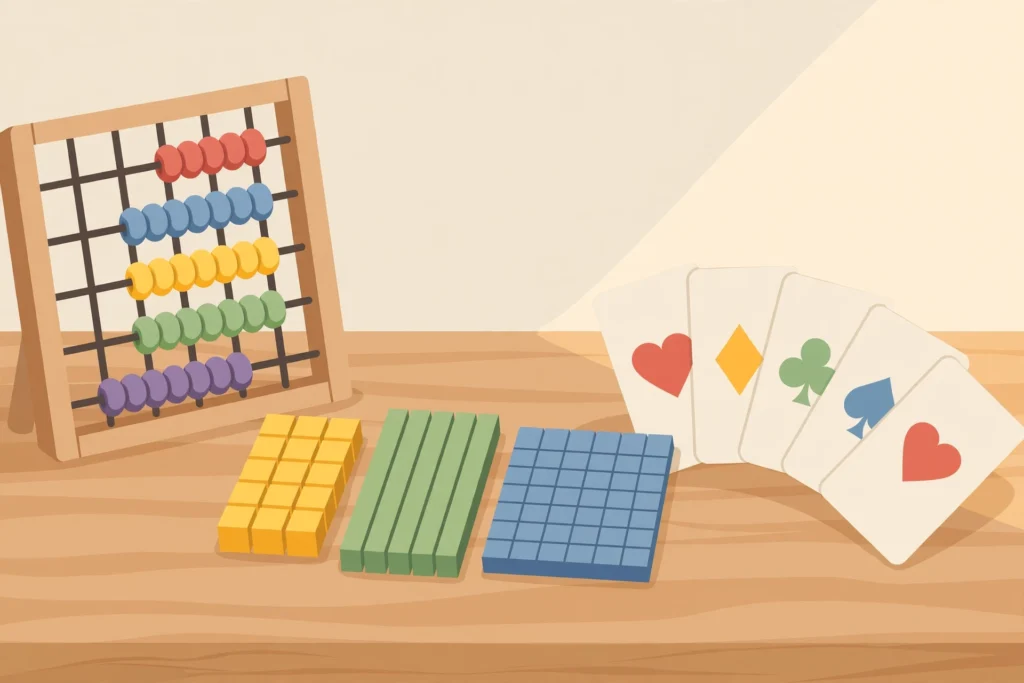
Math-U-See, from Demme Learning, teaches one topic per level to full mastery, and its colored blocks are not a kindergarten extra: students build numbers, operations, and even place value ideas physically before writing them.
Short video lessons introduce each concept, the parent presents it with the blocks, and the child proves mastery by teaching it back.
Placement is by skill rather than grade, through a free placement test, so a struggling fifth grader can start at the level where the gaps actually are without a “third grade” label on the cover.
Two details matter for this audience. First, the uncluttered workbook pages and single-topic focus calm children who are overwhelmed by busy, mixed pages.
Second, Demme’s add-on AIM programs target older students who are missing basic addition, subtraction, or multiplication facts, using the same blocks approach in materials designed not to feel babyish.
The downsides are real: a first full set with blocks runs about $210 to $255 (later levels cost less once the blocks are owned, from around $100), the parent must sit and present every lesson, and the topic-by-topic order differs from school scope and sequence, which some families dislike.
Skip it if you cannot be present for lessons at all.
RightStart Mathematics: best for rebuilding number sense from zero
RightStart, developed by Dr. Joan Cotter, rebuilds math from the quantity up. Instead of counting one by one, children learn to see quantities grouped in fives and tens on the AL Abacus, and facts are practiced through math card games rather than flash cards and timed sheets.
Lessons are scripted, which struggling-learner parents either love or tolerate, and run about 30 to 40 minutes with the parent teaching directly. For a young child whose counting-based strategies never grew into real number sense, this is the deepest rebuild on the list.
Costs: the book bundle is about $99 per level, and the one-time RS2 Math Set of manipulatives is about $220 (a Super Saver version runs about $140).
The honest downsides: this is the most parent-intensive program here, with teaching every day, and the sequence ends around grade 8, so high school needs a new plan. Skip it if your time is the scarcest resource in your homeschool.
Best Online Programs That Teach and Grade for You
CTCMath: best when the gaps are scattered everywhere
CTCMath covers kindergarten through grade 12 in one subscription, and a struggling learner’s superpower here is freedom of level: a child can work at grade 3 in fractions, grade 5 in geometry, and grade level in measurement, privately, without three different books announcing the fact.
Its 1,400-plus video lessons are short (roughly 4 to 10 minutes), every topic has a diagnostic test that tells you exactly which lessons to redo, and the parent dashboard sends weekly reports. The publisher’s homeschool pricing runs about $257 a year for one student and $397 for a family.
The downsides: it is screen-only, with no manipulatives and no handwriting practice built in, so pair it with something physical for younger children (our free worksheet generator prints practice at exactly your child’s level). Practice sets are on the short side, and the reports only help if you actually read them. Skip it if screens themselves are your battleground.
Teaching Textbooks: best for anxiety from grade 3 up
Teaching Textbooks is an app-based program with a design struggling learners feel immediately: every single problem has a hint, and every problem has a complete worked solution with audio, so a wrong answer turns into a private, instant explanation instead of a public failure.
Problems and hints can be read aloud, grading is automatic and private, and each enrollment includes pause time for the hard seasons of life. It runs from Math 3 through Pre-Calculus, and a free trial covers the first 15 lessons of any course with no card required.
Prices run from about $49 for Math 3 to about $84 for the highest courses, per student per year, with a large family plan at about $240 covering four to eight students.
The downsides: there is nothing below Math 3 for the youngest children, families pay per student per year with nothing to resell afterward, and the pace is widely considered gentle, so it suits a child who needs confidence more than a child who needs acceleration.
Skip it if your child is under grade 3 or if you want a book on the shelf.
The Gentle Reset: Best for Anxiety and Young Children
Math Lessons for a Living Education: the calm restart
Master Books’ Math Lessons for a Living Education teaches through an ongoing story about twins, with short lessons (about 30 minutes, woven into a 36-week year) and gentle mastery instead of drill volume.
For a five to nine-year-old who has already started to dread math, the story format lowers the emotional temperature enough for learning to get in. It is open-and-go: the parent reads and guides, and the child works in the book.
Levels run about $39 to $49 each and cover kindergarten through grade 6. Two honest flags. First, it is a Christian curriculum with faith content throughout, which is right for many families and a reason to look elsewhere for others.
Second, the gentle pace means fact fluency sometimes needs a boost from games on the side, and the series ends at grade 6. For an anxious child in grade 3 or above, start with Teaching Textbooks above instead.
Best for Older Students Who Need to Catch Up

Learn Math Fast: best for teens who are far behind
Learn Math Fast was built for the catch-up situation specifically. Its seven workbooks cover grade 1 math through high school geometry with no grade levels printed anywhere, written in a friendly tone at roughly a fourth-grade reading level, in lessons of about 20 minutes.
An older student can move through several volumes in a year, quietly rebuilding everything, without ever opening a book that announces where a ten-year-old should be. Worksheets can be printed free from the publisher’s site, so the books are reusable across siblings, and there is a 30-day money-back guarantee.
Volumes run about $40 to $60 each, with the full set around $250 to $290.
The downsides: it is print only, with no video lessons, so a child who needs to be shown rather than told may stall, and a weak reader will need a parent reading along at the start. The topic order is also unconventional compared with state standards.
Skip it if your teen shuts down without a video teacher. Denison below is the better fit in that case.
Denison Algebra: best when high school math has already failed once
Denison Algebra teaches its video courses as if every topic is brand new, reviewing the prerequisite arithmetic heavily and assigning one concept at a time, about 30 to 45 minutes a day.
For a teenager who failed algebra in a classroom that moved on without them, that assumption-free rebuild is the point. Courses cover Pre-Algebra, Algebra 1, Geometry, Algebra 2, and Advanced Algebra and Trigonometry, at about $175 to $195 per course.
Denison is also the only publisher here with a dedicated Success track: modified versions of each course with shorter lessons and extra review, designed for students with learning and processing challenges who still need high school math credits.
Choose it knowingly: the Success courses are deliberately not college-prep level, which affects transcripts and college plans, so check your state’s graduation requirements first. For a teen who needs the credit and the confidence more than an honors track, it can be the difference between math finished and math feared forever.
The downside beyond that flag is scope: high school only, nothing here for younger children.
How to Choose in 5 Steps
Step 1: Name the type of struggle. Use the four types above. The program follows from the diagnosis, not the other way around.
Step 2: Place by skill, not by grade. Take the publisher’s free placement test, believe the result, and start where your child actually is, even if that looks like a level behind. Early wins at the right level rebuild more than pride does.
Step 3: Trial before you commit. Use free trials (Teaching Textbooks’ 15 lessons, CTCMath’s trial), sample lessons, and placement tests before spending on a full program. While rebuilding fractions, our free fraction calculator checks work step by step, which keeps checking from becoming another argument.
Step 4: Give it a fair trial. Several weeks of consistent use before judging, unless the program is clearly making things worse. Every switch costs momentum.
Step 5: Review at a set date. Put a date six to eight weeks out in the calendar. If tears, avoidance, and gaps are all unchanged after a fair trial, switching is a strategy, not a failure. One program matched to the real problem, started at the right level, beats three programs started in panic.
What We Left Out, and Why
Beast Academy appears on several struggling-learner lists, and it does not belong there. It is an excellent program for advanced students, built on challenge and hard problems, which is exactly the wrong medicine for a child whose confidence is already damaged.
One honest exception: a capable child whose only struggle is boredom with drill may thrive on it. Math by Hand, a small Waldorf-style program of stories and crafts, is an enrichment style rather than a remediation system, with no placement diagnostics, so the hands-on need is better served by Math-U-See and RightStart above.
Frequently Asked Questions
What is the best homeschool math curriculum for struggling learners?
It depends on the kind of struggle. For concept gaps, Math-U-See. For scattered gaps across levels, CTCMath. For anxiety, Teaching Textbooks (grade 3+) or Math Lessons for a Living Education (younger). For teens far behind, Learn Math Fast or Denison Algebra. Matching the program to the cause matters more than any ranking.
How do I know if I should switch math curriculum or stick it out?
Stick it out when the child is progressing, even slowly, and the frustration is ordinary new-topic frustration. Switch when you have given it several consistent weeks and the same wall is still there: tears most days, no retention, or lessons regularly collapsing. A mismatch fixed early is cheaper than a year of dread.
What math program should I choose if my child might have dyscalculia?
No curriculum can diagnose or treat dyscalculia, and any program promising that should be avoided.
Families of children with dyscalculia most often choose multisensory, mastery-based programs such as Math-U-See and RightStart, because concepts are built with physical materials one step at a time.
If you suspect dyscalculia, a professional evaluation is the right first step, and the curriculum choice comes after.
My child is two grade levels behind in math. Where do we start?
Start with a placement test, not a grade label, and begin at the level where your child is solid, even if that is two levels back.
Mastery and catch-up programs are designed for this: Math-U-See places by skill, CTCMath unlocks every level at once, and Learn Math Fast prints no grade levels at all. Gaps close fastest when the work starts from firm ground.
How much does a math curriculum for struggling learners cost?
Expect roughly $40 to $260 to start, checked October 2026. Workbooks like Math Lessons for a Living Education run about $39 to $49 per level, online programs about $49 to $149 per year, and hands-on programs with manipulative kits about $210 to $255 for the first level, with later levels cheaper once the kit is owned.
Will a gentler or modified math course hurt my teen’s college chances?
The standard courses in the programs above are college-prep, and completing them well serves a college-bound student. A deliberately modified track, like Denison’s Success courses, is not college-prep level, so choose it knowingly: for some students the right goal is a diploma, finished credits, and confidence, and families should check their state’s graduation requirements either way.
Prices checked against publisher sites in October 2026 and can change. No curriculum replaces evaluation or support from qualified professionals where a child needs them, and the kindest thing any of these programs can do is meet your child where they actually are.
Every topic clicks faster with practice. Our Resource Library has free lesson packs with slides, printable worksheets and full answer keys, ready to download and teach.
Members unlock every lesson in the library, including the full Fractions, Multiplication, Place Value, Addition & Subtraction, Time & Money and Geometry & Shapes units. See the full library


