
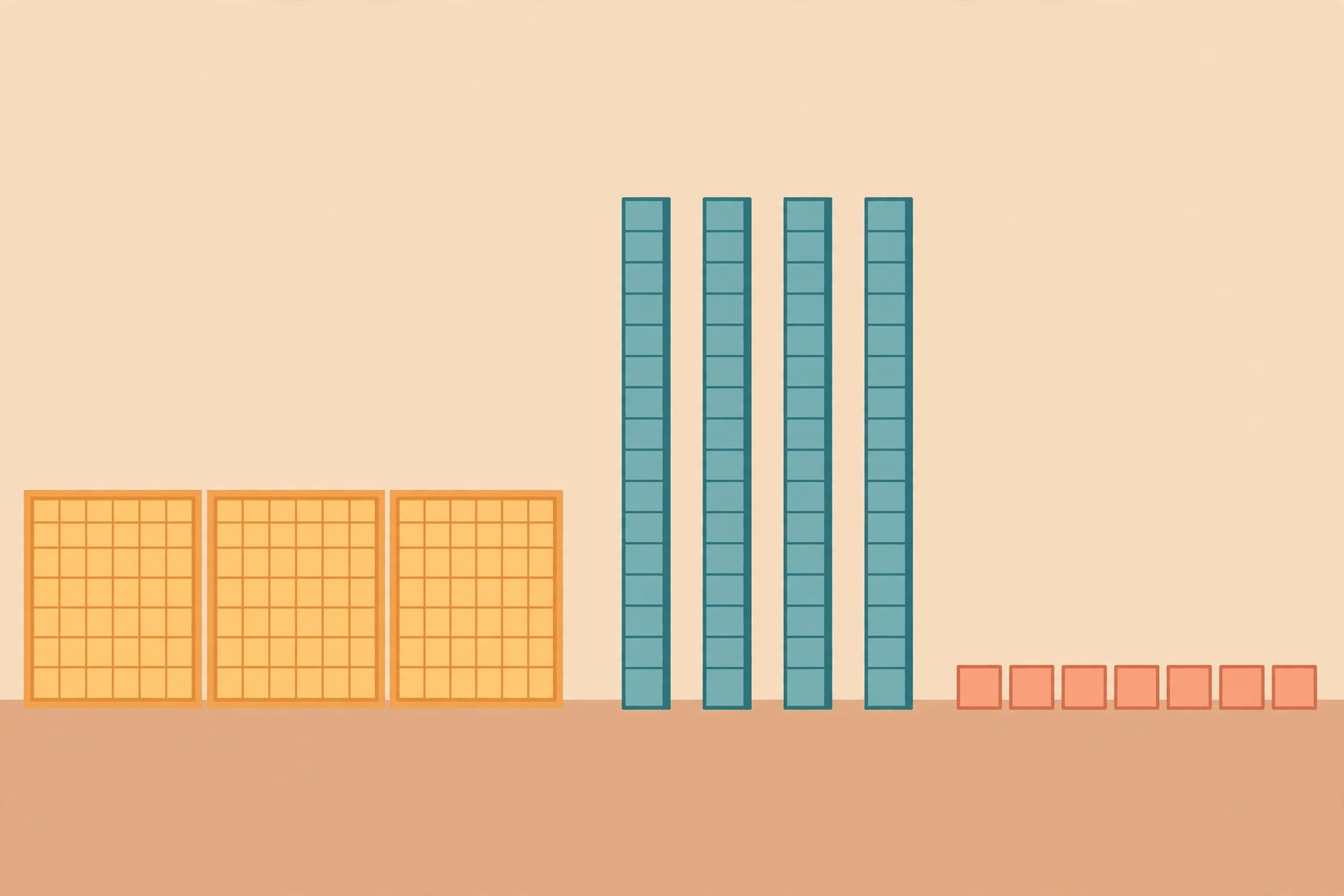
If you are asking what math should my 2nd grader know by June, here is the short answer. By the end of 2nd grade, your child should add and subtract within 20 from memory, add and subtract within 100 using real strategies, understand place value all the way to 1,000, tell time to the nearest five minutes, count and solve problems with money, read simple graphs, and take the first steps toward multiplication and fractions without ever opening a times table. Those expectations come from the grade 2 standards used in most US states, and this checklist translates them into plain language: what your child can actually do, with a two-minute way to check each skill at your own kitchen table.
Quick answer: Must know from memory: addition and subtraction facts within 20, so 8 + 7 = 15 comes out without counting. The big number work: place value to 1,000, and adding and subtracting within 1,000 with regrouping, using a strategy your child can explain. Multiplication: not yet.
Grade 2 builds equal groups, arrays and odd and even numbers instead, and the tables arrive in 3rd grade. Time and money: time to the nearest 5 minutes, plus word problems with coins and bills. First fraction words: halves, thirds and fourths, as equal shares of shapes, a full year before fraction symbols.
The 2nd Grade Math Checklist
Ten skill areas make up the 2nd grade year. Read the middle column as the expectation and the right column as your check: if your child can do the “try this” task by June, that box is ticked.
| Skill area | By the end of 2nd grade your child can | Try this at home |
|---|---|---|
| Addition and subtraction facts within 20 | Answer facts like 8 + 7 and 15 − 6 from memory, using tricks like making a ten | Flash one fact at breakfast and ask how they knew it |
| Word problems within 100 | Solve one-step and two-step problems, even when the starting amount is unknown | “You had some marbles, gave away 18, and now have 46. How many at first?” |
| Place value to 1,000 | Read, write and build 347 as 3 hundreds, 4 tens and 7 ones, and as 300 + 40 + 7 | Write a 3-digit number and ask your child to build it with straws or coins |
| Comparing numbers and skip counting | Say whether 482 or 521 is bigger and why, and skip-count by 5s, 10s and 100s | Count a pile of nickels by 5s together |
| Adding and subtracting within 1,000 | Add 246 + 378 or subtract 502 − 268 with regrouping, using blocks, a drawing or a written method | Ask for 435 + 287 on paper, then ask them to talk you through it |
| Mental jumps of 10 and 100 | Add or subtract 10 or 100 in their head (460 + 100 = 560, 460 − 10 = 450) | Shout a number, they add 100. Shout another, they take away 10 |
| Foundations of multiplication | Split objects into equal groups, spot odd and even, and add up a 4 by 3 array as 3 + 3 + 3 + 3 | Arrange 12 counters in rows and ask how many rows of 3 fit |
| Measurement and the number line | Measure in inches and centimeters, estimate first, and show addition on a number line | Guess the length of a book, then measure it together |
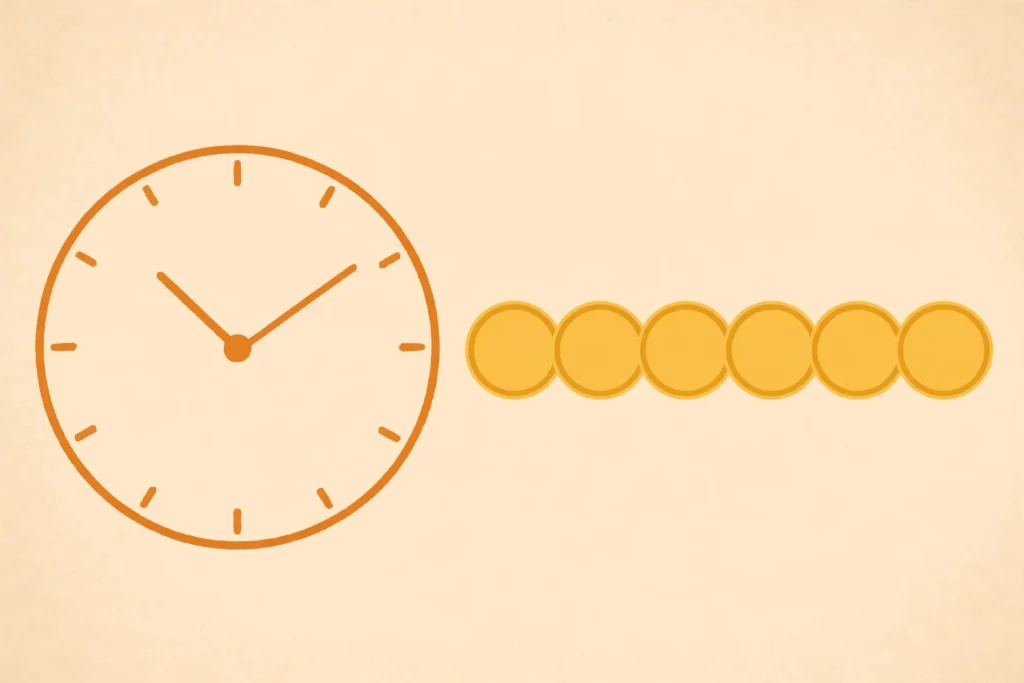
| Time and money | Tell time to the nearest 5 minutes with a.m. and p.m., and solve money problems (2 dimes and 3 pennies = 23 cents) | Ask the time at five past the hour and let them say it first |
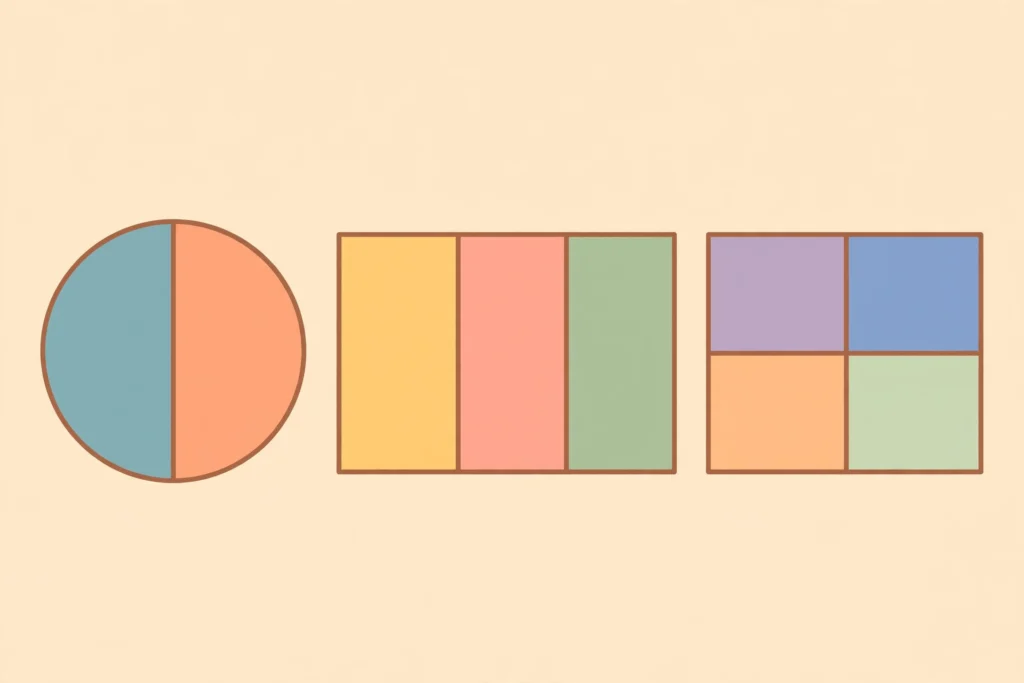
| Graphs, shapes and equal shares | Read a bar graph, name shapes by their sides, and split a rectangle into halves, thirds and fourths | Fold a paper “pizza” into thirds and ask which share is bigger, a half or a third |
How the Year Usually Unfolds
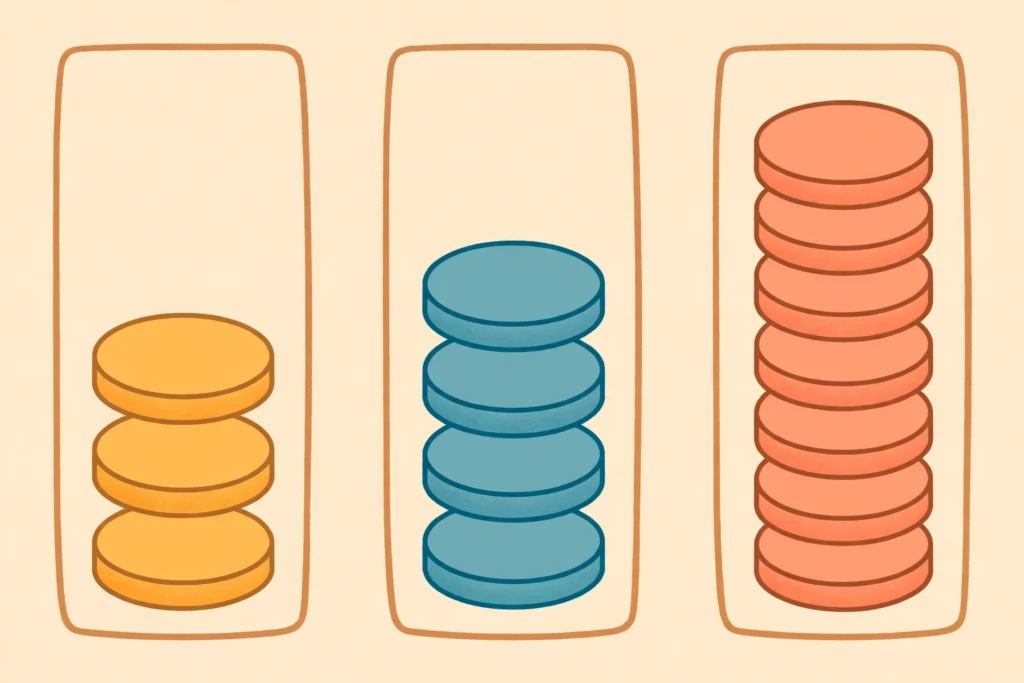
Districts order topics differently, so treat this as the typical pattern rather than a set of deadlines.
In the first half of the year, facts within 20 move toward memory, children add and subtract within 100 using strategies, and place value to 1,000 gets built with blocks, alongside comparing numbers (482 is less than 521, because it has fewer hundreds) and skip counting.
In the second half, the numbers grow: addition and subtraction within 1,000 with regrouping, measurement, sums and differences shown on a number line, time to five minutes, money problems, graphs, shapes and equal shares, and arrays with odd and even numbers.
What do those strategies within 100 actually look like?
A 2nd grader adding 46 + 38 might break both numbers into tens and ones (40 + 30 = 70, 6 + 8 = 14, 70 + 14 = 84), or make jumps on a number line, or round 38 up to 40, add, and take the extra 2 back off.
For facts within 20, the memory tricks have names you will hear at home: making a ten (8 + 7 becomes 8 + 2 + 5 = 15), using a double (7 + 7 = 14, so 7 + 8 is one more), and flipping a known addition fact to answer a subtraction.
A child using any of these reliably is fluent in the grade 2 sense, even if the answer takes three seconds instead of one.
One distinction matters more than the order: introduced is not the same as mastered. Only three things are true end-of-year mastery targets: facts within 20 from memory, fluent strategies within 100, and place value to 1,000.
Everything else is a “can do it with a strategy, a drawing or blocks, and explain it” expectation. Three-digit regrouping, arrays and equal shares are first solid passes that 3rd grade builds on, so a child who handles them slowly in May, with blocks nearby, is exactly where they should be.
The Skills Parents Ask About Most
Multiplication. There are no multiplication tables in 2nd grade, whatever a well-meaning checklist or a proud cousin says. Instead, children learn to split a group of up to 20 objects into pairs to decide odd or even, write an even number as two equal halves (10 = 5 + 5), and count rectangular arrays of up to 5 rows and 5 columns with repeated addition: 4 rows of 3 is 3 + 3 + 3 + 3 = 12. That equal-groups thinking is the on-ramp, and 3rd grade drives down it.
Regrouping. Yes, carrying and borrowing are 2nd grade work, but as understanding rather than speed.
Children add and subtract within 1,000 by grouping hundreds with hundreds, tens with tens and ones with ones, bundling ten ones into a ten or breaking a ten into ten ones when the problem needs it. Regrouping learned with objects first sticks.
A fast, polished written method is 3rd and 4th grade work, so do not drill the column trick ahead of the understanding.
Explaining their thinking. This one surprises parents: explaining why a strategy works, out loud or with a drawing, is itself a grade 2 expectation.
Children are also expected to add up to four two-digit numbers in one problem (24 + 15 + 31 + 12) and to handle word problems where the unknown sits at the start.
So when homework looks strange because your child is drawing jumps instead of stacking numbers, that is the curriculum working as designed.
What If My Child Is Behind?
First, the calming truth: one weak topic during the term it is taught is normal, especially second-half topics like three-digit regrouping or equal shares, which are first passes by design. Worry about patterns, not bad days.
The patterns worth a conversation with the teacher are first-half skills still missing late in the year (facts within 20 still counted out one by one in spring, or two-digit addition with no reliable strategy), a child who avoids math entirely, or a skill that was there in March and gone in May.
If you spot a pattern, three steps work better than a workbook marathon. One: practice the single weak skill for about 10 minutes a day, and stop while it is still going well. Our free worksheet generator prints short sheets aimed at exactly one skill, which keeps those 10 minutes focused.
Two: ask the teacher what they see in class, because a child can be fluent at school and theatrical at home, or the reverse. Three: recheck in a month with the same at-home task from the checklist. Most gaps at this age are small and close quickly once someone names them.
What they do not need is a label from the internet: if the gap stays wide after a month of practice, the teacher is the right next step, and they have seen it before.
Frequently Asked Questions
Should my 2nd grader know multiplication?
No. There are no multiplication tables in 2nd grade. Children build the foundations instead: equal groups, rectangular arrays counted with repeated addition, and odd and even numbers. The tables themselves arrive in 3rd grade.
Does my 2nd grader need to regroup (carry and borrow)?
Yes, as understanding rather than speed. By the end of the year children add and subtract within 1,000 and regroup when a problem needs it, using blocks, drawings or a written method they can explain. A fast, polished written method is 3rd and 4th grade work.
How well should a 2nd grader tell time?
To the nearest five minutes, on both analog and digital clocks, using a.m. and p.m. correctly. Time to the hour and half hour was the 1st grade expectation, so 2nd grade builds on it rather than repeating it.
What math facts should a 2nd grader have memorized?
All addition and subtraction facts within 20, such as 8 + 7 = 15 and 15 − 6 = 9, known from memory by the end of the year, often by flipping a known addition fact into its fact family partner. Within 100 the expectation is different: a reliable strategy, not memorized answers.
How can I tell if my 2nd grader is behind in math?
Look for patterns, not single bad days: first-half skills (facts within 20, two-digit addition with a strategy) still missing late in the year, counting every fact from one on fingers in spring, or avoiding math altogether. If you see a pattern, raise it with the teacher early, because most gaps at this age close with short, targeted practice.
How much should I help with 2nd grade math homework?
Help with the setup, not the answers. Ask “how did you work that out?” and let your child explain, because explaining a strategy is itself a grade 2 expectation. If the explanation shows a wrong method, note it for the teacher instead of reteaching a different method the same night.
Do not test the whole checklist tonight. Pick two or three at-home checks this week, the ones you are genuinely unsure about, and let the rest wait.
Then keep our free math tools page nearby for the practice that follows: a multiplication chart for the arrays your child is starting to build, step-by-step calculators for checking your own working before you check theirs, and printable worksheets for the one skill that needs the reps.
Every topic clicks faster with practice. Our Resource Library has free lesson packs with slides, printable worksheets and full answer keys, ready to download and teach.
Members unlock every lesson in the library, including the full Fractions, Multiplication, Place Value, Addition & Subtraction, Time & Money and Geometry & Shapes units. See the full library


