
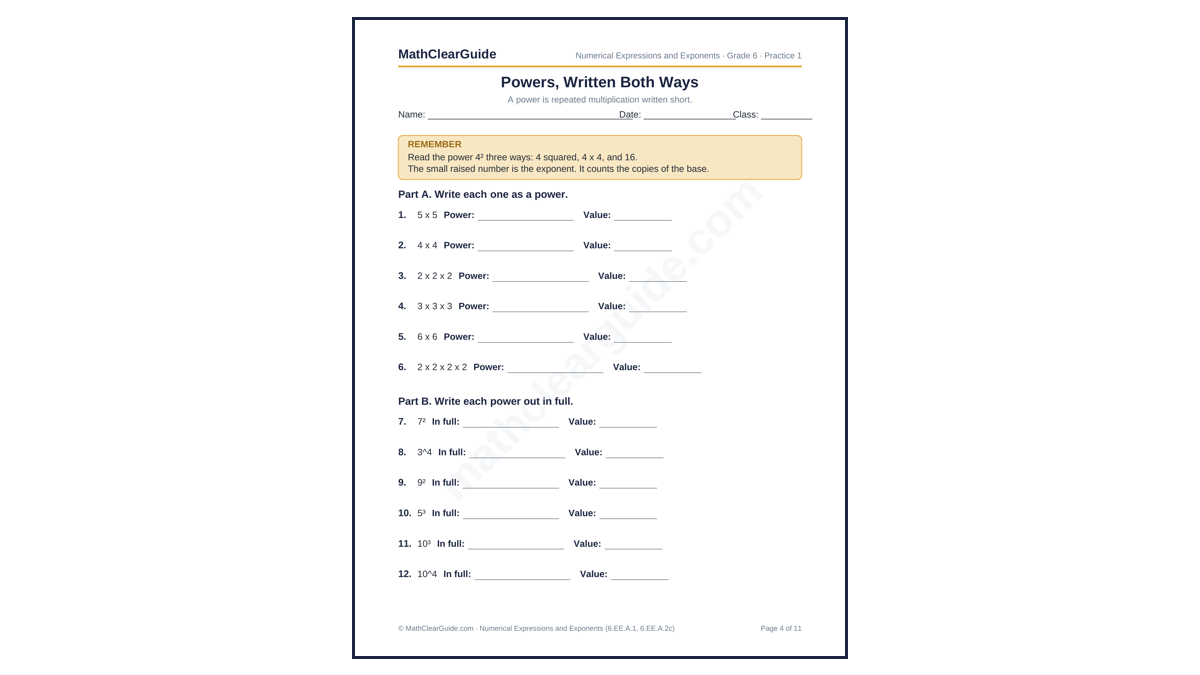
Expressions and equations are where Grade 6 math stops being only about answers and starts being about structure: how a quantity is built, how it can be reshaped, and how an unknown can be found and proven. Our Expressions and One-Step Equations unit teaches that ground in order, across five lessons, and it starts with a free one. The first lesson, Numerical Expressions and Exponents, is a complete lesson with slides, task cards, a worksheet and a filled in key, free with an email signup: https://mathclearguide.com/resources/numerical-expressions-and-exponents/. The unit follows our integers unit on the Grade 6 road, and this post walks through all five lessons.
What Expressions and Equations Really Mean
An expression is a phrase made of numbers, letters and operations: 3 + 4 x 5, or 2x + 3. It names a value, but it is not finished until it is worked out. An equation is a full sentence: it says two expressions name the same value, and it can be true or false. The letter in the sentence is a variable, a placeholder for a number whose value is not fixed yet, or not known yet. That is the whole subject in one breath. Everything in this unit is one of three moves on those phrases and sentences: work them out in the agreed order, reshape them without moving their value, or find the number the letter is hiding and prove it.
An expression is a phrase. An equation is a sentence. The equals sign is the verb, and it has to be true.
The Unit at a Glance
Every lesson follows the same shape: 23 teaching slides, a printable worksheet with a teacher guide, task cards, practice pages, and a filled in answer key that shows the working, never a bare list. The first lesson is free. The other four are member lessons. The ratio unit, the percent unit and the integers unit came first on this road. Grade 7 work, two-step equations and integer operations, comes after it.
| Lesson | What it teaches | Standard | Fits |
|---|---|---|---|
| 1. Numerical Expressions and Exponents (free) | Powers, grouping symbols, and the order of operations | 6.EE.A.1, 6.EE.A.2c | Week 1 |
| 2. Algebraic Expressions | Writing and reading expressions, naming the parts, substitution | 6.EE.A.2 | Week 2 |
| 3. Equivalent Expressions | The properties, the distributive property, and collecting like terms | 6.EE.A.3, 6.EE.A.4 | Week 3 |
| 4. One-Step Equations | The balance model, inverse operations, and the substitution check | 6.EE.B.5 to B.7 | Week 4 |
| 5. Inequalities and Two Variables | Crowds of solutions on a number line, and relationships in tables and graphs | 6.EE.B.8, 6.EE.C.9 | Week 5 |
Start Free: Numerical Expressions and Exponents
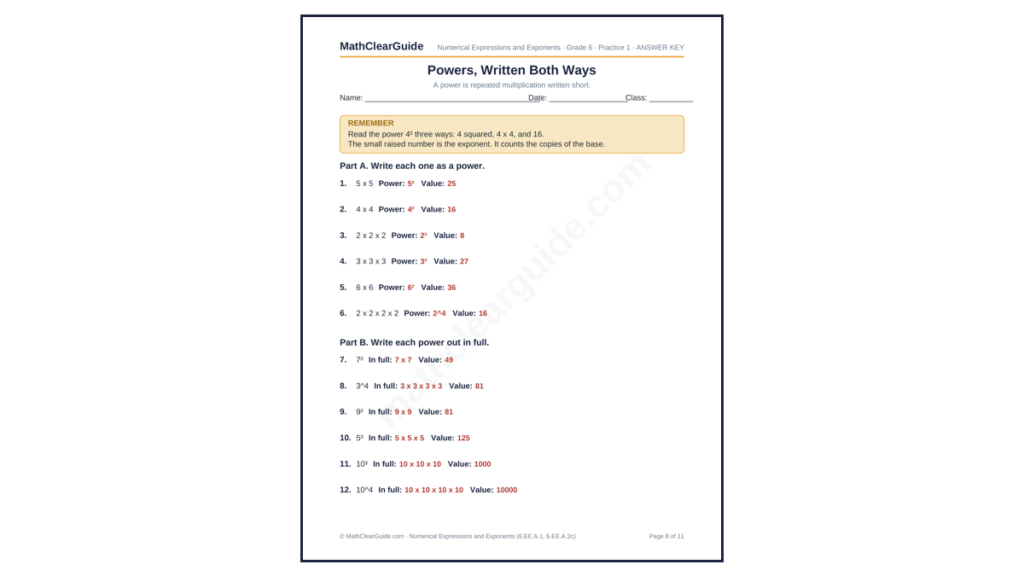
The free lesson opens with an argument every class has in week one: two calculators, one expression, two answers. It settles the argument the honest way, with an agreement: work inside grouping symbols first, then exponents, then multiply and divide from left to right, then add and subtract. Powers are taught as what they are, repeated multiplication written short, and read three ways until the reading is automatic. The Power Path task cards turn the order into a road a pair of pupils can walk and check for each other. Teach it free here: https://mathclearguide.com/resources/numerical-expressions-and-exponents/.
Algebraic Expressions
Lesson 2 brings the letters in properly, for the two honest reasons letters exist: the number is not known yet, or the number can change. Pupils write expressions from word phrases and read expressions back in words, because the translation both ways is the skill. They name every part of an expression: terms, factors, coefficients, and the constant term, including the honest case where there is no constant term to name. Then they evaluate by substitution, with one written step that never changes: the value goes in place of the letter, in parentheses, and the usual order does the rest. For fresh substitution practice in the same skill, the free Worksheet Generator builds it.
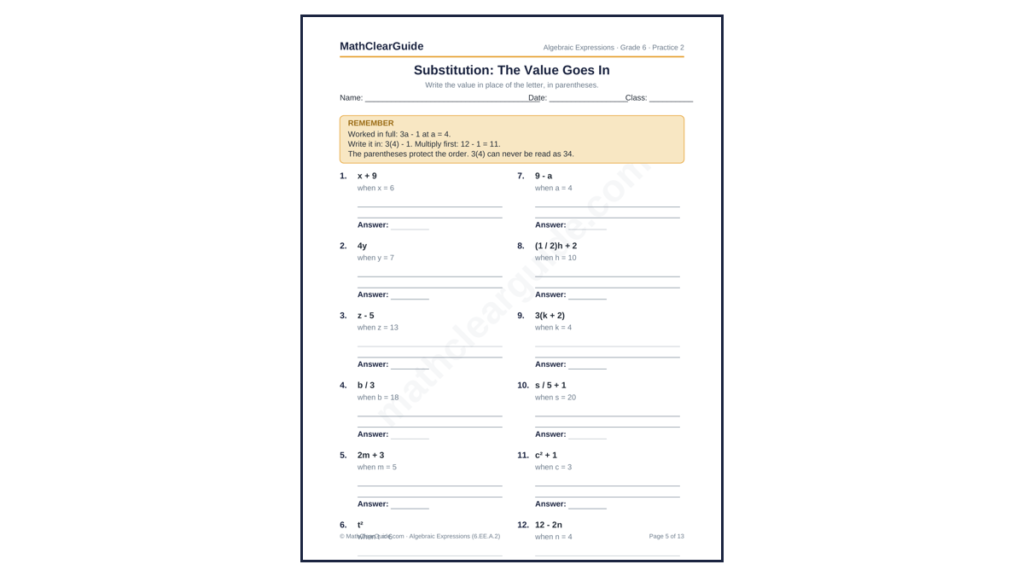
Members teach it here: https://mathclearguide.com/resources/algebraic-expressions/.
Equivalent Expressions
Lesson 3 teaches the moves that change an expression’s shape and keep its value: the distributive property in both directions, opening a(b + c) into ab + ac and pulling a shared factor back outside, and collecting like terms by adding their coefficients. The properties are named as they are used, commutative, associative and distributive, because a move with no name is a trick, and a move with a name is a tool. Every claimed pair faces the test: try it at values, and let one disagreement settle it. The Same Value Showdown cards include the pair that agrees once and parts later, because that trap is the lesson.
Same value, new shape. If the value moved, it was not a reshaping, it was a different expression.
Members teach it here: https://mathclearguide.com/resources/equivalent-expressions/.
One-Step Equations
Lesson 4 puts an equals sign in the middle and solves. The model is a balance: whatever is done to one side is done to the other, or the sentence stops being true. Each equation is undone by exactly one inverse operation, addition undone by subtraction, multiplication undone by division, and every solution ends the same way, with the check written out. Here is one in full, the way the key writes all of them. Solve x + 5 = 14. Subtract 5 from both sides: x = 9. Check: put 9 back in, 9 + 5 = 14, and the two sides match. The Balance Bag cards hand pairs an equation and a candidate value in a bag: if the value solves it, the bag is kept, and if not, it is emptied and solved again.
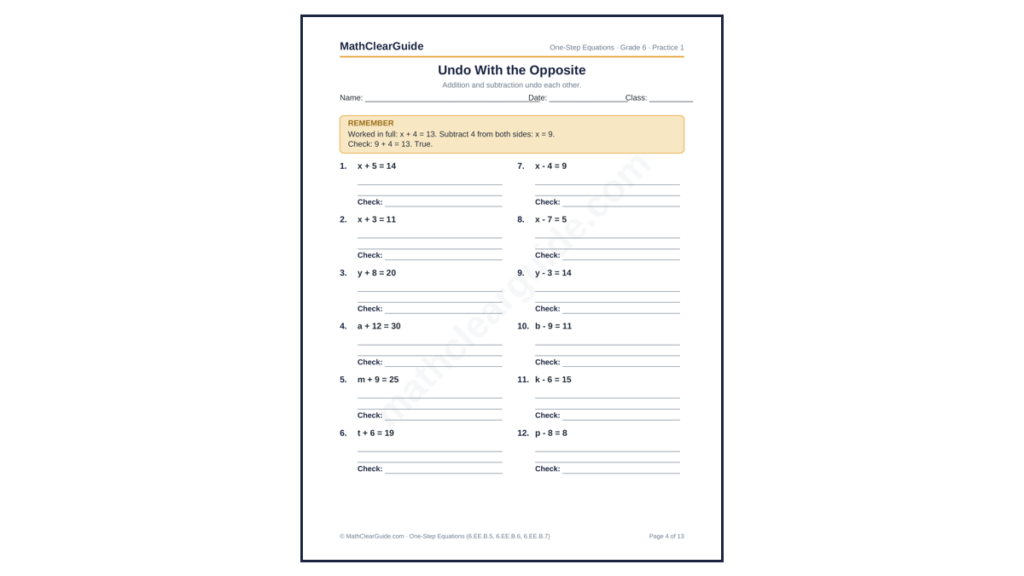
Members teach it here: https://mathclearguide.com/resources/one-step-equations/.
Inequalities and Two Variables
The capstone loosens the equals sign. An inequality does not name one number. It names a crowd of them, drawn as an open circle and an arrow on a number line, with the boundary honestly left out. Then the lesson turns to relationships between two quantities: bags and apples, weeks and savings, metres cut and metres left. Each relationship is shown three ways, in a table, on a graph, and as an equation, with the independent variable chosen and the dependent variable answering. The plotting pages pair with our free Coordinate Plane Practice tool, which drills the same ground the integers unit built.
Members teach it here: https://mathclearguide.com/resources/inequalities-and-two-variables/. One page at the end of this lesson is labelled a Grade 7 first look at two-step equations. It is skippable, it is claimed nowhere else, and nothing in Grade 6 depends on it.
Start Where Your Class Stands
Here is the honest ladder. A class that is still shaky on the order of operations starts at the free lesson above and stays there until the agreement is automatic. Nothing later in the unit stands up without it. A class that ran the integers unit is on the same Grade 6 road, and its step before this one is the integers free lesson, Positive and Negative Numbers. Start that class at the free lesson above too, and move at the speed the checks allow. And a class that finishes early should hear the plain truth: two-step equations and adding and subtracting integers are Grade 7 work, and they wait for their own units. The full shelf, free and member lessons together, sits in the Resource Library.
One Bag of Marbles, Three Levels
One story runs through the whole unit, and it is worth seeing whole. A bag holds some marbles, and 5 more are put in. In Lesson 1 the story is numbers only: the bag held 12, so the class writes 12 + 5 and works it out. In Lesson 2 the start is unknown, so the story becomes an expression, x + 5, ready for any start at all. In Lesson 4 the story gains its ending, the bag now holds 17, and it becomes an equation, x + 5 = 17, solved and checked: the bag held 12. Same marbles, three levels of honesty about what is known. That climb, from phrase to sentence to proof, is the unit in miniature, and it is why the lessons are in this order.
Questions Teachers and Parents Ask
What is the difference between an expression and an equation?
An expression is a phrase that names a value: 2x + 3. An equation is a sentence that says two expressions name the same value: 2x + 3 = 11. The equals sign is the difference, and an equation can be true or false, while an expression is just worked out.
What does evaluate actually mean?
It means work it out to its one value. Evaluating an expression with a letter in it takes one extra step first: write the given value in place of the letter, in parentheses, then work in the usual order.
Why the parentheses when a value goes in?
Because 2a at a = 4 must become 2(4), never 24. The parentheses hold the value in its place and protect the order of operations. It is a small habit that prevents a whole family of errors.
Are two-step equations in this unit?
No, and the unit says so on its own pages. Two-step equations are Grade 7 work. One labelled Extension page at the end of the last lesson offers a first look for pupils who finish early, and nothing in Grade 6 depends on it.
Where does this unit sit on the Grade 6 road?
After ratios, percent and integers, and before the Grade 7 units. The expressions work here is the ground that equation solving stands on, in this grade and the next one.
Teach the check like it is part of the answer, because it is. A solution that is never put back in is only a guess with good handwriting.
Start with the free lesson. If the order of operations lands and the checks become a habit, the rest of the unit is a straight road: letters, reshaping, solving, and crowds of solutions, each step proven as it is taken.
Every topic clicks faster with practice. Our Resource Library has free lesson packs with slides, printable worksheets and full answer keys, ready to download and teach.
Members unlock every lesson in the library, including the full Fractions, Multiplication, Place Value, Addition & Subtraction, Time & Money and Geometry & Shapes units. See the full library


3 thoughts on “Grade 6 Expressions and Equations: A Simple Guide for Teachers and Parents”