Last term, your child shared counters into equal groups without a second thought. This term there is a bracket on the homework page, the digits will not stay in their columns, and the same child is close to tears.
If you are the parent relearning the method from that homework sheet at eight in the evening, or the teacher watching it happen across a whole class, the way forward is the same.
How to teach long division is a question of order: check two skills first, start with blocks so every step means something, bridge with friendlier written methods, and only then teach the bracket itself.
Long division is a written method for dividing a larger number by another number one digit at a time, and it runs as one repeating cycle of six steps: Divide, Multiply, Subtract, Check, Bring down, and Repeat or Remainder.
This guide walks the whole sequence in that order, with fully worked examples you can copy at the table, and finishes with the errors that catch almost every child and the fix for each one.
Quick answer:
- Check first: multiplication facts and accurate subtraction. Build the facts alongside division, never as a gate before it.
- Start with blocks: share base-ten blocks into equal groups, so trading a leftover ten for ten ones is something the child has done with their hands.
- Bridge: partial quotients and the area model keep place value visible on paper.
- Then the cycle: Divide, Multiply, Subtract, Check, Bring down, Repeat or Remainder. One full cycle writes one digit of the answer.
- Two-digit divisors last: only when one-digit work is secure.
How to Teach Long Division: The Six-Step Cycle
Long division breaks one hard division into a cycle of small steps, repeated until every digit of the dividend (the number being shared out) has been used. Four words run through everything that follows.
The divisor is the number you divide by. The quotient is the answer, written on top. The remainder is what is left over when no more full groups fit.
Each step does one job. Divide asks how many whole groups of the divisor fit into the working number, the amount currently being shared. Multiply finds what those groups are worth. Subtract shows what is left. Check compares what is left with the divisor, because it must be smaller.
Bring down pulls the next digit of the dividend down to join what is left. Then the cycle repeats, or, when no digits remain, what is left at the bottom is the remainder and the problem is done.
Two layout habits keep the page honest. Every quotient digit sits directly above the dividend digit it came from, and every product is written under the working number it came from.
When no digits are left to bring down, the answer is written as the quotient, then R and the remainder, as in 186 R1. A remainder of 0 means the division is exact, with nothing left over.
Every finished problem can be checked the same way: divisor × quotient + remainder must give back the dividend you started with.
A memory sentence for the step initials helps some children, but steps with meanings survive longer than steps with a jingle, so this guide teaches the meanings.
One piece of local color: in UK classrooms the bracket layout itself is often called the bus stop method, because the working sits inside a shape like a bus stop. Same method, local name.
| Step | What you do | The question to ask out loud |
|---|---|---|
| 1. Divide | Look at the working number and decide how many whole groups of the divisor fit into it | “How many groups of [divisor] fit in [working number]?” |
| 2. Multiply | Multiply the divisor by that digit and write the answer under the working number | “What is [digit] groups of [divisor] worth?” |
| 3. Subtract | Take that amount away to find what is left | “What is left after we take those groups away?” |
| 4. Check | Compare what is left with the divisor: it must be smaller | “Is what is left smaller than the divisor? If not, another group fits” |
| 5. Bring down | Bring the next digit of the dividend down to join what is left, on the same line | “What digit comes down to join it?” |
| 6. Repeat or Remainder | Start the cycle again with the new working number, or, if no digits are left, what remains is the remainder | “Are there any digits left to bring down?” |
The step most lists leave out is Check, and it is the one that earns its keep. Without it, a quotient digit that is one too small is only discovered several steps later, when the working no longer makes sense and the whole problem has to be unpicked.
With it, the mistake is caught in the cycle where it happened: if what is left after subtracting is as big as the divisor, another group fits, and the digit goes up by one before you move on.
First, Check These Skills Are in Place
None of these is a gate. A missing skill does not mean long division waits. It means that skill gets a support while division starts. Run through the list before the first bracket, because most long division failures are actually one of these wobbling underneath.
- Multiplication facts, and the division facts that belong with them. Every Divide step asks for a multiplication fact, so shaky facts stall every cycle. The fix is support, not refusal. Before calculating, write the divisor’s multiples down the side of the page, a scaffold Marilyn Burns teaches in her division work, so the child reads the fact they need instead of recalling it under pressure. Facts practice continues alongside, and an untimed multiplication chart on the desk gives one more way to check a fact without a timer running.
- Division read backwards. The child should hear a division as a missing-factor question, “how many 4s make 28?”, and move comfortably inside fact families: if 7 × 4 = 28, then 28 ÷ 4 = 7 and 28 ÷ 7 = 4.
- Place value in three- and four-digit numbers. The child must be able to say what each digit is worth. The first digit of 745 is 7 hundreds, and that is why the written method shares hundreds first, then tens, then ones.
- Some short division first. Dividing by a one-digit divisor with the compact short method comes before the full layout in both systems, and in England it is the Year 5 expectation. A child who has never shared a three-digit number one place at a time meets long division as two new things at once.
- Accurate subtraction, including borrowing. Every cycle contains a subtraction, and with three- and four-digit dividends, many of them borrow. A slip here is not a division error, and it is not fixed by more division.
- Estimating before calculating. A rough answer first gives the child a way to spot an impossible result: 745 ÷ 4 is a bit less than 800 ÷ 4 = 200, so the answer belongs in the high one-hundreds.
- Multiples and factors, lightly. Recognizing multiples of the divisor is exactly what the Divide step does, and the margin list from the first item covers any gap in the moment.
Start With Blocks: Sharing 452 Into 4 Groups
Before any bracket is drawn, the division happens with objects. This is not a soft option for younger children.
In the US, the grade 4 expectation itself asks pupils to illustrate and explain division using equations, rectangular arrays and area models, and the IES practice guide for elementary mathematics intervention recommends teaching through representations in stages, concrete first, then drawn, then abstract, alongside systematic, explicit instruction and worked examples.
Blocks are where the meaning of every later step is built.
Build 452 with base-ten blocks: 4 flats for the hundreds, 5 rods for the tens, 2 unit cubes for the ones. Now share them into 4 equal groups.
- Hundreds: 4 flats shared between 4 groups is 1 flat in each group, and nothing is left over.
- Tens: 5 rods shared between 4 groups is 1 rod in each group, with 1 rod left over. Trade the leftover rod for 10 unit cubes.
- Ones: the 2 unit cubes plus the 10 traded cubes make 12, and 12 shared between 4 groups is 3 unit cubes in each group.
Each group now holds 1 flat, 1 rod and 3 unit cubes: 113 in each group. Check it the final way: 113 × 4 = 452.

Hold on to the trade in the second step, because the whole written method turns on it. The leftover 1 ten became 10 ones and joined the 2 ones to make 12.
On paper, that is exactly what bring down records: the brought-down digit joins what is left, on the same line, to form the next amount to share. A child who has made the trade with blocks already knows what bring down means before they ever write one.
Place-value counters on a place value mat do the same sharing with cheaper kit, and the swap, one ten counter traded for ten one counters, is the same trade. When sharing with objects is accurate, move to quick sketches of flats, rods and cubes. Drawings are the middle stage, and the next section swaps them for written strategies.
Bridge Strategies: Partial Quotients and the Area Model
Two written strategies sit between blocks and the bracket, and both keep place value visible. They are not enrichment activities. Equations, rectangular arrays and area models are named in the US grade 4 expectation itself, so this is the curriculum’s own route to the written method.

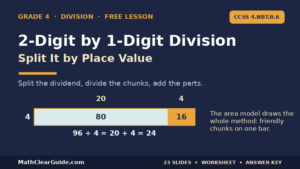
Partial quotients, taking away friendly chunks of the divisor at a time, works like this on 672 ÷ 3. Take away 3 × 200 = 600, and 72 is left. Take away 3 × 20 = 60, and 12 is left.
Take away 3 × 4 = 12, and nothing is left. Add the chunks: 200 + 20 + 4 = 224. Check: 224 × 3 = 672. Any correct chunks work.
A child who takes 3 × 100 three times and then works in smaller chunks still arrives at 224, and that freedom is the point of the bridge: the child picks chunk sizes they can handle, and growing fluency shrinks the chunks toward one per place.
The area model draws the same division as a rectangle. One side is 3 and the total area is 672. Split the rectangle into three sections with areas 600, 60 and 12.
The other side of each section is 200, 20 and 4, and the full side is 200 + 20 + 4 = 224. Same chunks, drawn instead of listed.
Now the point the whole sequence has been aiming at. The standard algorithm is these same chunks compressed: one place at a time, in a fixed order, from the largest place down. A child who can do partial quotients is not learning a second method when the bracket arrives, only a shorter recording of the first one.
Worked Example: 936 ÷ 3, Step by Step
Teach this one first. The dividend has three digits, the divisor is one digit, there is no remainder, and every cycle finishes cleanly, so the rhythm of the cycle is the only new thing. Say the place value out loud as you work: we are sharing 9 hundreds, then 3 tens, then 6 ones, into 3 groups.
        312
      ______
  3  ) 936
       -9
       --
        3
       -3
       --
        6
       -6
       --
        0
- Divide: 9 ÷ 3 = 3. Write 3 in the quotient, above the 9.
- Multiply: 3 × 3 = 9, written under the first 9. Subtract: 9 − 9 = 0. Check: 0 is smaller than 3, so the digit is right.
- Bring down the 3. It joins the 0 on the same line, so the new working number is 3.
- Divide: 3 ÷ 3 = 1, written above the 3. Multiply: 1 × 3 = 3. Subtract: 3 − 3 = 0. Check: 0 is smaller than 3.
- Bring down the 6, making the working number 6. Divide: 6 ÷ 3 = 2, written above the 6. Multiply: 2 × 3 = 6. Subtract: 6 − 6 = 0.
- No digits are left to bring down, and the remainder is 0. The answer is 312. Final check: 312 × 3 = 936, the dividend we started with.
Notice what made this example gentle: every subtraction finished exactly, so each working number after a bring-down was a single digit.
That is deliberate in a first walkthrough, because it teaches the rhythm before remainders complicate it. Notice too that one quotient digit landed for each dividend digit: three digits in, three digits up.
Worked Example With a Remainder: 745 ÷ 4
The second walkthrough adds the two things the first one avoided: cycles that do not finish exactly, and a remainder. Keep narrating place value as you go. Seven hundreds shared among 4 leaves 3 hundreds over, and those 3 hundreds become the first part of the next working number.
        186 R1
      ______
  4  ) 745
       -4
       --
        34
       -32
       ---
         25
        -24
        ---
          1
- Divide: 7 ÷ 4 = 1. One whole group of 4 fits, and two groups would be 8, too many. Write 1 above the 7.
- Multiply: 1 × 4 = 4, written under the 7. Subtract: 7 − 4 = 3. Check: 3 is smaller than 4, so no more groups of 4 fit in what is left.
- Bring down the 4. It joins the 3 on the same line, making the working number 34.
- Divide: 34 ÷ 4 = 8, because 8 × 4 = 32 and 9 × 4 = 36 is too many. Write 8 above the 4. Multiply: 8 × 4 = 32. Subtract: 34 − 32 = 2. Check: 2 is smaller than 4.
- Bring down the 5, making the working number 25. Divide: 25 ÷ 4 = 6, because 6 × 4 = 24. Write 6 above the 5. Multiply: 6 × 4 = 24. Subtract: 25 − 24 = 1. Check: 1 is smaller than 4.
- No digits are left to bring down, so the 1 at the bottom is the remainder. The answer is 186 R1. Final check: 186 × 4 + 1 = 745.
Watch the Check step earn its place twice in this one problem.
A child who writes 2 above the 7 is caught at Multiply, because 2 × 4 = 8 is more than the 7 they are sharing.
A child whose second digit is too small, say 1 instead of 8, multiplies 1 × 4 = 4 and leaves 34 − 4 = 30 after subtracting, and the Check catches that too, because 30 is not smaller than 4 and another group clearly fits.
The rough estimate from the readiness check agrees with the finished answer: it should sit just under 200, and 186 does.
To see the same steps drawn one at a time, open our Long Division Calculator and work through its own example, 154 ÷ 12 = 12 R10. Then let your child run 745 ÷ 4 through it and compare the tableau with the one above, line by line.
Extension: Two-Digit Divisors (878 ÷ 26)
Treat this section as the extension it is. In the US, dividing by a two-digit divisor is grade 5 work, and in England it is the Year 6 formal method. The cycle and the layout do not change at all.
One skill is new: the Divide step can no longer be read off a memorized table, so it becomes an estimate that the Multiply and Check steps then test.
Before starting, write the multiples of 26 in the margin: 26, 52, 78, 104, and so on. For two-digit work the margin list stops being a support and becomes part of the method.
A rounding estimate helps too: 26 is close to 30, and 87 ÷ 30 is a little under 3, so the first quotient digit should be about 3.
         33 R20
      ______
  26 ) 878
       -78
       ---
         98
        -78
        ---
         20
- Divide: the 8 alone is smaller than 26, so the first working number is the first two digits, 87. How many 26s fit in 87? From the margin list, 3 × 26 = 78 fits, and 4 × 26 = 104 is too many. Write 3 above the 7.
- Multiply: 3 × 26 = 78. Subtract: 87 − 78 = 9. Check: 9 is smaller than 26.
- Bring down the 8. It joins the 9 on the same line, making the working number 98. Divide: 3 × 26 = 78 fits, and 4 × 26 = 104 does not. Write 3 above the 8. Multiply: 3 × 26 = 78. Subtract: 98 − 78 = 20. Check: 20 is smaller than 26.
- No digits are left to bring down. The answer is 33 R20. Final check: 33 × 26 + 20 = 858 + 20 = 878.
A wrong first guess here is corrected by the method itself, not by a red pen.
Too big shows up at Multiply, when the product passes the working number. Too small shows up at Check, when what is left still fits another group. Hold this example back until one-digit divisors are secure: nothing in either curriculum asks for it earlier.
Common Errors and How to Fix Them
Once a child is working in the bracket, the same six errors account for nearly every wrong answer, and each one has a mechanical fix. The first is worth working in full, because it produces the most confidently wrong answers in this whole topic.

Work 612 ÷ 3 and watch for the missing zero. Share the 6: 6 ÷ 3 = 2, subtract, and 0 is left. Bring down the 1. The working number is now 1, and 1 is smaller than 3, so no whole group fits.
The quotient digit for this place is 0, and leaving it out is the error. Write the 0. Multiply: 0 × 3 = 0. Subtract: 1 − 0 = 1. Bring down the 2 to make 12, and 12 ÷ 3 = 4.
The answer is 204, not 24, and the final check proves it: 204 × 3 = 612. The rule that fixes this error everywhere is simple: every working number earns a quotient digit, including when the digit is 0.
The same slip survives into two-digit division, where it quietly drops a whole place from the answer.
| The error | What it looks like on the page | The fix |
|---|---|---|
| The missing zero | 612 ÷ 3 comes out as 24 instead of 204, because a working number smaller than the divisor got no digit in the quotient | Teach the rule: every working number gets a quotient digit, even when the digit is 0. Work the 612 ÷ 3 example above slowly |
| The too-small digit | After subtracting, what is left is as big as the divisor or bigger | Use the Check step after every subtraction. If another group fits, the digit goes up by one and that cycle is redone |
| The too-big digit | The multiplication answer is bigger than the working number, so the subtraction cannot be done | Go one digit lower and try again. Guessing and adjusting is part of the method, not a failure |
| Wandering columns | Products and brought-down digits drift out of line, so later steps divide the wrong numbers | Use squared (grid) paper, one digit per square, and write each quotient digit directly above the dividend digit it came from |
| Stopping too early | A number in the middle of the working is circled as “the remainder” while digits are still waiting in the dividend | End-of-problem checklist: every digit brought down, every subtraction done, nothing left to pull down. Only the very bottom number can be the remainder |
| The subtraction slip | The cycle is right but a borrow goes wrong inside a subtraction, and every step after it inherits the error | Slow the subtraction down and work it in the margin. Shaky subtraction with regrouping is a readiness gap (see the readiness check above), and it is fixed there, not inside division practice |
Two rows of that table deserve one more word. The subtraction slip is the most misread error of the six: the division cycle itself is understood, but a borrow inside one subtraction goes wrong and every step after it inherits the mistake.
If the borrowing itself keeps failing, the honest fix is a step sideways into regrouping practice of its own, not a pile of more division problems.
And the child who counts up on their fingers at every Divide step, then loses their place in the cycle, has a facts problem rather than a division problem: the margin multiples list from the readiness section is the in-the-moment fix, while fluency builds separately alongside.
When to Move From Models to the Written Method
There is no single day when models end and the written method begins, and any source that names one is guessing. Move in stages, and let what the child does, not the calendar, trigger each move.
Blocks and counters to drawings: when the child shares accurately with objects and can say what the trade means, that the leftover ten becomes ten ones, replace the objects with quick sketches of flats, rods and cubes.
Drawings to the bridge strategies: when the sketches are reliable, partial quotients and the area model carry the same place-value thinking onto paper without any objects at all. Bridges to the bracket: the signals are all things you can watch for. The child picks sensible chunks without prompting.
The multiplication facts for the divisors in use come quickly, or the child reaches for a margin multiples list without losing their place. Digits stay in their columns. And the child can say what each quotient digit is worth: the 1 in 186 is worth 100, because it came from sharing hundreds.
The curricula themselves keep the pressure off. In the US, the grade 4 and grade 5 expectations are strategy-based, and fluency with the standard algorithm is the grade 6 expectation.
In England, the formal written method is required in Year 6. A child using partial quotients confidently in grade 4, or in Year 5 in England, is on schedule, not behind it.
If a child stalls at the written stage, drop back exactly one stage: symbols to drawings, or drawings to blocks. Rebuild there, and come forward again. Dropping back is the sequence working as designed, not a restart.
Once the steps are secure, the job changes from learning the method to keeping it warm: generate short practice sets at the level your child has reached, rather than hunting for a fresh worksheet every time practice is due.
Remainders in Real Problems
In a bare calculation, what is left over is written as R and a number, and it is always smaller than the divisor. In a story problem, the story decides what happens to it.
England’s Year 6 curriculum names the three options outright: leave it as a whole-number remainder, carry it into a fraction, or round up or down as the problem requires.
Try 427 ÷ 15, worked briefly. First, 42 ÷ 15 = 2, because 2 × 15 = 30, leaving 12. Bring down the 7 to make 127. Then 127 ÷ 15 = 8, because 8 × 15 = 120, leaving 7. So 427 ÷ 15 = 28 R7, and the check is 28 × 15 + 7 = 427.
Now give those numbers a job. There are 427 children to move, and each minibus run carries 15. Twenty-eight full runs carry 420 children, and 7 children are still waiting, so 29 runs are needed if everyone travels. The remainder was not dropped, and it was not the answer either. The context rounded the count of runs up.
Ask a different question of the same numbers, how many full groups of 15 can be made from 427, and the answer is 28, with the remainder simply reported. Same division, different question, different treatment of what is left over.
Teaching a child to ask, at the end of every story problem, “What does this problem want done with what is left?” is the whole skill.
The Long Division lesson in our library breaks the method into the same steps with worked examples, a printable worksheet and a full answer key.
Frequently Asked Questions
What grade do students learn long division?
In the US, long division builds across grades 4 to 6: fourth graders divide up to four-digit numbers by a one-digit divisor using place-value strategies, arrays and area models, fifth graders extend that to two-digit divisors, and fluency with the standard written algorithm is the sixth-grade expectation.
In England, pupils learn short division in Year 5 and the formal written method of long division, dividing by two-digit numbers, in Year 6. The method in this guide is the same in both systems. Only the timetable differs.
What are the steps of long division?
The steps are one repeating cycle: Divide, Multiply, Subtract, Check, Bring down, then Repeat with the next digit or finish with the Remainder. Divide asks how many groups of the divisor fit in the working number. Multiply finds what those groups are worth. Subtract shows what is left.
Check confirms what is left is smaller than the divisor. Bring down pulls the next digit down to join what is left. One full cycle writes one digit of the answer, and the final check is quotient × divisor + remainder = dividend.
Does my child need to know all their times tables before starting long division?
No, not as a gate, but multiplication facts are the first skill to check, because every Divide step uses one.
The practical route is to start anyway with support: write the divisor’s multiples in the margin before calculating, so the child can read the facts they need instead of recalling them under pressure, and keep building fact fluency alongside division practice.
Marilyn Burns teaches this margin-multiples list in her division work, and UK guidance for two-digit division teaches the same scaffold. A child blocked on facts alone is not blocked on division.
What is the best way to teach long division to a struggling student?
Go back one stage and make the division physical again: share base-ten blocks or place-value counters into groups, where the key move is trading a leftover ten for ten ones, because that trade is what “bring down” means on paper.
Then rebuild through drawings and partial quotients before returning to the written cycle, teaching the steps explicitly, one worked example at a time, with the step list visible. That sequence (concrete, then drawn, then abstract, with explicit teaching and worked examples) is what the IES practice guide for mathematics intervention recommends.
Should I teach partial quotients or the standard algorithm first?
Partial quotients first, then the standard algorithm, because they are the same method at two levels of compression. Partial quotients lets the child take away friendly chunks of the divisor and keep place value visible, and it is one of the strategies the US grade 4 standard names.
The written algorithm does the identical work one place at a time in a fixed order, which is faster once the thinking is secure. Children who meet the bracket after partial quotients are learning a shorter recording of a method they already understand.
Why does my child keep getting lost in the middle of a problem?
Because a single long division problem asks for several skills in rotation: a multiplication fact, a subtraction that may need regrouping, careful column alignment, and remembering which step comes next, all inside one problem. Getting lost is usually one of those supports wobbling, not the division idea itself.
The fixes are mechanical: a margin list of the divisor’s multiples for the facts, squared paper for the columns, the Check step after every subtraction, and a step list kept visible until the cycle is automatic. The errors table in this guide matches each symptom to its fix.
The whole method, in one breath: check the facts and the subtraction, share with blocks until the trade makes sense, bridge with partial quotients and the area model, then teach the bracket as one honest repeating cycle.
When you want the tools beside you, all four free MathClearGuide tools live on one page, the calculator, the chart and the generator included, ready for whichever stage your child is on.
Reading about it is one thing, practising it is another. Our free What Is Division? lesson builds the idea step by step, with slides, a printable worksheet and a full answer key.
Members unlock every lesson in the library, including the full Fractions, Multiplication, Place Value, Addition & Subtraction, Time & Money and Geometry & Shapes units. See the full library