

It is 6:45 in the evening, the worksheet is open, and your child is stuck on problem four.
You lean in with the method you learned at school, the one that still feels obvious to you, and get the sentence every parent of an elementary child eventually hears: “That’s not how we do it.” Now there are two bad ways the evening can go.
You take the pencil and do it your way, which finishes the worksheet and teaches your child almost nothing, or you back away entirely and leave a seven-year-old alone with a problem they cannot start.
This guide is about the third way, and it is licensed by the research rather than by opinion: how you help matters more than how much you help.
Homework battles at this age usually come from three fixable causes: method confusion between home and school, help that quietly turns into doing, and the absence of any routine around the work.
This site sells no homework help and no tutoring; what follows is the evidence, the translation table between your schooling and your child’s, the questions that help without telling, a routine that ends most battles, and the signs that a homework problem is really a school problem.
The goal is a parent in the coach’s seat: asking, checking, and knowing when to stop.

Quick answer: Sit in the coach’s seat, not the teacher’s. Ask questions instead of giving steps (start with “What is the problem asking?” and “How did you do this in class?”), work in the school’s methods even when yours feel faster, keep a short routine with a time limit based on the 10-minutes-per-grade rule, and when a problem beats you both, stop and send the teacher a note instead of pushing through. At elementary age, homework’s effect on achievement is small (the Education Endowment Foundation puts primary homework at about +3 months, and Harris Cooper’s research synthesis found the amount of homework barely relates to achievement before middle school), so a calm evening beats a completed-but-copied worksheet every time.
What the Research Says About Homework and Helping
Elementary homework does much less than parents fear. The field’s reference point is Harris Cooper’s research synthesis (Cooper, Robinson and Patall, Review of Educational Research, 2006), which pooled the correlational studies and found that the relationship between the amount of homework and achievement varies sharply by age: for elementary students the average correlation was nearly zero, for middle grades about .07, and for high school students about .25. Those are correlations about homework amount, not proof that homework is pointless; Cooper himself argues that at this age homework serves other purposes, including study habits, responsibility, and reinforcing simple skills. The honest line for a parent is narrower than the headlines: no single worksheet is worth a war. The Education Endowment Foundation’s Homework strand points the same way with different numbers: an average of about +3 months of additional progress for primary pupils (against +5 for secondary), with the quality of the task mattering more than the quantity, the impact diminishing as time spent increases, and the highest-impact pattern setting homework around twice a week in a subject, linked to classroom work. The Foundation rates the security of this evidence as low, and this guide prints that rating rather than hiding it: the research gives a parent permission to relax about any one evening, not a verdict on homework itself.
The 10-minute benchmark. Both the NEA and the National PTA endorse the 10-minute rule that traces back to Cooper’s work: starting in 1st grade, no more than about 10 minutes of homework per grade level per night, all subjects combined.
So the whole evening’s expectation is roughly 10 minutes in 1st grade, 30 in 3rd, 50 in 5th.
Hold that number; the routine section below builds the family’s stop rule on it, and it calibrates a common panic: if math alone regularly takes double the entire benchmark, the problem is the fit between the task and the child, not your family’s effort, and that is information a teacher can use.
Which kind of help helps. Patall, Cooper and Robinson’s 2008 synthesis of parent involvement in homework is the study this post stands on.
Its most useful finding for a kitchen table: among the types of involvement, setting rules about when and where homework happens and what is expected showed the strongest positive association with achievement, stronger than direct help with the work itself.
Parent training told the same story from the other side: programs that taught elementary parents a better homework-time approach produced higher homework completion and fewer homework problems, with improved performance a possibility rather than a promise.
The synthesis also carries a warning that must be read honestly: across studies, parent involvement was more strongly related to achievement in mathematics negatively than in verbal subjects positively.
That does not prove helping causes harm; the standard reading, printed here because it is the fair one, is that parents of children who are already struggling help the most, so heavy help and low scores travel together. What it does prove is that “help more” is not a reliable lever.
The type of help is the lever, which is why the rest of this guide is about type.
Your own math nerves. One well-known study (Maloney and colleagues, Psychological Science, 2015) followed 438 children in grades 1 and 2 and found that children of math-anxious parents learned less math over the school year and had more math anxiety by its end, but only when those anxious parents reported helping with homework frequently; when anxious parents helped less often, their children’s achievement and attitudes were not related to the parents’ anxiety. The caveat travels with the finding, as it must: a later, larger study (3,018 children, kindergarten through grade 3, published in Developmental Science) could not reproduce that exact interaction, finding instead negative associations for homework-help frequency itself. What survives both papers is the direction this guide teaches from: frequent, tense, answer-focused help at the table is not associated with better learning, and a child’s repeated exposure to a parent’s fear of math is a plausible, avoidable channel. The practical version, for a two-adult home, is a role swap: the parent carrying the math nerves runs the routine (time, place, materials, close-out) and the calmer parent takes the questions seat. That is a real intervention, not a joke, and the next sections give both roles their scripts.
Speak the School’s Math Language
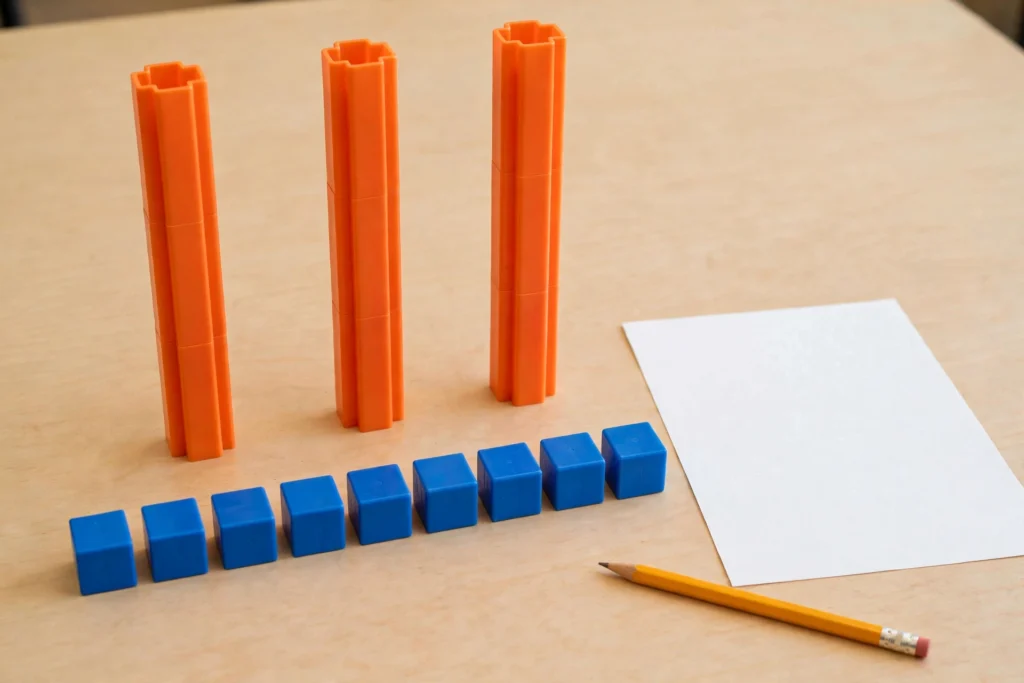
One master rule runs this whole section: at homework time, the child’s method wins, even when the parent’s method is faster. Homework is practice of the school’s method, marked against the school’s method, and a second method taught at 7pm tends to surface as confusion in class the next day.
The correct response to “that’s not how we do it” is curiosity, not correction: “Then show me your way, start to finish. I will just listen.” A child explaining the method is doing exactly the learning the homework exists to produce, and curriculum parent guides advise precisely this child-teaches-parent move.
If you still believe your method matters, its venue is a conversation with the teacher, not the worksheet. And one hard rule: never mark a correct school-method answer wrong, and never erase the child’s method to substitute yours. The table below translates the names.
| School method today | What it replaced in your schooling | What to say at home |
|---|---|---|
| Regrouping: trading one ten for ten ones, or ten ones for one ten | “Borrowing” and “carrying” | “Show me how your teacher trades the ten.” Nothing is borrowed, because nothing is given back; a ten is broken into ones, or ones are bundled into a ten |
| Area model for multiplication: a rectangle split by place value | One long vertical multiplication written in a single block | “What are the two parts of this number? Multiply the parts, then add.” Each box is one partial product, and the rectangle shows why the answer is that size |
| Partial products: multiply each place separately, then add | The same one-block vertical method, done silently | “Do the tens first, then the ones. Now put the parts together.” This is your vertical method with its hidden steps written out |
| Number line: an open number line, jumps of tens then ones | Counting on fingers, or the vertical column done mentally | “Start at the first number. Make your big jumps first, then your small jumps.” The empty number line is the scratch paper of modern classrooms |
| Partial quotients for division: subtract easy chunks of the divisor | Long division as one fixed routine with no visible reasoning | “How many groups of the divisor can you take out at once? Take out a chunk you are sure of, then another.” Any correct chunks reach the answer |
| Bar model (tape diagram): a strip split into parts | Guessing which operation a word problem “wants” | “Draw the story as a bar. Which part is missing?” The drawing chooses the operation, so the child stops hunting for keywords |
| Ten frame: a 2 by 5 grid for numbers to 10 and 20 | Memorizing number bonds with flashcards alone | “Fill the frame. How many to make ten? How many are left over?” Making ten first is the strategy behind most mental math that follows |
| Fact families: the same three numbers making four related facts | Learning addition and subtraction facts as separate lists | “You know 7 + 5 = 12. So what is 12 – 5?” One known fact unlocks three more, and checking an answer becomes free |
Three short walk-throughs show the translation in action. This site’s dictionary entries walk through regrouping, the area model, the number line, and fact families in full, the same definitions your child’s teacher is working from.
Example 1, regrouping subtraction (grades 2-3): 52 − 28. Your instinct: “Borrow from the 5, cross it out, write a little 4 and a little 1.” The school version your child will show: 52 is 5 tens and 2 ones; 2 ones cannot take away 8 ones, so trade one ten for ten ones; now it is 4 tens and 12 ones; 12 − 8 = 4 ones; 4 tens − 2 tens = 2 tens; answer 24. Your script: “I would have said borrow. Show me how your teacher trades the ten.” Then one check question, which is the parent’s real job in every example: “We started with 52 and took away 28, so should the answer be bigger or smaller than 52? Is 24 sensible?”
Example 2, partial products (grades 3-4): 23 × 4.
Your instinct: the vertical block: “4 times 3 is 12, write 2, carry 1; 4 times 2 is 8, plus 1 is 9; answer 92.” The school version: split 23 into 20 + 3; 20 × 4 = 80; 3 × 4 = 12; 80 + 12 = 92.
In the area model those are the two boxes of one rectangle, one 20 wide and one 3 wide, both 4 tall. Your script: “Your way writes out the steps my way hid.
Do the tens box first.” The point worth knowing: the carried 1 in your method was the ten from the 12 all along; the new method simply refuses to hide it. Same answer, visible reasoning, and you can check your child at each part instead of only at the end.
Example 3, fractions on the number line (grades 3-5): 1/2 + 1/4. The classic wrong move: add the tops and add the bottoms, getting 2/6. The school version: the pieces must be the same size before anything is added, so split the half into quarters, 1/2 = 2/4; then 2/4 + 1/4 = 3/4.
On the number line, 1/2 sits exactly where 2/4 sits, and one more quarter-step lands on 3/4. Your script: “Are the pieces the same size yet?
Make them the same size first, then add.” And the sanity check you can always run: the answer must be bigger than 1/2 and less than 1, and 2/6 (which is 1/3) fails that test on sight.
The family’s referee for a finished problem is this site’s fraction calculator, used after your child has worked, never before.
Help With Questions, Not Answers

Researchers who study tutoring name the trap precisely: the assistance dilemma. Too little help leaves a child frustrated; too much makes them dependent.
The move that threads it, described by Carnegie Mellon’s Kenneth Koedinger: work a similar problem, not the assigned one, step by step yourself, narrating each step, then have your child talk you through why each step is taken, and return them to their own problem.
You demonstrate on different numbers; your child performs on the assigned ones.
Wrapped around that move is a toolkit of questions, adapted here from the Shell Centre for Mathematical Education’s “Parents as Questioners” guidance (distributed by Reading Rockets), whose founding point deserves its own line: parents do not need to know how to solve the problem themselves to help a child think through it.
A good question opens the problem up; an answer closes it.
Use freely. These start the child’s own thinking and cost nothing: “What is the problem asking you to find?” “What have you tried so far?” “What do you know from the problem?” “Can you explain this part to me?” “Is this like a problem you did in class?” “Say the problem in your own words.” If you ask only one question all evening, the strongest single candidate, from the parent guidance around today’s curricula, is “How do you know that?”, asked the same level way after right answers and wrong ones, because it tests understanding without announcing a verdict.
Use sparingly. These hint at a strategy: “Could you draw it?” “What if you started with smaller numbers?” “Can you act it out with these coins?” “How could you organize what you know?” The discipline is dosage.
Each strategy hint quietly does part of the thinking for the child, so two hints in a row means you are solving the problem in installments. One hint, then back to the freely shelf.
Avoid. Moves that take the problem away: the hint dressed as a question (“Why not try three counters?”), the takeover (“No, you should do it like this”), and the answer wearing a question mark (“So it is 24, right?”).
Corrections like “that is not quite what I had in mind” belong here too: they teach the child to guess at the adult’s mind instead of doing the math.
The end-of-problem questions do double duty. Borrowed from the by-moment structure of the SciMathMN parent guidance (questions for getting started, while working, and reflecting at the end), the reflecting set is your completion check with no answer key required: “How do you know your solution is reasonable?” “How can you convince me your answer makes sense?” “What did you try that did not work?” A child who can answer the first two has understood; a child who cannot has shown you exactly where the evening’s real stuck point was. One household technique wraps the whole toolkit: after asking a real question, count to ten silently before speaking again. Children process aloud at about half adult speed, and most telling is just a parent filling a silence that was actually thinking.
A Nightly Routine That Ends the Battles

Patall’s rule-setting finding is the frame for this section: the routine is not preparation for the intervention, it is the intervention. Five parts, in order. One, same time, tied to a fixed anchor (after snack, before screens), chosen once.
Homework that starts by negotiation starts twenty minutes late and already tense; an anchor, unlike a clock time, is something a young child can hold. Two, same place, set up once: a cleared surface, good light, pencils, eraser, scrap paper or a small whiteboard, and counters or coins for the youngest children.
The three-trips-for-supplies pattern is where focus leaks at ages 5 to 8. Three, the two-minute preview: before starting, your child reads every problem aloud and sorts them into “can do alone”, “might need help”, and “no idea yet”.
You now know the evening’s shape, your child starts on a win, and the hard pile is identified while everyone is still calm. Four, work in a fixed order: alone first, questions second, worked example last.
Your child attempts every “can do” problem before any help is given on anything; help on stuck problems follows the questioning ladder; and the parent never touches the pencil for the assigned problems.
The parent’s physical role changes by band: for kindergarten to grade 2, sit alongside, because presence itself is the support; for grades 3 to 5, become checker-and-audience, nearby and available, called in for the reflecting questions rather than stationed over a shoulder.
A printed worksheet generator page on the week’s weak skill, ten minutes on a non-homework day, beats re-doing the same failed worksheet.
Five, the two-minute close-out: your child picks one problem and explains it start to finish (the teach-back), you check completion against the assignment list, not correctness, because correctness feedback is the teacher’s loop, and everything goes into the school bag tonight, not tomorrow morning.
The stop rule. When the session passes the family’s benchmark (roughly 10 minutes per grade level for all homework, from the research section) or when tears arrive, whichever comes first: stop, and write the note.
This mechanism is borrowed directly from curriculum parent guidance (Everyday Mathematics instructs its families to do exactly this when an assignment confuses parent or child): jot a short note on or with the homework explaining the difficulty, and send it back to the teacher.
“We worked on problem 4 for 15 minutes; she could start it but kept losing the second step” converts a failed evening into diagnostic information for the one professional who can act on it.
It also protects tomorrow: your child learns that stopping with a note is a legitimate move, not a defeat, and nobody has to choose between a child’s sleep and a teacher’s red pen. The note is written by the parent, in pen; the child is never sent in empty-handed to improvise an excuse.
If notes become a weekly event, that is no longer a routine problem. It is the next section.
What If You Were Never Good at Math Either?
Start with the Shell Centre’s founding point, because it was written for exactly you: the parent guidance built on their work begins from the fact that a parent does not need to solve the problem to help the child think. The questions above work whether or not you know the answer. Then use the class as your tutor.
Ask for the worked example from class, the textbook page, or the family letter many curricula send home at the start of each unit explaining its methods (Everyday Mathematics’ family letters are the named example); if your school does not send them, asking the teacher what to read is the move.
Let your child explain and audit the explanation: a child who cannot explain a step has found the stuck point for you, and no math was required from you to find it.
Use neutral referees after the work, not before: the fraction calculator shows worked steps for checking a finished fraction problem, and the long division calculator lays out the full working so you can compare it against your child’s page line by line.
In a two-adult home, split the roles the research points to: the parent with the math nerves runs the routine, the calmer parent takes the questions seat.
And skip one specific bonding line: “I was hopeless at this too, you get it from me.” However warm it feels, it hands the child a fear script and an excuse in the same sentence. Neutral honesty does the job better: “This way is new to me too. Show me.”
When Homework Struggle Is a Warning Sign
One bad evening is weather. A pattern is climate. Watch for patterns, each over weeks, not nights.
The same wall, nightly, for two to three weeks: not “fractions are hard” but the same specific skill failing the same way (every regrouping subtraction, every two-step word problem) while other work goes fine; a repeated single gap is information a teacher can act on the next day.
Homework fine, tests not, or the reverse: a child who completes homework with support but cannot reproduce any of it alone in class is telling you the help has quietly become the performance, or that a procedure is being copied rather than held.
Escalating distress: tears most nights, homework time lengthening week over week, dread starting at breakfast, physical complaints on school nights that vanish on weekends; frequency and trend are the signal, never one meltdown. Avoidance engineering: forgotten books, lost worksheets, homework migrating to the last possible minute despite a routine.
Foundations visibly missing: a 4th grader counting on fingers for single-digit sums, a 3rd grader who cannot say what 36 means in tens and ones (that is place value, and it is a gap, not laziness), a child who reads a word problem three times and cannot say what it is asking.
These are not effort problems, and effort-shaped remedies, more minutes and more pressure, make them worse. The note habit: the stop-rule note has gone home three or more times in a fortnight on related work. The stop rule working repeatedly is the ladder below telling you to climb it.
The ladder, in order. Rung 1: tell the teacher, in writing, with specifics. “She struggles with math” gives a teacher nothing to act on; “problem 4’s second step, three nights running” is a plan by Friday.
Ask two questions in the same message: how is this being taught in class (your method source for homework time), and what should homework time look like at home for this child. A copy-ready template:
Subject: Quick question about [child’s first name]’s math homework
Hi [teacher’s name],
Over the last two weeks, homework has been going fine except for one thing that keeps tripping [child’s first name] up: [the specific thing, e.g. “two-digit subtraction where she has to trade a ten”].
She can [the part that works, e.g. “start the problem and do the first step”], then loses it at [the exact point]. We usually spend about [X] minutes, then stop and write this rather than push through.
Two quick questions: is there a way you show this in class that I can copy at home? And is there anything you would like us to practice, or stop doing, at homework time?
Thanks, [parent name]
Rung 2: ask the school what it runs. Schools operate intervention blocks, small-group support, and homework clubs that parents are rarely told about until they ask, and since the pandemic-era tutoring funding thinned out, asking early, while places exist, is worth more.
The ask is one sentence: “If she needs more than classroom teaching on this, what does the school offer, and how does a child get into it?” Rung 3: use free outside routes as support, not rescue: the library’s live tutor access on homework nights, and a standing weekly slot rather than a nightly panic.
Rung 4: if the pattern survives a term of teacher contact, ask the school, in writing, how a child is considered for a learning evaluation. An evaluation is information, not a verdict, and asking for one commits the family to nothing; this site’s guide to the signs of dyscalculia is the reading for what that conversation covers.
Rung 5: paid help enters last, and knowingly. A tutor hired to re-teach a gap is a different purchase from a tutor hired to end an evening battle, and only one of those is a tutoring problem; cost it honestly before anyone signs anything.
Frequently Asked Questions
How can I help my child with math homework without giving them the answers?
Ask questions that start their thinking instead of steps that replace it: “What is the problem asking?”, “What have you tried?”, “How did you do this in class?” If questions are not enough, work a similar problem with different numbers yourself, step by step, then let your child do the assigned one and explain their steps back to you.
Researchers who study tutoring call the balance the assistance dilemma: too little help frustrates, too much makes the child dependent, and demonstrating on different numbers threads it.
My child says I do it wrong. The methods are completely different from how I learned. Who is right?
At homework time, the school’s method wins, even when yours is faster. Homework is practice of the method being taught and graded, and a second method introduced at 7pm tends to surface as confusion in class the next day.
Ask your child to teach you their way (“show me how your teacher trades the ten”), and use this post’s translation table to map the new names onto the ones you grew up with: regrouping is borrowing with the trade made visible, and partial products are the vertical algorithm with its hidden steps written out.
If you still want your method taught, that is a conversation for the teacher, not the worksheet.
How much homework should an elementary child actually have, and how long should it take?
The benchmark used by the National PTA and the NEA is the 10-minute rule, which comes out of Harris Cooper’s research: about 10 minutes per grade level per night, for all subjects combined.
So roughly 10 minutes in 1st grade, 30 in 3rd, 50 in 5th. If math alone regularly runs far past the whole benchmark, treat that as information for the teacher, not as a reason to sit longer.
Research also gives the evening some slack: Cooper’s synthesis found the amount of elementary homework barely relates to achievement, and the EEF puts primary homework’s average benefit at about +3 months, with quality mattering more than quantity.
Should I check my child’s homework answers and make them fix the wrong ones?
Check that it is complete, and let the teacher see the errors. Mistakes on the page are how the teacher knows what to reteach; a corrected-at-home worksheet tells the teacher the lesson landed when it did not.
What you can usefully do is ask one reflecting question (“How do you know this one is reasonable?”) and, if your child spots an error themselves, let them fix it and note what changed.
If a problem defeats you both after a fair try, stop and attach a short note saying where it got stuck.
A note like that is standard advice in curriculum parent guides, and it is far more useful to the teacher than an answer copied from the internet at 9pm.
I was terrible at math. Am I making my child worse by helping?
You do not need to be able to solve the problems to be useful at homework time. The Shell Centre’s parent guidance was built on exactly that point: good questions (“What have you tried?”, “Can you explain this part to me?”) help a child think whether or not the parent knows the answer.
One well-known study (Maloney and colleagues, 2015) found that children of math-anxious parents learned less math over the year only when those parents helped with homework frequently, although a later, larger study could not reproduce that exact pattern, so treat it as a nudge about how to sit at the table, not a verdict.
Practical version: run the routine, ask the questions, let your child teach you their method, and skip the “I was hopeless at this too” bonding line; neutral honesty works better: “This way is new to me. Show me.”
When should I get outside help for a child who struggles with math homework?
When the pattern stops looking like weather and starts looking like climate: the same skill failing the same way for two or three weeks, tears most nights, homework that takes longer every week, avoidance tricks, or homework that goes fine with you but never shows up on class tests.
Start with the teacher, in writing, with specifics about exactly where it breaks down, and ask what the school itself offers. If a full term of that changes nothing, ask the school how a child is considered for a learning evaluation.
Outside tutoring is the last rung, not the first, and it is worth costing honestly before anyone signs anything.
Homework is practice for the child and information for the teacher; it was never a product the parent is supposed to manufacture.
Set the routine, ask the questions, write the note when the note is what the evening needs, and give the evening back to your family.
The practice tools that support all of it between school days live on our free math tools page.
Every topic clicks faster with practice. Our Resource Library has free lesson packs with slides, printable worksheets and full answer keys, ready to download and teach.
Members unlock every lesson in the library, including the full Fractions, Multiplication, Place Value, Addition & Subtraction, Time & Money and Geometry & Shapes units. See the full library


