
These 15 fun math games for 3rd graders are completely screen-free. Every game runs on a deck of cards, a few dice, coins, paper and a pencil, and every game comes with its full rules, so you can start playing in the next five minutes.
Grade 3 is the multiplication and division year, with fractions, rounding, time and money arriving alongside, and each game below is labeled with the exact skill it practices. Pick the game that matches what your child is learning in class this month, and fact practice stops feeling like homework.
Quick answer: The best starter games are Multiplication War (pure luck, so a weaker player can win), Salute! (division practice disguised as a card trick) and Multiplication Bingo.
For the skills grade 3 actually teaches, use Closest to 1,000 for place value, Rounding Race and Rounding Relay for rounding, Fraction Memory Match and Fraction Line-Up for fractions, Race to $1.00 for money, and I Have, Who Has for telling time.
The hardest and best game on the list is Math Dice, which trains the two-step thinking grade 3 word problems demand. Ten to twenty minutes a session is plenty.
Quick Picks: All 15 Games at a Glance
| Game | Skill | Players | Time | Materials |
|---|---|---|---|---|
| Multiplication War: Grade 3 Edition | Multiplication facts to 9 × 9 | 2 | 10-15 min | Deck of cards, cut down |
| Salute! | Missing factors, division facts | 3 | 10 min | Deck of cards, cut down |
| Fraction Memory Match | Fraction recognition | 2-4 | 10-15 min | 20 handmade cards |
| Closest to 1,000 | Place value, 3-digit addition | 2-4 | 5 min a round | Cards, paper, pencil |
| Multiplication Bump | One times table in depth | 2 | 10 min | 2 dice, counters, paper board |
| Rounding Race | Rounding to the nearest 100 | 2-4 | 10 min | 3 dice, paper |
| Race to $1.00 | Coin values, counting money | 2-4 | 10-15 min | 1 die, play or real coins |
| Math Dice | Two-step thinking, all four operations | 2 or more | 10-15 min | Boxed game, or 5 regular dice |
| Multiplication Bingo: Grade 3 Edition | Multiplication fact recall | 3 or more | 10-15 min | Paper boards, counters, fact slips |
| Fraction Line-Up | Fractions on a number line | 2-4 | 10-15 min | Paper number line, fraction cards |
| Multiplication Tic-Tac-Toe | Multiplication facts, planning | 2 | 5 min a game | Paper grid, fact cards |
| I Have, Who Has? Telling Time | Telling time to 5 minutes | 3 or more | 10 min a run | Handmade chain cards |
| Around the World | Fact speed and recall | 5 or more | 10-15 min | Fact flash cards |
| Fact Catch | Multiplication and division fluency | 3 or more | 10 min | A soft ball |
| Rounding Relay | Rounding to the nearest 10 and 100 | 4 or more, 2 teams | 10 min | Board or big paper, markers, number cards |
Card Games
1. Multiplication War: Grade 3 Edition
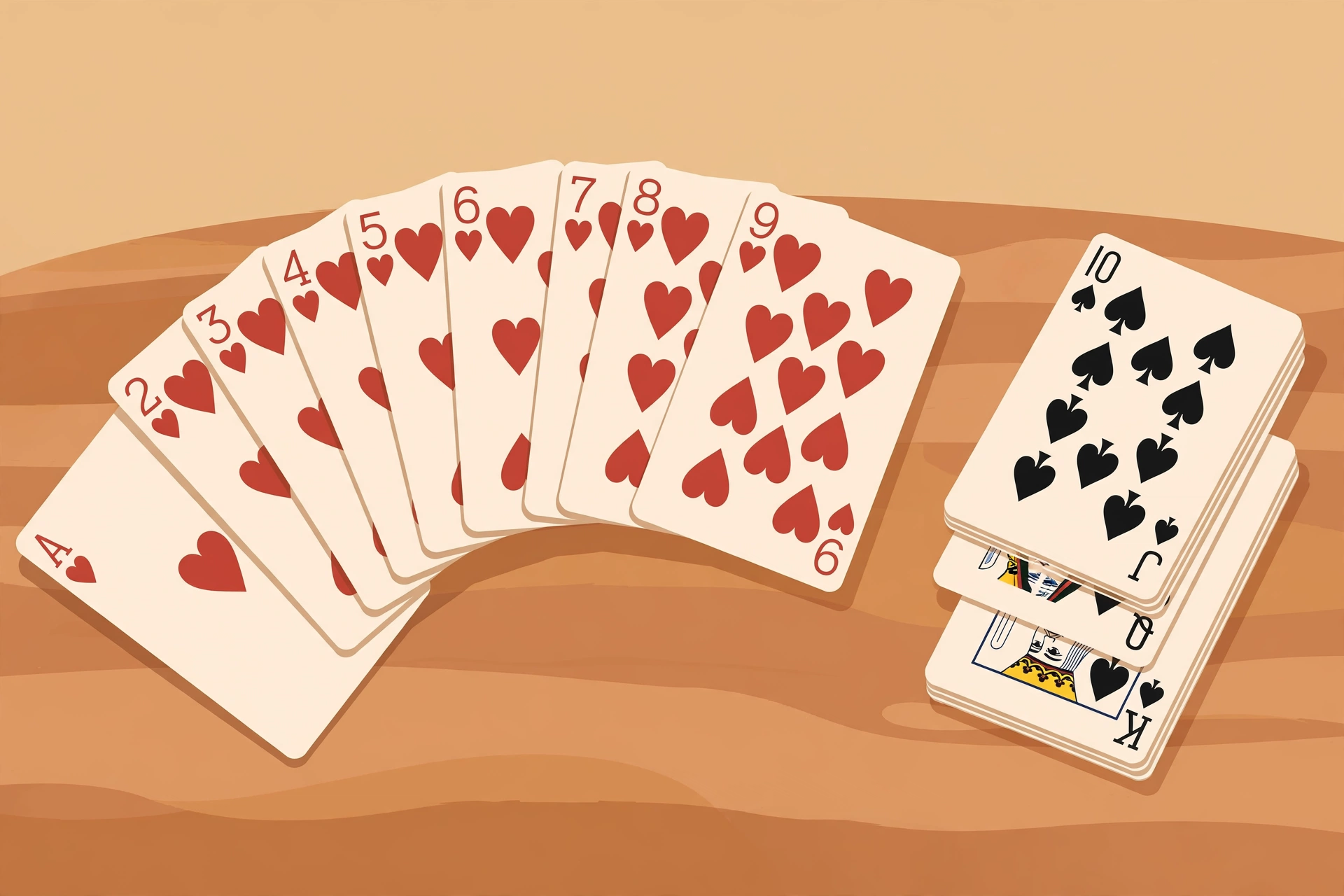
Players: 2. You need: one deck of playing cards with the 10s, Jacks, Queens and Kings removed. Aces count as 1, so the deck runs Ace to 9 and every product stays inside the grade 3 facts.
Setup: Shuffle the 36 cards and deal them all out face down, half to each player.
How to play:
- Both players flip their top two cards at the same time.
- Each player multiplies their own two cards and says the full fact out loud, for example “4 times 7 is 28.”
- The higher product wins all four cards. The winner slides them under their pile.
- If the products tie, it is war: each player flips two more cards and multiplies again. The higher product takes all eight cards.
- Play until one player holds every card, or stop at a set time and count piles. Most cards wins.
Example turn: You flip 4 and 7 and say 28. Your partner flips 3 and 8 and says 24. Your 28 wins all four cards.
Skill: multiplication facts to 9 × 9. Luck decides who wins, and that is the point for a reluctant player. The practice is in the saying, so make both players say both facts every turn. The player who loses the hand still does the math.
2. Salute!
Players: 3 (one caller, two card holders). You need: a deck of cards cut down to Ace (counts as 1) through 9. For the first weeks, use Ace through 5 only and add the higher cards as the facts are learned.
Setup: The two card holders split the deck between them and hold their piles face down. The caller sits where they can see both foreheads.
How to play:
- Each holder takes the top card of their pile and holds it against their own forehead, facing out, without looking at it.
- The caller looks at both cards, multiplies them, and announces only the product. Seeing a 6 and a 7, the caller says “42.”
- Each holder can see the other holder’s card but not their own. Each one races to work out their own card by dividing the product by the card they can see. The holder looking at the 7 thinks “42 divided by 7 is 6” and shouts “6.”
- The first holder to name their own card correctly wins both cards.
- Rotate after every round so everyone calls. When the piles run out, most cards wins.
Skill: missing factors, division facts and fact families. This is the only card game here that practices division without ever calling it division. Being the caller is not a rest turn either, since the caller does the multiplication on every round, so rotate often.
3. Fraction Memory Match
Players: 2 to 4. You need: 20 index cards. On 10 cards write a fraction: 1/2, 1/3, 2/3, 1/4, 3/4, 1/6, 1/8, 3/8, 5/8, 7/8. On the other 10, draw the matching picture, a circle or rectangle split into equal parts with that fraction shaded.
Setup: Shuffle all 20 cards and lay them face down in a grid of 4 rows of 5.
How to play:
- On your turn, flip over any two cards so everyone can see them.
- A match is a fraction card and the picture card that shows the same fraction. To keep a match you must say the fraction out loud, for example “three eighths.”
- If the two cards match, keep the pair and take another turn.
- If they do not match, flip both back face down in the same places and the turn passes.
- The game ends when every pair is found. Most pairs wins.
Skill: fraction recognition, and the idea that a fraction means equal parts of a whole. The drawing is part of the learning, so let your child help make the cards. The parts must be equal sizes. A circle cut into uneven pieces is not thirds, and spotting that is a real grade 3 lesson.
4. Closest to 1,000
Players: 2 to 4. You need: a deck of cards cut down to Ace (counts as 1) through 9, plus paper and a pencil for each player.
Setup: Shuffle. Each round, deal 6 cards face up in front of every player.
How to play:
- Each player arranges their 6 cards into two 3-digit numbers, then adds the two numbers on paper.
- The goal is a total as close to 1,000 as possible. Going over counts the same as going under: a total of 1,015 is 15 away.
- The player closest to 1,000 scores 1 point. If two players are equally close, the one under 1,000 takes the point. If still tied, both score.
- Collect the cards, shuffle, and deal the next round. First to 3 points wins.
Example turn: Your cards are 8, 6, 4, 9, 2 and 5. You build 486 + 529 = 1,015, which is 15 away from 1,000. Your partner builds 864 + 295 = 1,159, which is 159 away. Your arrangement wins the round.
Skill: place value to 1,000, adding two 3-digit numbers with regrouping, and estimation. The hundreds digits decide this game. Once a child sees that, they stop placing cards at random and start planning, and that planning is the real practice.
Dice Games
5. Multiplication Bump
Players: 2. You need: 2 dice, 10 counters per player in two different colors (coins, buttons or beans), and a game board you draw on paper.
Setup: Pick the one times table your child is learning. Write its 11 products, for dice sums 2 to 12, on the paper in mixed-up boxes. For the 7 times table the board reads 14, 21, 28, 35, 42, 49, 56, 63, 70, 77, 84.
How to play:
- Roll both dice and add them. Multiply the sum by the board’s table and say the fact out loud. Roll 3 and 5 on the 7 board: the sum is 8, and 8 × 7 = 56.
- Put one of your counters on that product.
- If the product already holds one of your opponent’s counters, bump it off. Their counter goes back to their pile and yours takes the space.
- If the product already holds one of your own counters, place a second counter on top. That space is now locked, and locked spaces can never be bumped.
- If the product is locked by either player, you cannot play and your turn ends.
- Take turns. The first player to get all 10 of their counters onto the board wins.
Skill: one times table in real depth, plus quick addition. A full game gives each player roughly 15 to 30 fact repetitions.
Drawing a fresh board for a new table takes two minutes and is the whole prep, so start with the table your child is on this week at school.
A child playing a new table can check a product on our multiplication chart instead of guessing.
6. Rounding Race
Players: 2 to 4. You need: 3 dice and a paper score sheet. Decide before you start that you are rounding to the nearest 100.
How to play:
- On your turn, roll all 3 dice and arrange them into any 3-digit number you like.
- Round your number to the nearest 100 and say it with the reason, for example “486 rounds to 500, because 86 is past halfway to the next hundred.”
- Every player rolls once per round. The highest rounded number wins the round and scores 1 point.
- If two players tie on the rounded number, the higher unrounded number wins the point.
- First to 5 points wins the game.
Example turn: You roll 4, 8 and 6 and arrange 486, which rounds to 500. Your partner rolls 3, 5 and 9, arranges 359, which rounds to 400. Your 500 takes the round.
Skill: rounding to the nearest 100 and place value to 1,000. Easier version: roll 2 dice, build a 2-digit number and round to the nearest 10. Arranging the dice is the strategy. A 4 in the hundreds place with a 9 beside it (495, rounds to 500) beats a careless arrangement, and children figure that out fast.
7. Race to $1.00
Players: 2 to 4. You need: 1 die and a shared bank of coins, real or play money: about 30 pennies, 10 nickels, 10 dimes and 4 quarters. Everyone starts with no coins.
How to play:
- On your turn, roll the die and take that many pennies from the bank.
- Whenever you can trade up, you must: 5 pennies trade for 1 nickel, 2 nickels trade for 1 dime, and 2 dimes plus 1 nickel trade for 1 quarter.
- Say your running total out loud after every trade, for example “I have a nickel and 2 pennies, that is 7 cents.”
- The first player to hold exactly $1.00 wins. If a roll would take your total past $1.00, take no coins on that turn.
- Shorter version for new players: race to 50 cents instead.
Example turn: You roll a 4 and take 4 pennies. Next turn you roll a 3 and take 3 more. Now you hold 7 pennies, so you trade 5 of them for a nickel and keep 2 pennies. You are at 7 cents and climbing.
Skill: coin values, counting money and trading equal values. Forced trading is the whole game. Left alone, children hoard pennies and count them one by one. The trade-up rule is what teaches them that five pennies and a nickel are the same money.
8. Math Dice
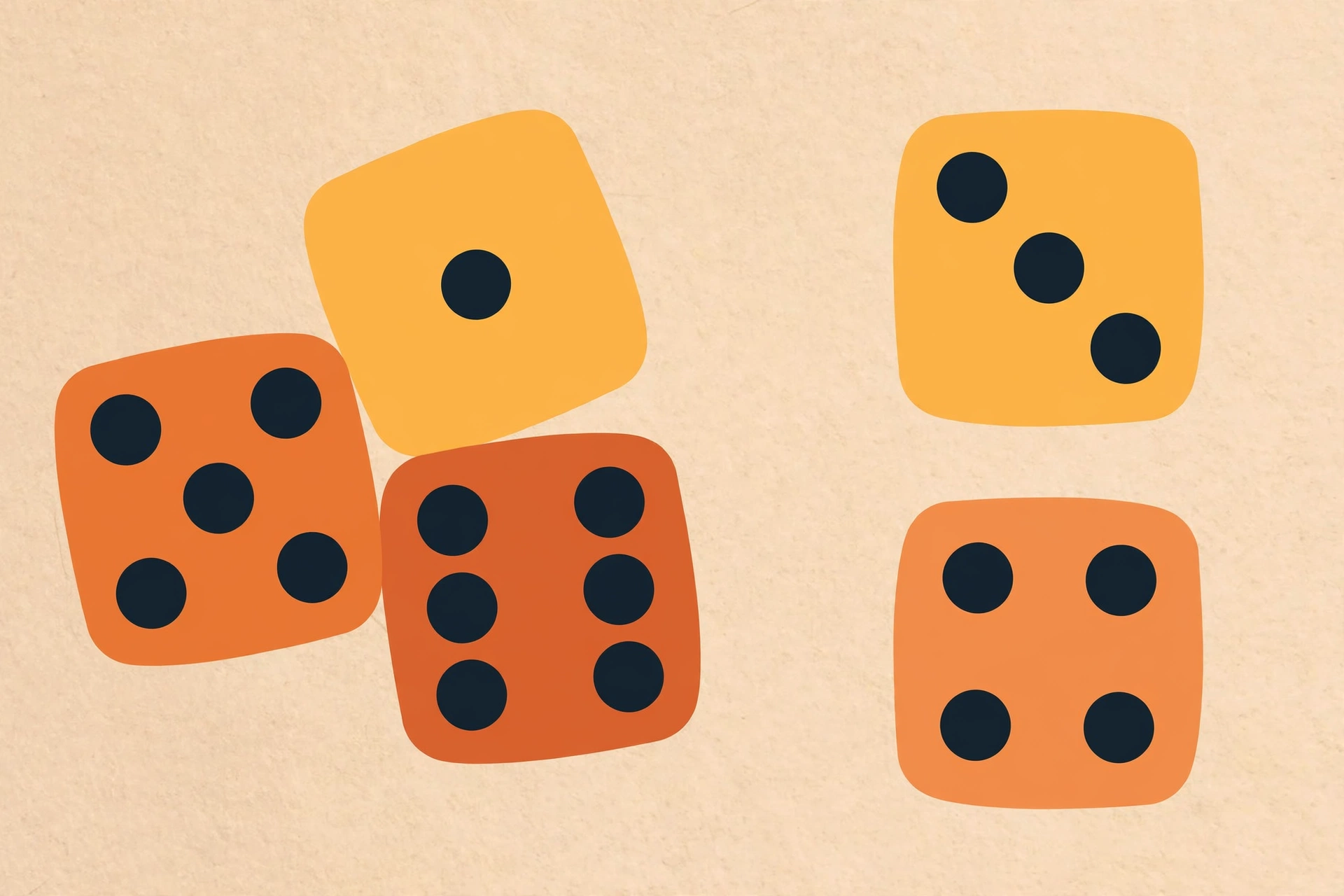
Players: 2 or more. You need: the Math Dice game by ThinkFun, which contains two 12-sided dice and three 6-sided dice. No special dice at home? Play the household version with five regular dice: two as target dice and three as scoring dice.
How to play:
- Roll the two target dice and multiply them. That product is the target number. In the household version, multiply two regular dice, so targets run from 2 to 36.
- Roll the three scoring dice.
- Every player races to build an equation using each scoring number once and only once, combined with addition, subtraction, multiplication or division, that lands on the target or as close to it as possible.
- Players call out their answers as they find them. Every new call must be closer to the target than the last. A player who hits the target exactly ends the round at once.
- The player with the closest answer wins the point. First to 4 points wins the game.
Grade 3 settings: these are the publisher’s own easier options. Roll only one target die, so targets run 1 to 12, or add the two target dice instead of multiplying, so targets run 2 to 24. Skip powers.
The official rules ban pencil and paper in competitive play, but at home with a 3rd grader, allow paper. Working out should be encouraged, not rushed.
Example turn: The target dice show 3 and 4, so the target is 12. The scoring dice show 5, 3 and 2. One player calls 10 (5 + 3 + 2). Another calls 13 (5 × 3 − 2), which is closer, and 13 takes the point unless someone finds 12 exactly.
Skill: two-step thinking and all four operations. Grade 3 word problems are two-step, and this game is two-step thinking in its purest form. It is the hardest game on the list and the best one, so start with the one-die target setting until your child can win a few rounds, then move up.
Board and Paper Games
9. Multiplication Bingo: Grade 3 Edition
Players: 3 or more (one caller plus at least two players). Two can play if one person calls and plays a board at the same time. You need: paper, counters (beans, coins or buttons), and a set of fact slips.
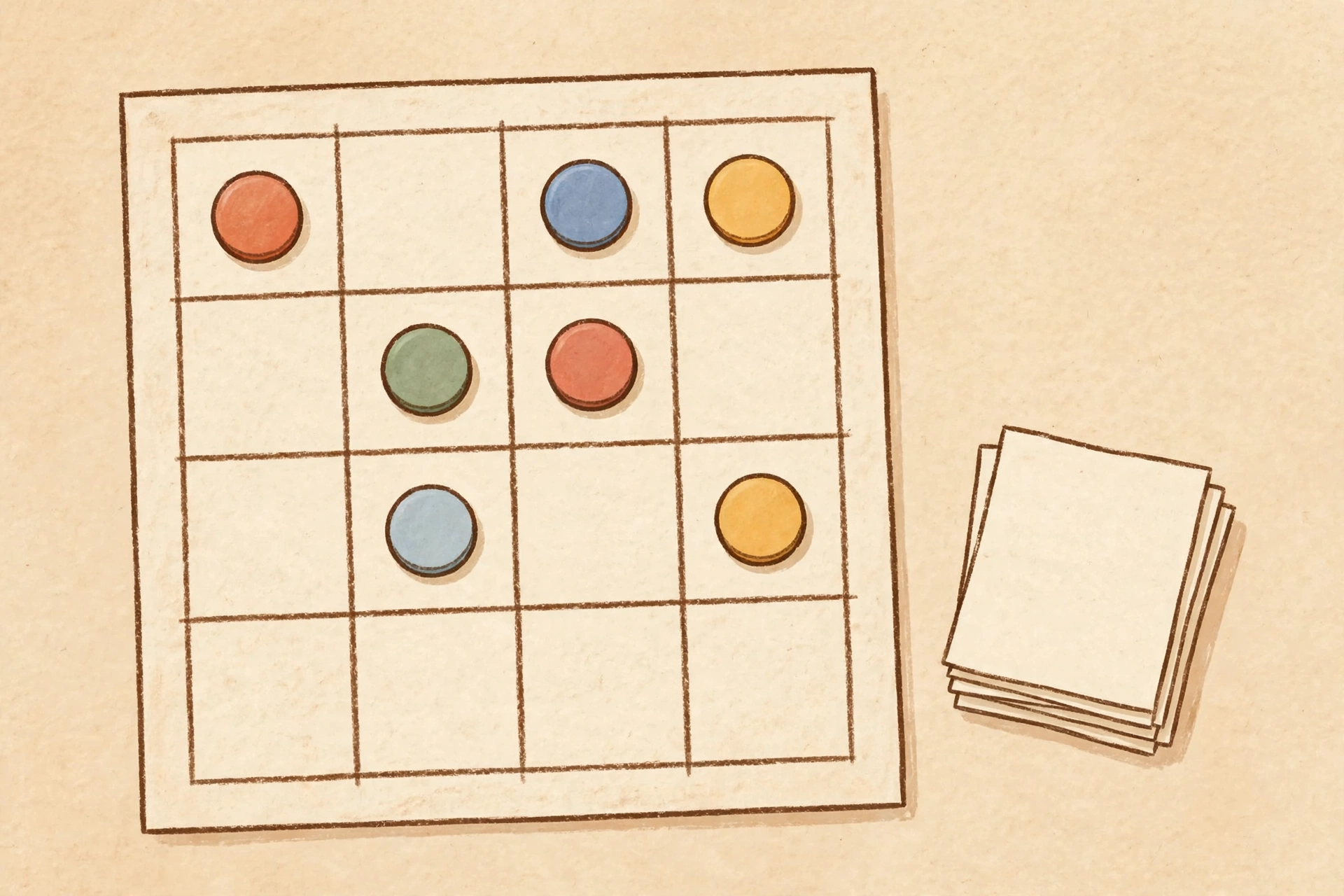
Setup: Each player draws a 4 by 4 grid and fills the 16 squares with products from the facts your child is learning, in any order. Every board should be different. For facts up to 9 × 9, good square fillers include 12, 18, 24, 36, 42, 48, 56 and 64.
Write one multiplication fact per slip of paper (6 × 7, 8 × 8, and so on) and put the slips in a bowl. Make sure every product on every board has its fact in the bowl.
How to play:
- The caller draws a slip and reads the fact out loud: “6 times 7.”
- Every player who has 42 on their board covers it, and says the full fact as they cover: “6 times 7 is 42.”
- The first player to cover a full row, column or diagonal calls “Bingo.”
- To win, that player reads back the fact for every covered square in the line. The caller checks the answers against the drawn slips. A wrong fact anywhere in the line means play continues.
Division mode: fill the boards with quotients from 1 to 9 instead of products. The caller reads division facts (“42 divided by 6”) and players cover the answer, 7.
Skill: multiplication fact recall under gentle time pressure. The read-back rule is what separates this from a shouting match. Never skip it. It is the moment the winner proves the facts instead of guessing from the pattern of the board.
10. Fraction Line-Up
Players: 2 to 4. You need: a long strip of paper (or a line of tape on the floor), a marker, one small button or coin per player as a marker, and about 16 fraction cards.
Setup: Draw a number line on the strip. Mark 0 at the left end, 1 at the right end and 1/2 in the middle. Leave the rest blank. On the cards write 1/2, 1/3, 2/3, 1/4, 2/4, 3/4, 1/6, 2/6, 4/6, 5/6, 1/8, 2/8, 3/8, 5/8, 6/8, 7/8. The repeated values in different forms are deliberate.
How to play:
- Shuffle the cards face down. On your turn, draw the top card.
- Place your marker on the line where you believe that fraction belongs, and say why, for example “3/4 goes halfway between 1/2 and 1.”
- The other players judge the placement. If the group agrees it is right, your marker stays and you score the card. If the group challenges it and the placement is wrong, the marker comes off and the card goes to the bottom of the pile.
- Markers from different players may share a spot. Two quarters really is the same point as one half, and that argument is worth having at the table. Parents can settle it with our fraction calculator.
- The first player to place 5 markers correctly wins.
Skill: fractions on a number line, benchmark fractions (0, 1/2, 1) and equivalent fractions. Grade 3 is the year fractions move onto the number line, and it is the idea children find hardest. This game is the most curriculum-true fraction practice on the list.
11. Multiplication Tic-Tac-Toe
Players: 2. You need: paper and a pencil.
Setup: Draw a 3 by 3 grid. Fill the nine squares with nine different products, for example 12, 16, 18, 24, 28, 36, 42, 48 and 56.
On nine slips of paper, write one multiplication fact for each product (3 × 4 for 12, 7 × 8 for 56, and so on). Write a large X on about half the slips and a large O on the rest.
Shuffle the slips face down.
How to play:
- Players take turns drawing the top slip.
- Solve the fact out loud. If you solve it correctly, place the slip on the square with its product. The mark printed on the slip is the mark that counts, X or O, whoever drew it.
- If you solve it wrong, the slip goes to the bottom of the pile and your turn ends.
- The player whose placed slip completes a row, column or diagonal of three matching marks wins the game.
- If the grid fills with no line of three, the game is a draw. Shuffle and play again. Best of three rounds makes a good match.
Division version: fill the grid with the quotients 1 to 9 and write division facts on the slips.
Skill: multiplication facts, plus early planning. Because the marks are shuffled, luck levels the game. A child who is behind on facts can still win, which keeps them playing long enough to catch up.
12. I Have, Who Has? Telling Time
Players: 3 or more. A whole class is ideal. At home, a family works if each person holds several cards. You need: about 20 index cards, made once by an adult.
Setup (adult prep, and it matters): First write out a list of about 20 times in a chain order, for example 3:00, then 4:25, then 6:10, and so on. Then make one card per time. Each card reads “I have [this time].
Who has [the next time in the list, written in words]?” The first card in the chain is marked START. The last card’s “Who has” points back to the first card’s time, closing the loop. Deal all the cards out.
How to play:
- The player holding the START card reads it aloud: “I have 3:00. Who has twenty-five past four?”
- The player whose card says 4:25 answers: “I have 4:25. Who has ten past six?”
- Play continues around the group until the chain loops back to the START card.
- If the chain stalls, the group works out together which time is missing and who should have answered.
- Time the run with a stopwatch. On the next play, try to beat the group’s own record.
Grade 3 settings: use times to the nearest 5 minutes for the first set. The harder set uses times to the nearest minute and “minutes to” wording, such as “five to seven” for 6:55.
Skill: telling time, and hearing times spoken the way adults actually say them. The game is won or lost in the setup. If two cards carry the same time, the chain breaks, so write the ordered list first and check it before you write a single card.
Active Games: Stand Up and Play
13. Around the World
Players: 5 or more. A whole class is best. At home, a family around a table plays the same way. You need: a set of fact flash cards. For grade 3: multiplication and division facts to 9 × 9.
Setup: Players sit in a circle, or stay at their desks. Pick one player to be the first challenger.
How to play:
- The challenger stands behind a seated player.
- The leader holds up a flash card so both can see it. The first of the two to say the correct answer wins the pairing. A wrong answer loses the pairing at once.
- If the challenger wins, they move on and stand behind the next player.
- If the seated player wins, the challenger takes that seat, and the seated player stands up and becomes the new challenger, moving to the next player.
- The goal is to travel all the way around the circle as challenger and arrive back at your own seat.
Skill: fact speed and recall. This is fluency practice with the whole group watching, which is why children take it seriously. Decide the tie rule before you start. If both answer at the same instant, show a new card. Announcing this first prevents the only argument this game ever causes.
14. Fact Catch
Players: 3 or more. You need: a soft ball or a beanbag. Stand in a circle, indoors or outside.
How to play:
- The leader calls out a fact and tosses the ball to another player: “7 times 6!”
- The catcher says the answer, “42,” then calls a new fact and tosses the ball to someone else.
- If a catcher cannot answer, nobody is out. The whole circle rescues them by skip-counting that multiple together: “7, 14, 21, 28, 35, 42.” Then the catcher repeats the fact and answer, and play moves on.
- For division rounds, call division facts instead: “42 divided by 7.”
- Speed rule for confident groups: the answer must come within a slow count of five.
Skill: multiplication and division fluency, and multiples. The rescue rule means the child who needs the practice most hears the full count every time. No elimination, on purpose. In an elimination version, the weakest player sits out first and gets the least practice. The rescue version gives them the most.
15. Rounding Relay
Players: 4 or more, in two teams. You need: a whiteboard or two large sheets of paper, a marker per team, and a set of 3-digit number cards (index cards with numbers such as 486, 352, 729 and 961 written on them).
Setup: Teams line up facing their board or paper. The leader stands where both first runners can see the number card.
How to play:
- The leader shows the first runner from each team the same number card.
- Each runner races to their board, writes the number rounded to the nearest 10 and underneath it rounded to the nearest 100, saying the rounding rule out loud as they write: “486. The ones digit is 6, so it rounds up to 490. The tens digit is 8, so it rounds up to 500.”
- The runner races back and tags the next player, who gets a new number.
- If a rounding is wrong, the leader calls the runner back to fix it before the tag counts.
- The first team to finish all its runners with correct answers wins.
Skill: rounding to the nearest 10 and the nearest 100, said out loud under mild pressure. Requiring the spoken rule slows the fastest runners down just enough to keep it fair, and the explanation is the actual practice. Speed alone teaches nothing.
How to Pick the Right Game for Your Child
Match the game to the skill being learned in class this month, not to the skill your child has already mastered. If the class is on the 7 times table, that is this week’s Bump board. If fractions just started, that is Fraction Memory Match.
For a reluctant player, start with the luck-heavy games (War, Bingo, Tic-Tac-Toe) where a weaker player can genuinely win, and let your child deal, call and keep score, since those jobs carry their own quiet practice.
Keep sessions to 10 to 20 minutes and stop while it is still fun. Four short game sessions a week build more fluency than one long Saturday session, and a game that ends too early gets asked for again.
Frequently Asked Questions
Are these games aligned with what 3rd graders actually learn?
Yes. Grade 3 math is multiplication and division facts within 100, fractions as numbers on a number line, place value to 1,000 with rounding, telling time and money. Every game in the Quick Picks table is labeled with the skill it practices, so you can match the game to what your child is doing in class this month.
What do I need to buy to play these games?
Nothing. Fourteen of the fifteen games run on a deck of cards, dice, coins, paper and a pencil, and the card sets (Fraction Memory Match, I Have Who Has) are made from index cards in about ten minutes. The one boxed game, Math Dice, includes a version that uses five ordinary dice, so even that one costs nothing.
How long should a game session be?
Ten to twenty minutes is the sweet spot for a 3rd grader. Play two or three short rounds of one game, or one round each of two games, and stop while it is still fun. Short sessions four or five times a week build more fluency than one long session on the weekend.
Can these games replace homework or worksheets?
No, and they are not meant to. Games build fact fluency, number sense and confidence. Written practice builds the habit of showing work and solving multi-step problems on paper. Use games for the daily repetition that worksheets make miserable, and keep some written practice alongside, for example a short set from our worksheet generator on the skill of the week.
My child hates math. Which games should we start with?
Start with the luck-heavy games where a weaker player can still win: Multiplication War, Multiplication Bingo and Multiplication Tic-Tac-Toe. Let your child be the caller, the dealer or the scorekeeper, keep sessions to ten minutes, and skip the timer games (Around the World, Fact Catch speed rounds) until confidence is up.
Can teachers use these games in a classroom?
Yes. Around the World and I Have, Who Has are whole-class games. Salute, Multiplication Bump, Multiplication War and Multiplication Bingo work as partner and center games with almost no prep.
Fraction Line-Up and Rounding Relay suit small groups and indoor recess. Every game lists its player count and time in the Quick Picks table, so you can slot them into a rotation quickly.
Keep the deck cut down and the dice where you can find them, and the games will get played.
Our free math tools page pairs with this list when a game raises a question: the multiplication chart settles a disputed fact, the fraction calculator checks whether two fractions really are equal, and the worksheet generator turns the week’s weakest skill into five minutes of written practice.
Every topic clicks faster with practice. Our Resource Library has free lesson packs with slides, printable worksheets and full answer keys, ready to download and teach.
Members unlock every lesson in the library, including the full Fractions, Multiplication, Place Value, Addition & Subtraction, Time & Money and Geometry & Shapes units. See the full library


