
Somewhere in your house there is a deck of cards: in a kitchen drawer, a game shelf, a holiday stocking from three years ago. That deck is a complete math practice kit.
This post collects 15 math card games that run on one standard 52-card deck and nothing else: no dice, no printables, no apps, no accounts, nothing to buy.
Every game below comes with complete rules you can play from tonight, labeled with the grades it suits and the exact skill it practices, and grouped so a 1st grader and a 5th grader can both find their games on the same page.
There is even published research behind the young end of the list: in a 2020 study, preschoolers who played numerical card games in four short sessions improved their numeral identification, and the gains were still there eight weeks later. Cards will not replace school math, and this page will not pretend otherwise.
What they do is turn the daily repetition that builds fluency into the part of the day your child asks for.
Quick answer: Start tonight with the game that matches your child. For a 1st grader, play Garbage, which needs only number order from 1 to 10. For grades 3 and 4, play Close Call, a two-digit addition game with a target of 100.
For a 5th grader, play Make 24, which uses all four operations on four cards. For the whole family at one table, play Ninety-Nine. Every game needs one deck of cards, most take 10 to 15 minutes, and the Quick Picks table below lists all 15 with their grades, players, skills and times.
Quick Picks: All 15 Math Card Games at a Glance
| Game | Grades | Players | Skill | Time |
|---|---|---|---|---|
| Garbage (Trash) | 1-2 | 2 or more | Number order, 1 to 10 | 10-15 min |
| Tens Go Fish | 1-2 | 2-4 | Pairs that make 10 | 10 min |
| Make Ten | 1-2 | 1-2 | Pairs that make 10, scanning | 5-10 min |
| Tens Concentration | 1-2 | 1-4 | Pairs that make 10, memory | 10-15 min |
| Sum Snap | 1-2 | 2 | Addition facts to 20 | 5-10 min |
| Elevens | 3-4 | 1-2 | Pairs that make 11 | 10 min |
| Pyramid | 3-4 | 1-2 | Pairs that make 10, planning | 10-15 min |
| Make 21 | 2-4 | 2-4 | Addition to 21, judging risk | 10 min |
| Close Call | 3-4 | 2-4 | Two-digit addition, place value | 10-15 min |
| Kings in the Corners | 3-4 | 2-4 | Sequencing, one less | 15-20 min |
| Ninety-Nine (99) | 3-5 | 2-6 | Mental addition to 99 | 15 min |
| Make 24 | 4-5 | 2-4 | All four operations | 10-15 min |
| Race to 100 | 2-5 | 2-4 | Running totals to 100 | 10-15 min |
| Golf | 3-5 | 2-6 | Adding a set of numbers, memory | 15-30 min |
| Speed | 2-5 | 2 | Number order at speed | 5 min a round |
Setting Up Your Deck: Face Cards, Aces and Jokers
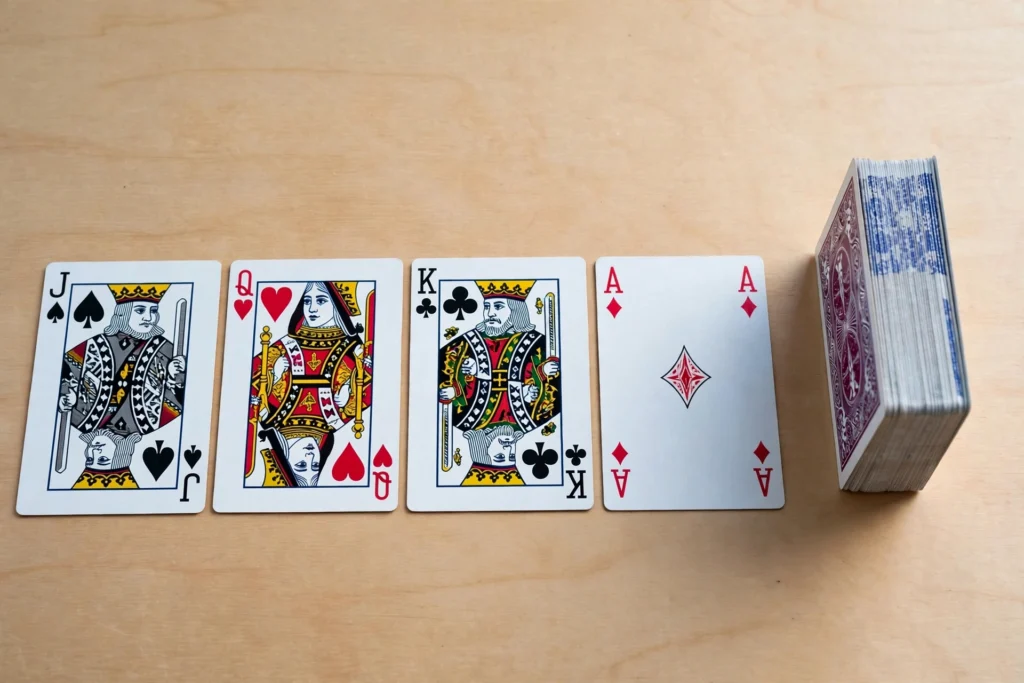
The deck is the whole supply list. Every game in this post uses one standard 52-card deck, and the jokers come out for all 15 games and can go straight back in the box.
Aces almost always count as 1; the one exception is Ninety-Nine, where the player who plays an Ace chooses 1 or 11, out loud, each time. Face cards get three different jobs depending on the game.
In most grades 1 and 2 games they come out of the deck entirely, so the numbers stay small.
In some games they take number values: Make 21 counts Jack, Queen and King as 10 each, Golf counts a King as 0, and Race to 100’s older version counts them as 11, 12 and 13.
And in a few games they get special duties: in Elevens a Jack, Queen and King leave only as a set of three, in Kings in the Corners only a King can open a corner pile, and in Garbage Jacks are wild.
Every game entry below states its own card values, so you never have to flip back to this section mid-game.
| Deck setup | Used by |
|---|---|
| Full deck, jokers out | Garbage, Elevens, Kings in the Corners, Ninety-Nine, Golf, Speed |
| Face cards out, Ace counts as 1 | Tens Go Fish (10s out too), Make Ten (10s out too), Pyramid (young version) |
| Ace to 10 only | Tens Concentration, Sum Snap, Make 24 (face cards out), Close Call (10s out too) |
| Face cards valued as 10 | Make 21, Golf (King counts 0), Ninety-Nine (Jack and Queen 10, King sets 99) |
| Face cards valued 11, 12, 13 | Race to 100 (older version), Pyramid’s classic variation |
Only have an UNO deck? You can still play tonight. Pull out the action cards (Skip, Reverse, Draw Two, Wild and Wild Draw Four), and the number cards, which run 0 to 9, stand in for a number-only deck.
Six of the fifteen games work this way: Tens Go Fish, Make Ten, Tens Concentration, Sum Snap, Close Call and Make 24.
Set the 0 cards aside for Close Call, whose deck starts at 1, and in the others either let 0 count as a free pass or set the 0s aside too, agreed before you start.
The other nine games need real face cards or the full Ace to King sequence, so those need a standard deck.
Card Games for Grades 1 and 2
1. Garbage (Trash)
Grades: 1 to 2 · Players: 2 or more (2 to 3 players per deck; add a second deck for 4 or more) · You need: one deck of cards with the jokers removed.
Setup: Deal 10 cards face down to each player. Each player arranges their cards in two rows of five, without looking at them. The top left card is position 1 and the bottom right card is position 10.
The rest of the deck goes face down in the middle as the draw pile. Flip its top card face up beside it to start a discard pile.
How to play:
- On your turn, take the top card of the draw pile or the top card of the discard pile.
- If the card is an Ace through 10, place it face up in the position with the same number (an Ace goes in position 1, a 7 in position 7). Pick up the face down card that was sitting in that position.
- If that flipped card also has a free position, place it too and pick up the card under it. Keep going for as long as each new card can be placed.
- Jacks are wild. A Jack can be placed in any position, and it stays there.
- If you draw or flip a Queen or a King, or a number card whose position is already filled, that card goes on the discard pile and your turn ends.
Winning: The first player to have all 10 positions face up in order wins the round.
For a longer match, the winner of a round starts the next round with 9 cards (positions 1 to 9), then 8, and so on. The first player to complete a one-card round wins the game.
With young children, one round is a complete game.
Skill: Number order and sequencing from 1 to 10, and position words (first, second, third).
Variation: Easier: play with five cards in one row, positions 1 to 5, for a child still learning the order to 10.
Honest note: Your layout is a number line built out of cards, one position at a time. Luck does most of the work, which makes this the gentlest first game on the list for a child who is convinced they are bad at math.
2. Tens Go Fish
Grades: 1 to 2 · Players: 2 to 4 · You need: one deck with the face cards and the four 10s removed. Aces count as 1, so the deck runs Ace to 9 and every card has a partner that makes 10 (a 5 pairs with the other 5s).
Setup: Deal 5 cards to each player. The rest of the deck goes face down in the middle as the fishing pond. Before play starts, every player lays down any pairs in their hand that make 10.
How to play:
- On your turn, pick one card in your hand and ask one other player for its partner: “I have a 3. Do you have a 7 to make 10?”
- If that player has the card, they must hand it over. Lay your pair face up in front of you and take another turn.
- If they do not have it, they say “Go fish.” Draw the top card of the pond. If it completes a pair in your hand, lay the pair down. Either way, your turn ends.
- If you run out of cards in your hand, draw one card from the pond and carry on.
- Play until the pond is empty and nobody can make another pair.
Winning: The player with the most pairs face up in front of them wins.
Skill: Number pairs that make 10, the single most useful fact family in grades 1 and 2.
Variation: Harder: put the 10s back in the deck and fish for pairs that make 11 instead (1 with 10, 2 with 9, and so on).
Honest note: The asking is the practice. A child has to work out the missing partner before they can ask for it, so every turn starts with a small addition problem they set themselves.
3. Make Ten
Grades: 1 to 2 · Players: 1 to 2 (or a family team playing against the deck) · You need: one deck with the face cards and the four 10s removed. Aces count as 1.
Setup: Shuffle the 36 cards. Lay 9 cards face up in a square of 3 rows of 3. Keep the rest face down beside the square as the stock.
How to play:
- Look over the 9 cards for any two cards that add up to 10, such as 7 and 3 or 6 and 4.
- Say the pair out loud as a full fact (“7 and 3 make 10”), take both cards off the table, and set them aside in a pairs pile.
- Deal two new cards from the stock into the empty spaces.
- Keep going until the stock is used up and no pair is left on the table.
- With two players, take turns claiming one pair each. With one player, or as a team, the challenge is to clear the whole deck.
Winning: Playing alone or as a team, you win if every card ends up in the pairs pile. With two players taking turns, most pairs wins.
Skill: Pairs that make 10, plus scanning a set of numbers and holding two values in mind at once.
Variation: Harder: allow sets of three cards that make 10 as well (2, 3 and 5, for example). The grid suddenly holds far more answers.
Honest note: This is the calmest game on the list. No turns to lose, no race, and a child can play it alone at the table while dinner cooks.
4. Tens Concentration
Grades: 1 to 2 · Players: 1 to 4 · You need: one deck cut down to Ace through 10 (40 cards, jokers and face cards removed). Aces count as 1.
Setup: Shuffle the 40 cards and lay them all face down in 5 rows of 8, without looking at them. For a first game with a young child, build a smaller grid of 24 cards instead (4 rows of 6), using 12 pairs chosen in advance.
How to play:
- On your turn, flip over any two cards so everyone can see them.
- If the two cards add up to 10, take them and keep them in front of you.
- A 10 on its own is already a complete set. If one of your two flipped cards is a 10, take it at once and flip one more card to try to complete a pair with your remaining card.
- If the two cards do not add up to 10, leave them face up for a few seconds so everyone can memorize them, then turn them back face down in the same places. Your turn ends.
- If you took a pair, you may take another turn straight away. (Families with mixed ages can drop this rule for older players only, so younger children get more turns.)
Winning: When every card has been claimed, the player holding the most cards wins. Playing alone, count your turns and try to clear the grid in fewer turns next time.
Skill: Pairs that make 10 and visual working memory. Remembering where the 4 was is half the game.
Variation: Harder: flip three cards on each turn and take any two of them that make 10, turning the third back down (the extra card makes the memory load much bigger).
Honest note: This is the memory-and-matching format that researchers have used in published studies of young children’s number learning. Children who cannot yet add fluently can still win on memory while the pairs quietly sink in.
5. Sum Snap
Grades: 1 to 2 (grade 1 with the easier deck below) · Players: 2 · You need: one deck with the face cards removed. Aces count as 1 and the 10s stay in, so sums run from 2 to 20.
Setup: Shuffle and deal all the cards out face down, half to each player. Each player keeps their pile face down in front of them.
How to play:
- Both players flip the top card of their pile face up into the middle at the same time.
- Both players race to add the two cards and call out the sum, as a full fact: “6 plus 5 is 11.”
- The first player to call the correct sum takes both cards and puts them at the bottom of their pile.
- If a player calls a wrong sum, the other player can take both cards by calling the correct sum.
- If both players call the correct sum at exactly the same moment, leave the cards and flip again. The winner of the next flip takes all four cards.
- Play until one player holds every card, or stop at a set time and count piles.
Winning: Most cards when the game stops, or all of them.
Skill: Addition facts to 20, said out loud at speed.
Variation: Easier: cut the deck to Ace through 5 so sums stay within 10. Harder: Difference Snap. Flip the same way, but call the difference between the two cards (bigger number minus smaller number) instead of the sum.
Honest note: Speed games reward the child who already knows the facts, so keep the pairs fair. If one player is much faster, that player must say the full fact sentence before taking the cards, which slows them down just enough and doubles their practice.
Card Games for Grades 3 and 4
6. Elevens
Grades: 3 to 4 (the variation suits grade 2) · Players: 1, or 2 racing side by side with two decks · You need: one full deck of cards, jokers removed.
Setup: Shuffle and deal 9 cards face up in a square of 3 rows of 3. The rest of the deck sits face down beside the square as the stock. Card values: Ace is 1, number cards are face value, and face cards have no number value.
How to play:
- Look for two cards in the square that add up to 11: Ace and 10, 2 and 9, 3 and 8, 4 and 7, or 5 and 6. Remove the pair.
- A Jack, a Queen and a King showing in the square at the same time are removed together as a set of three. That is the only way face cards can leave the square.
- Deal new cards from the stock into every empty space.
- Keep removing pairs and refilling until the stock is empty and no move is left in the square.
Winning: You win outright if you remove all 52 cards, which happens roughly once in ten games, so treat it as a celebration when it lands. Otherwise, count how many cards you removed and try to beat that score next game.
Skill: Pairs that make 11, which means fast recall of every addition pair one step past the make-10 pairs.
Variation: Easier: play the same game as Tens. Pairs that make 10 are removed, a single 10 comes off on its own, and face cards are simply set aside before you start. A harder published sibling, Thirteens, removes pairs that make 13 with Jack as 11 and Queen as 12.
Honest note: This is a patience game, hundreds of years old in spirit and printed in classic solitaire collections. It is the list’s best quiet game for a child who likes puzzles more than contests.
7. Pyramid
Grades: 3 to 4 (the classic version in the variation suits grade 5) · Players: 1 to 2 (partners taking turns, or a solo game) · You need: one deck with the face cards removed for this version. Aces count as 1 and the 10s stay in.
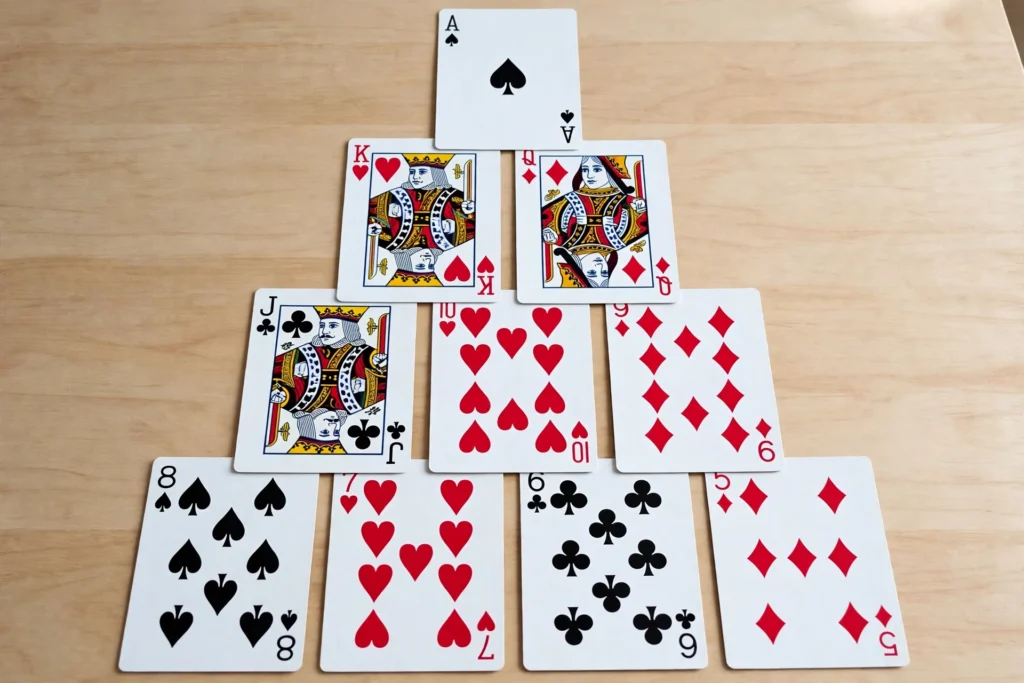
Setup: Deal 21 cards face up into a pyramid of 6 rows: 1 card in the top row, then 2, 3, 4, 5 and 6 cards, with each row overlapping the row above it so the cards partly cover each other. The rest of the deck is the stock, face down beside the pyramid.
How to play:
- A card is free only when no other card overlaps it. At the start, only the bottom row is free.
- Remove any two free cards that add up to 10, such as 6 and 4. A single free 10 is removed on its own.
- Every removal can free the cards above it. Before taking a pair, check what it unlocks.
- When no pair is available among the free cards, turn the top card of the stock face up. If it pairs with a free card to make 10, you may remove both. If not, it stays face up as a waste pile, and only its top card can be used.
- Keep going until the pyramid is cleared or no pair can be made anywhere.
Winning: Clear all 21 cards out of the pyramid. If you get stuck, count the cards left in the pyramid as your score and try to leave fewer next time.
Skill: Pairs that make 10, plus planning two moves ahead, because the pair you take decides which cards open up next.
Variation: Harder, and the classic game: play Pyramid with the full deck, a 28-card pyramid of 7 rows, and pairs that add up to 13 (Ace with Queen, 2 with Jack, 3 with 10, 4 with 9, 5 with 8, 6 with 7). Kings count as 13 and are removed on their own.
Turn the stock one card at a time and allow yourself only one pass through it. Clearing the whole pyramid this way is rare, roughly one deal in fifty, which is exactly why older children keep coming back to it.
Honest note: Greedy pairs lose this game. Taking the first pair you see can bury the one card that would have freed the whole left side. That pause to plan is real mathematical thinking, not a delay.
8. Make 21
Grades: 2 to 4 · Players: 2 to 4 · You need: one full deck of cards, jokers removed. Card values: Ace is 1, number cards are face value, and Jack, Queen and King are each worth 10.
Setup: Deal 2 cards face up to each player. Leave the rest of the deck face down in the middle.
How to play:
- Each player adds up their two cards and announces the total out loud.
- On your turn, choose one of two moves. Hit: take one more card from the deck and add it to your total, announcing the new total. Or stick: keep your total and take no more cards.
- You may hit as many times as you like on your turns, one card per turn. If your total goes over 21, you are bust and score nothing this round.
- When every player has either stuck or gone bust, the round ends and totals are compared.
- Shuffle all the cards back in and deal the next round.
Winning: The player closest to 21 without going over scores 1 point. Tied players each score 1 point. A player whose first two cards total exactly 21 scores 2 points. Going over 21 scores 0. First player to 10 points wins the game.
Skill: Addition with totals up to 21, and the judgment call inside every turn: how close to 21 is close enough to stop?
Variation: Easier: play to a target of 15 with younger children, using the same rules. The hit or stick decision is the same, with smaller sums.
Honest note: Adults may recognize the shape of this game from blackjack. On this page it is a pure addition game: there is no betting, no dealer playing against the table, and nothing at stake but points. Every player plays their own hand against the number 21.
9. Close Call
Grades: 3 to 4 · Players: 2 to 4 · You need: one deck with the 10s and face cards removed and the jokers out. Aces count as 1. Plus paper and a pencil for each player.
Setup: Shuffle the 36 cards and deal 6 cards face down to each player. Players may look at their own cards.
How to play:
- Look at your 6 cards and choose 4 of them. Arrange those 4 cards into two 2-digit numbers, such as 73 and 24.
- Add your two numbers on paper. Your aim is a total as close to 100 as possible without going over. Going over 100 cannot win the round.
- When everyone is ready, reveal the numbers and the totals together. Each player checks another player’s addition before any points are given.
- The two cards you did not use stay in your hand. Deal 4 new cards to each player for the next round.
- Play 5 rounds in total.
Example turn: Your chosen cards are 7, 4, 3 and 2. Arranged as 74 and 32 they total 106, which is over. Arranged as 73 and 24 they total 97, only 3 away from 100. The arrangement, not the adding, is where the game is won.
Winning: The player closest to 100 in a round scores 1 point. If two players are equally close, both score. Most points after 5 rounds wins.
Skill: Place value (the tens digit decides everything), two-digit addition, and estimating a total before you commit to it.
Variation: Harder: Close to 1,000, the published partner version. Deal 8 cards, choose 6, build two 3-digit numbers, and get as close to 1,000 as possible without going over.
Honest note: This game comes from the Close to 100 family of classroom games used in the TERC Investigations curriculum, and it is not the same game as the Closest to 1,000 game elsewhere on this site: the numbers are smaller, the target is 100, and going over is not allowed.
Checking each other’s addition is a rule, not a courtesy. It is where a second round of practice hides.
10. Kings in the Corners
Grades: 3 to 4 · Players: 2 to 4 · You need: one full deck of cards, jokers removed.
Setup: Deal 7 cards to each player. Put the rest of the deck face down in the center as the stock. Turn 4 cards face up around the stock, one above it, one below, one to the left and one to the right. These are the four starting piles. The four diagonal gaps between them are the corners.
How to play:
- Start your turn by drawing the top card of the stock.
- Play as many cards from your hand as you can. A card can be played on a pile when it is one rank lower than the pile’s top card and the opposite color: a red 9 goes on a black 10, a black 7 goes on a red 8.
- A King can only be played into an empty corner. It starts a new pile there, which then builds down in the same one-lower, opposite-color way.
- You may also move a whole pile onto another pile when the bottom card of the moving pile fits the same rule (one lower, opposite color) on the other pile’s top card. Moving a pile frees a starting spot, and any card from your hand can be played into a freed spot.
- When you can make no more plays, your turn ends and the next player draws and plays.
Winning: The first player to play the last card from their hand wins the round. Play best of three rounds for a match.
Skill: Number sequencing (always one less), tracking two conditions at once (rank and color), and planning a chain of plays before you start.
Variation: Easier for a young grade 2 player: build down in the same color instead of alternating colors. One rule disappears and the sequencing practice stays. Add the alternating rule back once the game flows.
Honest note: This is the classic family card game Kings in the Corners (also called Kings Corner), a multiplayer relative of solitaire. It is the longest game on the list and the one grandparents are most likely to already know.
11. Ninety-Nine (99)
Grades: 3 to 5 · Players: 2 to 6 · You need: one full deck of cards, jokers removed, and 3 tokens for each player. Tokens are counters or buttons used as lives. No money, no stakes.
Setup: Deal 3 cards to each player. The rest of the deck is the draw pile. Every player puts their 3 tokens in front of them. The running total starts at 0.
Card values (say them before the first game): Number cards are worth their face value. Jack and Queen are worth 10. An Ace is worth 1 or 11, and the player who plays it announces which. A 4 changes nothing and reverses the direction of play.
A 9 is a pass: the total does not change. A 10 subtracts 10 from the total. A King takes the total straight to 99, or keeps it at 99.
How to play:
- On your turn, play one card from your hand onto the center pile and announce the new running total out loud: “67 plus 8 is 75.”
- Draw one card from the draw pile, so you always hold 3 cards.
- Play passes to the next player (or the previous player, if a 4 has reversed the direction).
- If you cannot play any of your 3 cards without pushing the total over 99, you lose one token. The round ends, the cards are shuffled, and a new round starts at 0.
- A player who loses all 3 tokens is out of the game.
Winning: The last player still holding a token wins.
Example turn: The total is 84 and your hand is a 7, a 10 and a King. Playing the 7 makes 91 and leaves you exposed. Playing the King makes 99 and puts the pressure on everyone else.
Playing the 10 drops the total to 74 and buys you time. All three are legal, and choosing between them is the game.
Skill: Mental addition up to 99 on every single turn, plus holding a plan for the special cards.
Variation: Easier starter version for grade 3: strip the deck to Ace through 10, drop the special cards, and race the shared total to 50. Players add one card at a time to the same running total, and the player who cannot play without passing 50 loses the round.
Honest note: The values above are the ones printed by Bicycle, the card maker, in its official rules for 99. Save your 10s, 9s and Kings for when the total climbs past 80. Playing a King early feels powerful and usually just helps everyone else.
Card Games for Grade 5 and Mixed Ages
12. Make 24
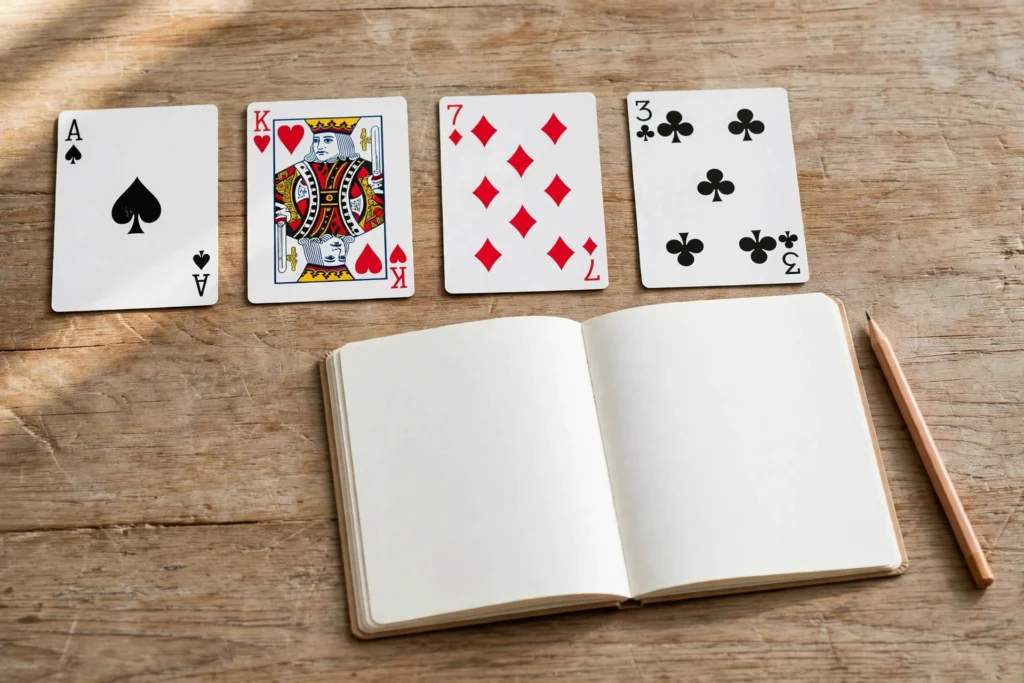
Grades: 4 to 5 · Players: 2 to 4 · You need: one deck with the face cards removed. Aces count as 1, so the deck runs Ace to 10. Paper and a pencil for checking.
Setup: Deal 4 cards face up in the middle of the table where everyone can see them. Keep the rest of the deck as a draw pile.
How to play:
- Everyone studies the same 4 cards at the same time.
- Build a calculation that uses all four numbers exactly once, with addition, subtraction, multiplication, division and parentheses, and lands exactly on 24.
- The first player who finds one calls out “24” and then says the whole calculation. For the cards 2, 3, 4 and 9, one answer is (9 + 3) x (4 – 2) = 12 x 2 = 24.
- If the calculation checks out on paper, that player takes the 4 cards and puts them in a winnings pile. Deal 4 new cards into the middle.
- If a full minute passes and nobody can make 24, set those 4 cards aside and deal 4 new ones. Some sets of four cards cannot make 24, and spotting a dead set is part of the skill.
Winning: When the deck runs out, the player holding the most cards wins.
Skill: All four operations in one problem, order of operations, and the factor pairs of 24 (3 and 8, 4 and 6, 2 and 12), which are the shapes almost every solution takes.
Variation: Easier: change the target to 12 and use 3 cards, for a grade 3 player or a first game. Harder: race individually instead of sharing the four cards. Each player gets their own 4 cards and works alone, and the first correct solution takes the round.
Honest note: Play it as a race only once everyone has solved a few sets slowly.
A child who is still working out 6 x 4 under pressure learns to dread the game, and checking a product on the multiplication chart while building toward 24 is good practice, not cheating.
The factor-pair spotting that makes this game valuable comes from the slow rounds.
13. Race to 100
Grades: 2 to 5 · Players: 2 to 4 · You need: one deck of cards, jokers removed, plus paper and a pencil for each player. Card values: Ace is 1 and number cards are face value. For the older version, Jack is 11, Queen is 12 and King is 13.
Setup: Each player writes 0 at the top of their paper. That is their running total. For younger players, take the face cards out of the deck before you start.
How to play:
- On your turn, flip the top card of the deck and add its value to your own running total.
- Write the new total on your paper and say it out loud: “47 and 8 makes 55.”
- Put the used card on a discard pile and pass the turn.
- The first player to reach exactly 100 wins. A card that would take your total past 100 does not count: discard it and your turn ends with your total unchanged.
- If the deck runs out before anyone reaches 100, shuffle the discard pile and keep going.
Winning: First player to land exactly on 100.
Skill: Adding one number at a time to a growing total, which means bridging tens and hundreds dozens of times per game (55 and 8, 96 and 7).
Variation: Easier: race to 50, with the face cards out. Harder: race to 200 with the Jack, Queen and King values in play, so late-game totals need real care.
Honest note: Each player races their own total, so nobody can be knocked out and a younger child is never playing defense against an adult.
While a total is still less than 100 it keeps growing one card at a time, and the written running total is a quiet record you can check together at the end: any adding slip shows up as a total that stops making sense.
14. Golf
Grades: 3 to 5 · Players: 2 to 6 (add a second deck for 5 or 6 players) · You need: one deck of cards, jokers removed, plus paper and a pencil for scores.
Card values: Ace is 1, a 2 is worth minus 2, cards 3 to 10 are face value, Jack and Queen are worth 10, and a King is worth 0.
Setup: Deal 6 cards face down to each player. Each player arranges their cards in 2 rows of 3, without looking at them, then turns any two of their cards face up. The rest of the deck is the draw pile. Turn its top card face up beside it to start the discard pile.
How to play:
- On your turn, take the top card of the discard pile, or draw the top card of the draw pile.
- If you want the card, swap it for one of your six cards. The new card goes into that space face up, and the card you took out goes onto the discard pile.
- If you drew from the draw pile and do not want the card, you may simply discard it instead of swapping.
- A column of two matching cards (the same rank, one above the other) cancels out and scores zero for that column, so building a matching column is as good as finding low cards.
- The round ends as soon as one player has all six cards face up. Every other player gets one last turn, and then all remaining face down cards are turned over.
- Add up your six card values, with matching columns counting as zero. Carrying across tens as the six values are added is regrouping in action, done as bookkeeping. Write the score down and deal the next round.
Winning: The lowest score wins each round. Play 9 rounds (or 3 on a school night) and the player with the lowest total score wins the game.
Example scoring: Your six cards are 2, 6, 4 in the top row and King, 6, 9 in the bottom row. The two 6s share a column and cancel to zero. The 2 scores minus 2, the King scores 0, and the 4 and 9 score 13. Your round scores 11.
Skill: Adding a mixed set of numbers including a negative value, memory for your own face down cards, and judging a swap under uncertainty.
Variation: Easier for younger players: Four-Card Golf. Deal 4 cards in a square of 2 rows of 2, turn one card face up at the start, and play the same way. The adding is lighter and the rounds are faster.
Honest note: Golf is a traditional game in its own right, not a classroom invention, and it plays like one: the decision to swap a card you cannot see the replacement cost of is real judgment. A grade 5 child who explains why they kept a face down card is doing expected-value thinking in plain clothes.
15. Speed
Grades: 2 to 5 · Players: 2 · You need: one full deck of cards, jokers removed. A clear table with room in the middle.
Setup: Split the deck in half, 26 cards each. Build the middle layout from both halves: at each end of the middle row, place a face down reserve pile of 10 cards (one pile from each player’s half), and between them place two single face down starter cards (one from each half).
Each player keeps their remaining 15 cards as a personal stock pile and draws a hand of 5 cards from it, leaving 10 in the stock. When both players are ready, flip the two starter cards face up together. They are the two center piles.
How to play:
- There are no turns. Both players play at the same time, as fast as they can.
- Play a card from your hand onto either center pile when it is one rank higher or one rank lower than the pile’s top card. On a 7 you can play a 6 or an 8. Suits and colors do not matter, and the ranks loop: an Ace plays on a King, and a King plays on an Ace.
- Every time you play a card, draw a new one from your stock so you always hold 5 cards, while your stock lasts.
- If neither player can play, both players flip a new card from the reserve piles onto the center piles at the same moment and play resumes. If the reserves run out, shuffle each center pile except its top card to make new reserves.
- When your stock is empty, keep playing from your hand alone.
Winning: The first player to play the last card from their hand calls “Speed” and wins the round. Play best of three rounds for a match.
Skill: Number order, one more and one less, recognized at full speed. It is the counting sequence turned into a reflex.
Variation: Easier for a grade 2 player: take turns instead of racing, one card at a time, until they can spot the higher-lower pattern without pressure. The race can come later.
Honest note: This is the published Speed version of the Spit family of games, and it is the loudest game on this list by a wide margin. It is also the one game where a younger sibling routinely beats an older one, because it rewards attention over knowledge.
Which Game for Which Skill
| What you want to practice | Play this |
|---|---|
| Number order, 1 to 10 | Garbage |
| Pairs that make 10 | Tens Go Fish, Make Ten, Tens Concentration, Pyramid |
| Addition facts at speed | Sum Snap, Make 21 |
| Sums to 11 | Elevens |
| Two-digit addition and place value | Close Call, Race to 100 |
| Mental addition with a running total | Ninety-Nine, Race to 100 |
| Adding a set of numbers | Golf, Make 21 |
| Number sequences, one more and one less | Kings in the Corners, Speed |
| All four operations | Make 24 |
| Quiet solo play | Elevens, Pyramid, Make Ten, Tens Concentration |
| The whole family at one table | Ninety-Nine, Golf, Race to 100, Kings in the Corners |
Frequently Asked Questions
What age can a child start playing math card games?
From about age 5 or 6, as soon as a child can count to 10 and recognize the numbers on the cards. Garbage and Tens Go Fish are the two starters on this list: Garbage needs only number order, and Tens Go Fish practices one fact family.
Every game in the Quick Picks table is labeled with its grade band, and most games print an easier variation, so a game can grow with the child instead of being outgrown.
How many decks of cards does a family need?
One deck covers thirteen of the fifteen games for a typical family. A second deck helps in three spots: Garbage with four or more players, Golf with five or six players, and an Elevens race where two players play side by side, each with their own deck.
Start with the one deck you already have. If card games become a Friday habit, a second deck costs very little and ends all arguments about whose turn it is to shuffle.
Can card games replace worksheets or homework?
No, and they are not meant to. Card games build fact fluency, number sense and confidence, and there is published research behind the young end of that claim: in a 2020 study, preschoolers who played numerical card games in four short sessions improved their numeral identification, and the children who played a number-comparison card game also got better at judging which of two numbers is bigger, with the gains still present eight weeks later. Written practice does a different job: it builds the habit of showing work and solving multi-step problems on paper. Use games for the daily repetition that worksheets make miserable, and keep some written practice alongside, such as a page from our math worksheet generator.
My child is in 5th grade but still shaky on the basics. Which games fit?
Pick by skill, not by the grade on the box. The grade bands in the Quick Picks table describe the math inside the game, not who is allowed to play it. For weak pairs to 10, the Tens games (games 2 to 4) still work at any age because their mechanics are real games, not drills.
For two-digit addition, Close Call and Race to 100 carry it inside strategy and a race. Golf and Ninety-Nine are the best mixed-level picks: the math is addition, but the decisions are grown up enough that a 5th grader never feels handed a baby game.
How do we play with children of different ages at the same table?
Choose games where every player runs their own hand or layout, so each child can play at their own level inside the same game: Garbage, Race to 100, Close Call and Golf all work this way. Then adjust the deck or the target per player.
In Sum Snap, a 1st grader plays with an Ace to 5 deck while a 4th grader plays Ace to 10. In Make 24, a younger player aims for a target of 12 with three cards while everyone else plays the full game.
In Close Call, a younger player can build toward 50 while the rest of the table plays to 100. The easier variation printed with each game is written for exactly this.
We only have an UNO deck. Can we still play these games?
Six of the fifteen, yes. Take out the action cards (Skip, Reverse, Draw Two and the Wild cards) and the UNO number cards, which run 0 to 9, work as the deck for Tens Go Fish, Make Ten, Tens Concentration, Sum Snap, Close Call and Make 24.
Set the 0 cards aside for Close Call, which starts at 1. The other nine games need Jacks, Queens and Kings or the full Ace to King sequence, and for those you need a standard deck of playing cards.
One deck, fifteen games, and a kitchen table are the whole program.
Start with the game that matches the skill your child is working on this month, keep sessions short enough to end while everyone still wants one more round, and let the deck do the drilling that worksheets cannot.
The free tools that pair with these games, calculators, charts and printable practice, live on our free math tools page.
Every topic clicks faster with practice. Our Resource Library has free lesson packs with slides, printable worksheets and full answer keys, ready to download and teach.
Members unlock every lesson in the library, including the full Fractions, Multiplication, Place Value, Addition & Subtraction, Time & Money and Geometry & Shapes units. See the full library


