

If your child counts on their fingers for 4 + 3 and loses track halfway to 20, the most useful thing you can do tonight is play a game.
Dyscalculia activities at home do not need special equipment or a diagnosis to start: they are short games and routines with dice, cards, dominoes and counters that build number sense a few minutes at a time.
The strongest starting points are dot patterns, counting real things and walking a number line, and every activity below names the skill it builds, the ages it fits and how to make it easier or harder.

One honest expectation before you begin: these activities support and practice number sense. They do not treat dyscalculia, and no page can tell you whether your child has it. Progress with these learners is usually slow and uneven, with good weeks and stuck weeks, and that is normal rather than a sign you are doing it wrong.
Pick activities by skill stage, not by birthday. The age labels below describe the stage each game fits, so a 9-year-old who still counts everything in ones needs the early activities, not the ones printed for their age.
That is the right place to start, not a step backwards. Sessions follow one rule: five to ten minutes, most days, and stop while it is still fun.
Please read this first: This post shares activities parents use to support number sense at home. It is not medical or professional advice, it cannot diagnose dyscalculia, and only a qualified professional, for example an educational psychologist, or a school evaluation team in the US, can assess a child. If you are worried, keep playing these games and follow the assessment routes in the questions at the end.
Quick picks:
- Best first activity tonight: Flash and Say
- Best for a child who will not sit down: Walk the Number Line and Complements Ping-Pong
- Best for facts without tears: Cover the Numbers
- Best whole-family option: Family Game Night
Dyscalculia Activities at Home at a Glance
Every activity on this list runs on things already in a kitchen drawer, and none of them is timed.
| Activity | Skill it builds | Ages | You need | Time |
|---|---|---|---|---|
| Flash and Say (dot patterns) | Seeing small quantities without counting | 5-8 | Homemade dot cards, or a die | 5 min |
| Domino Match and Sort | Dot patterns, splitting numbers into parts | 5-9 | A set of dominoes | 10 min |
| How Many Are Hidden? | Parts of a number, complements to 10 | 5-8 | 10 counters or beads, a cup or cloth | 5 min |
| Counting Collections | Counting with one-to-one matching, grouping | 5-8 | Buttons, beans, coins or pasta | 10 min |
| Count It, Point to It, Say It | Linking quantity, touch and number name | 5-9 | 1-2 dice, counters | 10 min |
| Build the Number | Tens and ones, place value to 100 | 6-10 | Straws or sticks, rubber bands, paper | 10 min |
| Trading Tens | Regrouping, why ten ones become one ten | 6-10 | Counters or coins, a paper tens-and-ones mat | 10 min |
| Walk the Number Line | Number order, distance between numbers | 5-10 | Chalk, tape or paper numbers on the floor | 10 min |
| Which Number Is Bigger? | Comparing numbers, magnitude | 6-11 | Deck of cards or homemade number cards | 10 min |
| Cover the Numbers (Shut the Box) | Addition combinations to 12 | 6-11 | 2 dice, paper, pencil | 10 min |
| Complements Ping-Pong | Number pairs that make 10, then 20 and 100 | 6-10 | Nothing, or a ball to roll back and forth | 5 min |
| Fact Family Triangles | How addition and subtraction facts connect | 7-11 | Counters, paper triangles or index cards | 10 min |
| Groups You Can Eat | Multiplication as equal groups | 7-11 | Raisins, pretzels or other small snacks | 10 min |
| Play Shop and Set the Table | Money, counting in real life | 5-11 | Real or play coins, household items | 15 min |
| Family Game Night (board and card games) | Counting, turn-taking, confidence | 5-11 | A board game with a die, Uno or dominoes | 20 min |
Choose one activity for the skill that is wobbling, not all fifteen at once. Rotate two or three favorites for a month before adding more, because repetition inside a familiar game is where number sense settles.
Before you start the activities, print the free checklist and tick what you notice so your practice time targets the right skills first. Get the free printable dyscalculia checklist (PDF) (A4 version)
Seeing Quantities: Subitizing and Early Number Sense
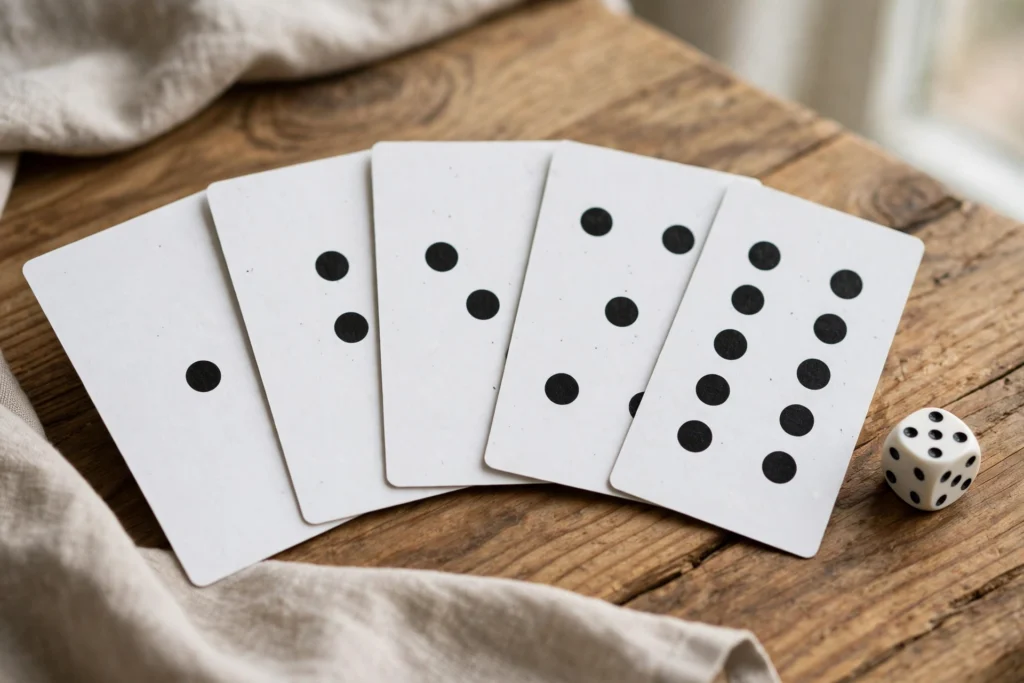
Before numbers can mean anything, a child has to see how many there are without counting one by one. Specialist teacher Ronit Bird starts here, with patterns before symbols, and so does this list.
1. Flash and Say (Dot Patterns)
Ages: 5 to 8, and the first activity for a child who still counts every dot on a die. You need: homemade dot cards, index cards with dots drawn in dice patterns, or a single die.
How to play: this comes from Ronit Bird’s Dyscalculia Toolkit, whose first section is built on dot patterns. Show a dot card for about two seconds, then hide it. Your child says how many dots they saw, without counting.
Start with patterns for 1 to 5, then 6 to 10 built as doubles, so 8 shows as two groups of 4. If your child counts the dots, the pattern is too big for now, so drop back a step. That is the whole game.
Skill it builds: seeing small quantities at a glance instead of counting them. It looks too easy to matter, and it is the foundation everything else stands on. Bird starts here on purpose, patterns before symbols.
Make it easier or harder: easier, stay with patterns 1 to 5 and show each card a little longer. Harder, use the doubles patterns for 6 to 10 and flash the card more briefly.
2. Domino Match and Sort
Ages: 5 to 9, for a child who can count objects but does not yet see that 7 is made of parts. You need: a standard set of dominoes, and a double-six set is enough.
How to play: Bird’s Toolkit uses dominoes throughout the early number work. Play three short rounds. First, sort the dominoes by total spots. Second, find all the dominoes that make one chosen total, for example all the ways to make 7.
Third, match pairs: turn one face up and find another with the same two parts in either order. Name the parts out loud as you go: 5 and 2 make 7.
Skill it builds: dot patterns and splitting numbers into parts. Dominoes show the doubles and near-doubles parts of numbers up to 12, and many other ways of splitting a number in two. Older children who find dot patterns babyish often accept dominoes, so this works for 9 to 11-year-olds too.
Make it easier or harder: easier, work only with dominoes whose totals are 6 or less. Harder, hunt for all the ways to make a bigger total, such as 9 or 10.
3. How Many Are Hidden?
Ages: 5 to 8. It builds the pairs that make 10, the single most useful fact set at this age. You need: exactly 10 counters, beads or buttons, and a cup or cloth to hide some under.
How to play: in Bird’s Toolkit this game is played on a bead string of 10 beads in two colors. This home version swaps the string for loose counters. Your child counts out all 10.
While they look away, hide some under the cup. They count what is visible and work out how many are hidden. Swap roles, so they hide and you work it out.
Skill it builds: parts of a number and complements to 10. The hiding is the teaching. Your child has to hold the whole number in mind and split it, the skill underneath every addition fact.
Make it easier or harder: easier, play the same game with a total of 6. Harder, use totals of 7, 8 and 9, and later 20 counters hidden in two handfuls.
Counting That Sticks
Counting looks simple and is not. These two routines slow counting down until each object, each touch and each number word line up.
4. Counting Collections
Ages: 5 to 8, for a child whose counting skips objects, double-counts, or cannot say how many there were at the end. You need: a collection of real things, such as buttons, beans, coins, pasta shapes or toy cars.
How to play: this is an everyday routine rather than a named program, of the kind the Raising Children Network’s parent guidance recommends. Tip out a small collection, starting under 20.
Your child counts by moving each object into a counted pile as they say its number, so each object is touched once and named once. Then count the same pile a smarter way, grouped into 5s or 10s. Finish by asking, so how many are there altogether?
The last number said is the total.
Skill it builds: counting with one-to-one matching, and knowing the final count word is the total. Recounting the same pile spread out or bunched up, and getting the same total, is a milestone, not a trick.
Make it easier or harder: easier, collections under 10. Harder, bigger collections grouped into 10s, or the Estimation Jar below.
Estimation Jar variant: fill a small jar with beans or coins. Your child guesses how many, writes the guess down, then counts by grouping into 10s. Closer guesses over the weeks are progress you can both see.
5. Count It, Point to It, Say It
Ages: 5 to 9, for a child who can recite the counting words but whose counting does not connect to quantities. You need: one or two dice and a handful of counters.
How to play: this is a UK practitioner’s multisensory routine, presented here as a routine, not a program. Roll a die. Your child touches each dot in turn, counts out loud, then covers the die and builds the same quantity with counters from memory. Sight, touch and sound together link the quantity to its number name.
Skill it builds: linking quantity, touch and number name. The routine’s own suggestion runs up to twenty minutes a day. For younger children five to ten minutes is plenty, and short daily play is the pattern parent guidance agrees on.
Make it easier or harder: easier, one die, left uncovered while your child builds the counters. Harder, two dice for totals to 12, then matching a roll to a written numeral card your child chooses.
Place Value: Tens, Ones and Bigger Numbers

Written place value is shorthand for something physical: ten loose ones bundled into one ten. Both activities here make that bundle by hand.
6. Build the Number
Ages: 6 to 10. You need: drinking straws, sticks or pencils, rubber bands or string, and paper for a mat and for writing the number.
How to play: this is a home adaptation of classroom place value building, and specialist guidance for dyscalculia recommends physical materials for place value for exactly this reason. Draw a paper mat with a tens side and a ones side. Call a two-digit number, for example 43.
Your child bundles straws into groups of ten with bands, 4 bundles, leaves 3 single straws loose, lays them on the mat and writes the number. Then reverse it: you build a number, your child reads and writes it.
Skill it builds: tens and ones, and place value to 100. The bundling is the lesson. A child who physically makes a ten out of ten ones owns the idea in a way a worksheet column cannot give them.
Make it easier or harder: easier, build numbers under 30. Harder, move to hundreds by bundling ten tens into one big bundle.
7. Trading Tens
Ages: 6 to 10. You need: counters or coins, and a paper mat with a tens column and a ones column.
How to play: this home version of the classroom trading game is regrouping done with objects instead of carried digits. Roll two dice and take that many ones counters onto the mat.
Whenever the ones column reaches ten, stop and trade: ten ones come off, and one ten goes on, a different colored counter or a straw bundle from Build the Number. First to build 100 wins, played cooperatively if competition causes tears.
Skill it builds: why ten ones become one ten. Play the trading as a physical swap every single time, even when your child says they know. The swap is what the written method is shorthand for.
Make it easier or harder: easier, race cooperatively to 50 instead of 100. Harder, reverse the game: start at 50 and trade back down to zero, breaking a ten into ten ones whenever a subtraction needs it.
Number Lines and Comparing Numbers
A number is also a position and a size. These two activities build the sense of how far apart numbers sit and which one is bigger, with the reasoning said out loud.
8. Walk the Number Line
Ages: 5 to 10. You need: chalk on a driveway, painter’s tape on a floor, or numbered paper sheets, making a line from 0 to 20.
How to play: parent guidance returns to the number line more than any other home tool, and this floor version is a standard home adaptation of it. Your child stands on a starting number. Call a move: start on 7, take 4 steps forward. Where are you standing?
Backward moves cover subtraction. Later, cover the labels on some squares and ask your child to stand where they think 15 belongs between 0 and 20. A die turns it into a roll-and-move game for two.
Skill it builds: number order and the distance between numbers. Standing on the numbers makes distance physical: a child can feel that 18 is far from 7 and close to 20. That feeling is magnitude sense, not just counting.
Make it easier or harder: easier, use a line from 0 to 10. Harder, build a line to 100 marked in tens, with some labels hidden.
9. Which Number Is Bigger?
Ages: 6 to 11. You need: a deck of cards with the face cards removed and aces counting as 1, or homemade number cards to 100 for older children.
How to play: this is a standard card comparison game, adapted for this audience on purpose. Each player turns over a card at the same time.
The bigger number takes both cards, but only after its owner says why in numbers: mine is bigger because 8 is two more than 6. No timers, no slapping, no speed bonus. On a tie, both players turn one more card and compare again.
Play until the deck runs out, then count the piles.
Skill it builds: comparing numbers and magnitude. The race is removed deliberately, because the classic version rewards the fastest answer and penalizes slow processing. This version asks for the reasoning instead, and the sentence is the activity.
The language of bigger and smaller is the same language as the greater than and less than signs, and saying how you know builds the sense that estimation, rounding and checking answers depend on.
Make it easier or harder: easier, cards to 10 only. Harder, homemade number cards to 100, where the tens digit does most of the deciding.
Math Facts Without the Drill
Facts learned through strategy stick differently from facts learned through chanting. No timers appear anywhere in this section, on purpose.
10. Cover the Numbers (Shut the Box)
Ages: 6 to 11, for addition facts to 12 played as strategy, not recall speed. You need: two dice, paper and a pencil, with a row of boxes numbered 1 to 9 drawn on the paper.
How to play: this is one of Ronit Bird’s Toolkit games. Roll both dice and add them. Cover, by crossing out, any open numbers that add up to the total rolled: the total itself, or a pair that makes it.
Keep rolling and covering until no open numbers can make the rolled total. Your score is the sum of the numbers left uncovered, and the next player tries to beat it. Covering all nine numbers is the win to celebrate.
Skill it builds: addition combinations to 12. Bird’s method teaches the key splitting facts for each number, 5 and 4 for 9, and reaches the rest by reasoning rather than rote memory.
A child choosing whether to cover 9 alone or 5 and 4 is doing exactly that reasoning, so leave the choosing to the child, even when it is slower.
Make it easier or harder: easier, play without scoring, as a puzzle against the dice. Harder, keep score across several rounds and try to beat your own best total.
11. Complements Ping-Pong
Ages: 6 to 10, and the portable one, for families who will not sit down for a math activity. You need: nothing, or a ball or beanbag to roll or toss back and forth for rhythm.
How to play: another of Bird’s Toolkit games, from her complements of 10 work. You say a number from 0 to 10. Your child says the number that completes it to 10, then serves the next number back to you. There is no clock and no score. Play it in the car, in a queue, or while dinner cooks.
Skill it builds: the number pairs that make 10, the pairs every later strategy leans on. This is the one game in the post that looks like a drill, so keep it playful and stop the moment it stops being a game.
Make it easier or harder: easier, keep ten counters on the table to check against while you play. Harder, move to pairs that make 20, then pairs that make 100: you say 40, they say 60.
12. Fact Family Triangles
Ages: 7 to 11. You need: counters, and index cards or paper triangles drawn with a number at each corner.
How to play: Bird’s books include versions of this triangle format in her triad games. Pick three numbers that belong together, for example 3, 5 and 8.
Build them with counters first: a group of 3 and a group of 5 make the group of 8.
Then say and write all four facts the group shows: 3 + 5 = 8, 5 + 3 = 8, 8 – 5 = 3 and 8 – 3 = 5.
Draw the triangle with 8 at the top and 3 and 5 at the base corners, cover one corner, and ask which number is hiding and how they know.
Skill it builds: how addition and subtraction facts connect as fact families. Four facts learned as one connected picture are a lighter memory load than four facts learned as four separate lines, which is the whole reason this format exists for these learners.
Make it easier or harder: easier, stay with totals to 10 and keep the counters out. Harder, use bigger totals and cover a corner, so your child has to explain the missing number, not just read it.
13. Groups You Can Eat
Ages: 7 to 11. You need: raisins, pretzels, grapes or any small snack, and a muffin tin or drawn circles as the grouping frame.
How to play: this comes from Understood.org’s multiplication tips for grade-schoolers with dyscalculia. Ask for groups, not answers: show me 3 groups of 4.
Your child builds the groups, counts the total, and you write the matching number sentence together, 3 × 4 = 12. Then reverse it: write a sentence and let your child build it.
The snack gets eaten at the end, which settles the motivation question.
Skill it builds: multiplication as equal groups. No times-table chanting and no timed testing here: the goal is a child who can picture what 3 × 4 means. Recall speed is a later, separate project.
Once the groups are solid, find the same groups as a pattern on the multiplication chart. Extension: build the groups in neat rows as an array, the first step toward the area model older children meet for bigger multiplications.
Make it easier or harder: easier, 2 groups of a small number, such as 2 groups of 3. Harder, start from the written sentence every time, or double a real recipe together and count the doubled amounts out loud.
Money and Time in Daily Life
The cheapest classroom is the house itself. This activity is three small routines, and you pick one at a time.
14. Play Shop and Set the Table
Ages: 5 to 11. Money work uses US coins by default, and the same routines work with UK coins unchanged, because the values differ but the counting does not. You need: real or play coins, household items as shop stock, paper price labels, a table to set and a simple recipe.
How to play: this is the everyday-life cluster parent guidance agrees on most, including the Raising Children Network’s suggestions. Pick one routine at a time:
- Play Shop: price five items at round amounts, 10c, 25c, 50c and $1. Your child buys one item and pays with real coins, counting out loud. Later, they pay with a bigger coin and you count the change back together.
- Set the Table: your child works out how many plates, cups and forks a stated number of people needs and lays them out one to one. Add a guest halfway and count again.
- Kitchen Counting: your child counts spoonfuls and cup measures into a real recipe, reads the scale or timer numbers out loud, and tells you when two minutes are left. Halving a recipe together is a first, edible encounter with fractions, well before the word appears in a textbook.
Skill it builds: money, counting and measuring in real life. None of this should feel like a lesson. It works because it is real: the shop needs the right change, and dinner needs the right number of forks.
Make it easier or harder: easier, shop prices of one coin each and a table set for the family only. Harder, price two items and add them together, or let your child run the shop and make your change.
Calming Math Anxiety Through Play

15. Family Game Night
Ages: 5 to 11, the whole family, and the one to start with for a child who refuses anything labeled math. You need: one family board game with a die and a track, such as Snakes and Ladders or Ludo, or Uno, or dominoes.
How to play: SkillsYouNeed’s parent guidance on dyscalculia is blunt about this: play games rather than doing worksheets, because a dice and counting game gives practice a child does not even register as learning. So play the real game, unmodified, with the family.
Counting moves along a track, matching numbers, keeping a tally score and handling small wins and losses are the practice. Two parent rules matter: let your child move their own counter and count their own moves rather than counting for them, and keep score together using counters or a tally, not mental arithmetic.
Skill it builds: counting, turn-taking and confidence. Confidence is the curriculum here. A child who happily plays a counting game for twenty minutes is doing more number work than a child crying over a worksheet for five.
Make it easier or harder: easier, play as a team against the game, with everyone helping the youngest player count. Harder, hand your child the score sheet and let them keep a written tally and add the totals at the end.
Three habits make every activity in this post work better. Praise effort and strategies, never speed. Never time your child, on anything, even playfully. And let them use fingers and counters for as long as they need them, because those are tools, not cheating.
If You Want One Bought Resource
Everything above runs on what you already own. Two bought resources in this space are genuinely good. Neither is necessary.
Ronit Bird’s books (SAGE) are the deepest home resource in this area, and several activities above come from them. The Dyscalculia Toolkit is the starting point for a learner who relies on counting, built on dot patterns, dominoes and Cuisenaire rods.
The Dyscalculia Resource Book: Games and Puzzles for Ages 7 to 14 collects 100 photocopiable games needing no equipment beyond what an average home has.
Numicon (Oxford University Press) is a set of colored shapes with holes that show the quantities 1 to 10, widely used in UK and international specialist teaching as the concrete material behind work like the first three activities here. It is a school-grade resource, genuinely useful, and entirely optional: every activity in this post works without it.
When Home Practice Is Not Enough
Home activities have a limit, and reaching it is not a failure.
Ask for more help when months of steady, short practice are not shifting the earliest skills at all, when your child’s distress around numbers is growing rather than shrinking, or when the gap with classmates keeps widening.
For an older child in this age band, worked examples can lower the temperature at homework time while you wait: our long division calculator shows each step rather than just handing over an answer.
The assessment routes are set out in full in the fifth question below: a written request for a school evaluation in the US, and a first conversation with the SENCO in the UK.
Frequently Asked Questions
What are the best dyscalculia activities to start with at home?
Start with dot patterns. Flash and Say (activity 1) takes five minutes, needs only homemade dot cards or a die, and builds the quantity recognition every later skill stands on.
Add Counting Collections for careful counting and Walk the Number Line for number order, and you have covered the three foundations. Specialist teacher Ronit Bird’s method, which several activities here follow, starts with dot patterns and dominoes for the same reason: patterns before symbols.
How often should we do these activities, and for how long?
Little and often. Five to ten minutes most days is the pattern parent guidance agrees on, and the UK Dyscalculia Information Centre builds its parent materials around ten minutes a day.
One activity at a time, two or three favorites in rotation for a few weeks, beats working down the whole list. Stop while it is still fun. A session that ends in tears teaches the wrong lesson no matter what the math was.
Do I need a dyscalculia diagnosis before starting these activities?
No. Every activity in this post is an ordinary number game or routine that is safe and useful for any child who struggles with number sense, diagnosed or not.
What needs a professional is the diagnosis itself: this page cannot tell you whether your child has dyscalculia, and neither can any online checklist.
If you want certainty, the routes are in the next answer but one, and you can keep playing these games while you wait.
My child uses fingers and counters for everything. Should I stop that?
No. Keep the fingers and counters. Parent guidance is consistent on this point: fingers and objects are how a child holds a number steady while their brain works, and taking the tools away adds anxiety without adding understanding.
The activities here are built around counters, dice and dominoes on purpose. Recognition of patterns (activity 1) is what gradually replaces counting in ones, and it comes from practice, not from banning fingers.
When should I get my child assessed for dyscalculia, and how does it work in the US and UK?
Ask for an assessment when steady home and school practice over months is not shifting the earliest skills, or when your child’s distress around numbers keeps growing. In the US, a parent can request an evaluation through the child’s public school in writing.
The school team assesses whether a specific learning disability in math is affecting schoolwork.
In the UK there is no equivalent school-run dyscalculia test: start with the school’s SENCO, and a formal assessment is usually carried out by an educational psychologist, arranged privately or sometimes through the school. Either way, an assessment is information, not a verdict.
It tells you which skills to target and what support school should provide.
Can these activities cure dyscalculia or replace school support?
No, and any page that promises that is selling something. Dyscalculia is a lasting difference in how the brain handles number. These activities build number sense, confidence and everyday fluency around it, the way practice wheels support a rider.
They sit alongside school teaching and any support the school provides, not instead of it. What they genuinely change is the home experience: numbers become familiar and low-stakes, and that makes every other kind of help work better.
Start tonight with one activity, five minutes, dice from the kitchen drawer.
For the paper side of practice, our free math tools page gathers the site’s helpers in one place: check a halved recipe or any worked fraction with the fraction calculator, and print short practice pages with the worksheet generator, untimed, one skill at a time, at the pace you choose.
Every topic clicks faster with practice. Our Resource Library has free lesson packs with slides, printable worksheets and full answer keys, ready to download and teach.
Members unlock every lesson in the library, including the full Fractions, Multiplication, Place Value, Addition & Subtraction, Time & Money and Geometry & Shapes units. See the full library


